
Cloud and DevOps roles continue to dominate tech hiring in 2026. Companies are cloud-native by default, outages are unacceptable, and automation is no longer “nice to have.”
But one question keeps coming up:
Should I become a DevOps Engineer or a Cloud Engineer and which one pays better?
The answer isn’t as simple as “DevOps pays more.” Salary depends on skills, scope, region, and impact, not just job titles.
In this guide, we’ll break it all down:
- Salary comparisons (global + US + India)
- Skills that move the pay needle
- Career growth and ceiling
- Which role is more future-proof in 2026+
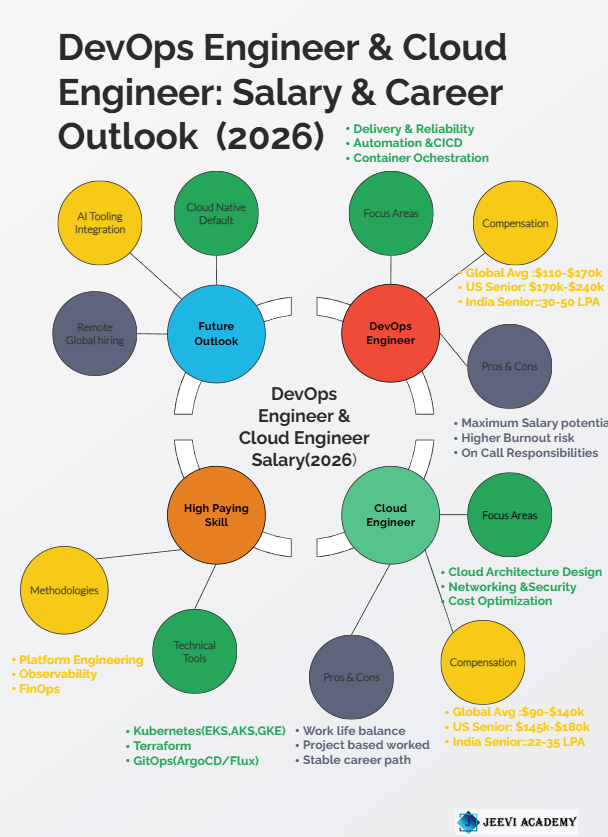
1. DevOps Engineer vs Cloud Engineer: Quick Overview
Before we talk money, let’s align on what these roles actually do because salary differences often come from responsibility, not buzzwords.
DevOps Engineer (What They Do)
DevOps Engineers focus on delivery, reliability, and automation.
Typical responsibilities:
- CI/CD pipelines (GitHub Actions, GitLab, Jenkins)
- Infrastructure as Code (Terraform, CloudFormation)
- Kubernetes & container orchestration
- Monitoring, alerting, incident response
- Improving deployment speed & system reliability
DevOps sits between development and operations, touching production systems daily.
Cloud Engineer (What They Do)
Cloud Engineers focus on designing, building, and maintaining cloud infrastructure.
Typical responsibilities:
- Designing cloud architectures (AWS, Azure, GCP)
- Networking, IAM, security best practices
- Cost optimization and scalability
- Migration from on-prem to cloud
- Managing cloud services (EC2, S3, VPC, Azure VNets, etc.)
Cloud Engineers are more infrastructure and architecture focused.
2. DevOps vs Cloud Engineer Salary: 2026 Snapshot
Global Average Salary Ranges (2026)
| Role | Global Average Salary |
|---|---|
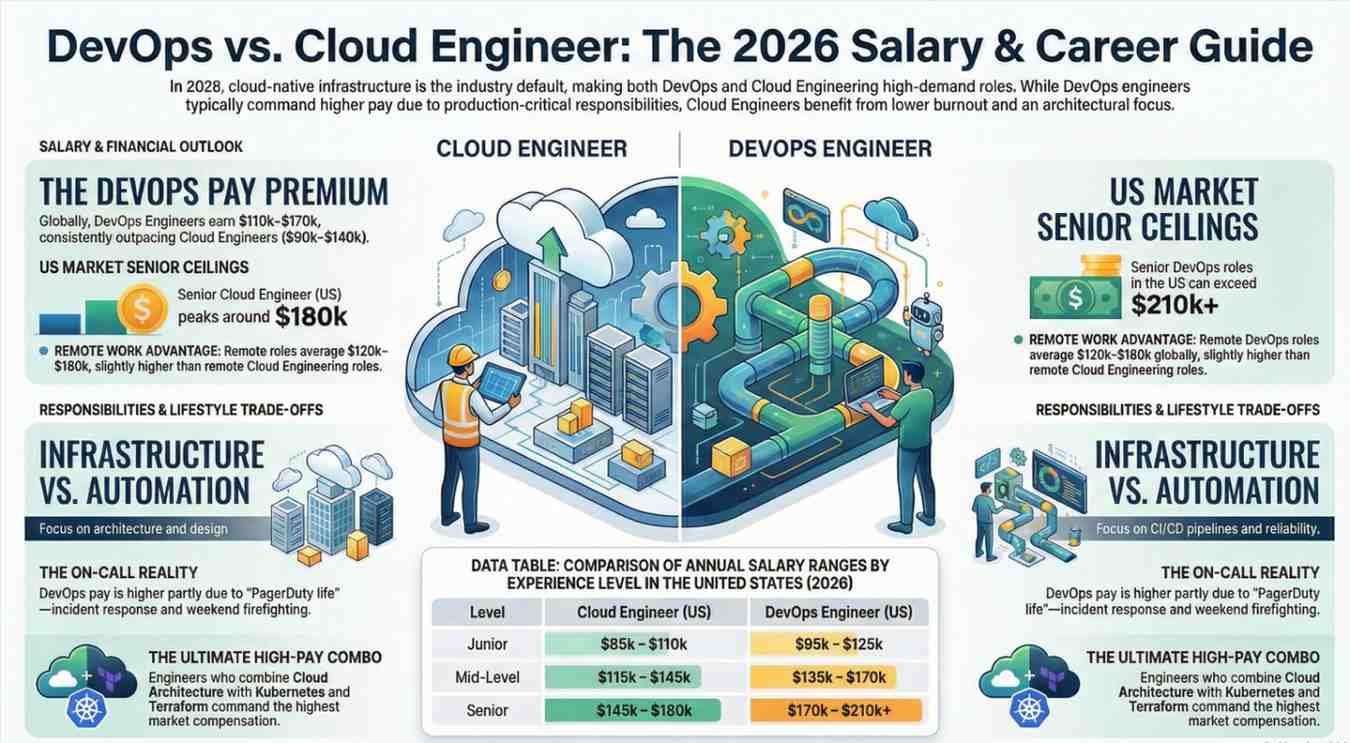
| Cloud Engineer | $90,000 – $140,000 |
| DevOps Engineer | $110,000 – $170,000 |
DevOps Engineers generally earn more, especially at mid-to-senior levels, because:
- They handle production risk
- They are on-call
- They own deployment pipelines and uptime
3. DevOps vs Cloud Engineer Salary in the United States
🇺🇸 US Salary Ranges (2026)
| Level | Cloud Engineer | DevOps Engineer |
|---|---|---|
| Junior | $85k – $110k | $95k – $125k |
| Mid-Level | $115k – $145k | $135k – $170k |
| Senior | $145k – $180k | $170k – $210k+ |
Why DevOps pays more in the US:
- Direct impact on revenue and uptime
- Incident ownership (PagerDuty life)
- Strong overlap with SRE and Platform Engineering
At FAANG-level companies, senior DevOps/SRE roles often cross $220k–$250k total compensation.
4. DevOps vs Cloud Engineer Salary in India
🇮🇳 India Salary Ranges (2026)
| Level | Cloud Engineer | DevOps Engineer |
|---|---|---|
| Fresher | ₹6 – ₹10 LPA | ₹7 – ₹12 LPA |
| 3–5 Years | ₹12 – ₹20 LPA | ₹15 – ₹28 LPA |
| Senior | ₹22 – ₹35 LPA | ₹30 – ₹50+ LPA |
In India, DevOps salaries have pulled ahead sharply since 2023 due to:
- Remote global hiring
- Kubernetes & Terraform demand
- Fewer truly skilled DevOps engineers than cloud generalists
5. Skill-Based Salary Differences (The Real Pay Driver)
Job title matters less than what you can actually do.
High-Paying DevOps Skills (2026)
- Kubernetes (EKS, AKS, GKE)
- Terraform (multi-cloud)
- GitOps (ArgoCD, Flux)
- Observability (Prometheus, Grafana, OpenTelemetry)
- Incident management & reliability engineering
- Platform engineering experience
High-Paying Cloud Engineer Skills
- Cloud architecture design
- Networking & security (VPCs, IAM, Zero Trust)
- Cost optimization (FinOps)
- Large-scale migrations
- Multi-cloud architecture
A Cloud Engineer with Terraform + Kubernetes often earns DevOps-level pay.
6. Remote Jobs: DevOps vs Cloud Engineer
Remote work continues to favor DevOps roles.
Why?
- DevOps roles are output-driven
- On-call coverage works well across time zones
- Companies hire DevOps remotely to save costs
Remote salary reality (2026):
- Remote DevOps: $120k–$160k (global)
- Remote Cloud Engineer: $100k–$135k
DevOps still wins but only if you’re hands-on, not just theoretical.
7. Career Growth & Salary Ceiling
Cloud Engineer Career Path
Cloud Engineer → Senior Cloud Engineer → Cloud Architect → Principal Architect
- Strong long-term stability
- Less burnout
- Slightly lower salary ceiling unless you move into architecture or leadership
DevOps Engineer Career Path
DevOps Engineer → Senior DevOps → SRE / Platform Engineer → Staff / Principal
- Higher stress
- Faster salary growth
- Higher ceiling (especially in big tech & SaaS)
Top-end DevOps/SRE roles pay more than Cloud Architect roles in most markets.
8. Burnout vs Salary: The Hidden Cost
This matters more in 2026 than ever.
DevOps Reality
- On-call rotations
- Incident pressure
- Weekend firefighting
Cloud Engineer Reality
- More project-based work
- Fewer emergencies
- Better work-life balance on average
Honest take:
DevOps pays more because it’s harder emotionally and operationally.
9. Which Role Is More Future-Proof?
Cloud Engineering Outlook (2026+)
✅ Stable
✅ Always needed
❌ Some tasks being abstracted by managed services
DevOps / Platform Engineering Outlook
✅ Growing demand
✅ Tighter integration with AI tooling
✅ Platform engineering replacing traditional DevOps
DevOps isn’t dying it’s evolving.
Platform Engineers with DevOps foundations are among the highest-paid engineers in 2026.
10. So… DevOps or Cloud Engineer? Final Verdict
Choose DevOps Engineer if:
- You enjoy automation & troubleshooting
- You’re okay with on-call stress
- You want maximum salary potential
- You like owning production systems
Choose Cloud Engineer if:
- You enjoy architecture & design
- You prefer stability over firefighting
- You want long-term growth without burnout
- You may move into cloud architecture or leadership
Best strategy in 2026:
Start as a Cloud Engineer, then add DevOps skills.
That combo unlocks the highest-paying roles.
TL;DR
- DevOps Engineers earn more on average in 2026
- Salary difference grows with experience
- Skills > job titles
- Platform Engineering is the next big leap
- Balance money with lifestyle
Conclusion: DevOps Engineer vs Cloud Engineer Salary (2026)
In 2026, both DevOps Engineers and Cloud Engineers are among the highest-paid and most in-demand roles in tech, but they reward different strengths.
DevOps Engineers generally earn higher salaries, especially at mid-to-senior levels, because they own production systems, handle on-call responsibilities, and directly impact uptime and revenue. The role offers faster salary growth and a higher ceiling but often comes with increased pressure and burnout risk.
Cloud Engineers, on the other hand, offer more stability. While average salaries are slightly lower, the work is more architecture-focused, less reactive, and better suited for engineers who prefer long-term system design over incident response. With the right skills, Cloud Engineers can transition into high-paying Cloud Architect or Principal roles.
The real differentiator in 2026 isn’t the job title it’s the skill set. Engineers who combine cloud architecture with DevOps practices like Terraform, Kubernetes, CI/CD, and observability consistently command the highest compensation.
Final takeaway:
- Choose DevOps for maximum earning potential and faster growth
- Choose Cloud Engineering for balance, stability, and architectural depth
- Master both, and you future-proof your career and your salary
In today’s market, the most valuable engineers aren’t choosing sides they’re bridging the gap.
For more information about Cloud Computing and DevOps, you can refer to Jeevi’s page.
This tutorial is just the beginning learn Cloud Computing and DevOps hands-on in our complete course. Upgrade your skills.