Introduction.
In 2026, the demand for cloud computing professionals continues to rise as businesses migrate to scalable, secure, and cost-effective platforms, making AWS certification and Azure certification crucial for career growth. Both Amazon Web Services (AWS) and Microsoft Azure dominate the cloud services market, offering robust cloud solutions, including infrastructure as a service (IaaS), platform as a service (PaaS), software as a service (SaaS), serverless computing, and cloud security.
Choosing between AWS vs Azure certification requires understanding industry trends, job market demand, skills validation, technical expertise, and salary potential. AWS certification paths, such as AWS Solutions Architect, AWS Developer, and AWS DevOps Engineer, emphasize cloud architecture, deployment automation, and scalable solutions, making them ideal for enterprise-level cloud professionals.
On the other hand, Azure certification paths, including Azure Administrator, Azure Solutions Architect, and Azure DevOps Engineer, focus on integration with Microsoft products, hybrid cloud environments, and cloud governance, catering to organizations leveraging Microsoft ecosystems. For career advancement in 2026, evaluating job roles, market share, learning resources, hands-on experience, and certification credibility is critical.
While AWS dominates global cloud adoption, Azure is growing rapidly, especially in enterprise IT environments, government sectors, and hybrid cloud deployments. Both certifications enhance cloud skills, professional credibility, project opportunities, and earning potential, making them highly valuable for IT professionals, developers, architects, and DevOps engineers.
Furthermore, understanding cloud computing trends, such as AI integration, data analytics, IoT solutions, and cybersecurity in cloud, can influence the choice between AWS certification benefits and Azure certification advantages. In addition, organizations often prioritize vendor-specific expertise, making certification alignment with industry demand a key consideration for career progression. Whether aiming for high-paying cloud roles, leadership positions, or specialized cloud projects, obtaining AWS or Azure certification equips professionals with hands-on experience, best practices, and industry-recognized credentials.
Moreover, the certification roadmap, exam difficulty, continuous learning, and upskilling opportunities can shape long-term career growth in cloud architecture, cloud administration, DevOps, and enterprise solutions. By 2026, having a cloud certification is not just an advantage but a requirement for IT professionals aspiring to thrive in digital transformation initiatives, hybrid IT infrastructures, and innovative cloud strategies.
Therefore, understanding the differences, benefits, and market relevance of AWS vs Azure certification is essential for anyone seeking to enhance their technical expertise, career trajectory, and global job opportunities in the ever-expanding cloud computing industry.
Why Cloud Certifications Matter in 2026
Cloud adoption continues to grow at unprecedented rates. According to industry reports:
- 90% of enterprises use multiple cloud platforms.
- Certified cloud professionals earn significantly more than their non-certified peers.
A strong cloud certification not only boosts your salary but also validates your expertise to employers. That’s why choosing the right cloud certification is crucial.
AWS vs Azure Certification Overview
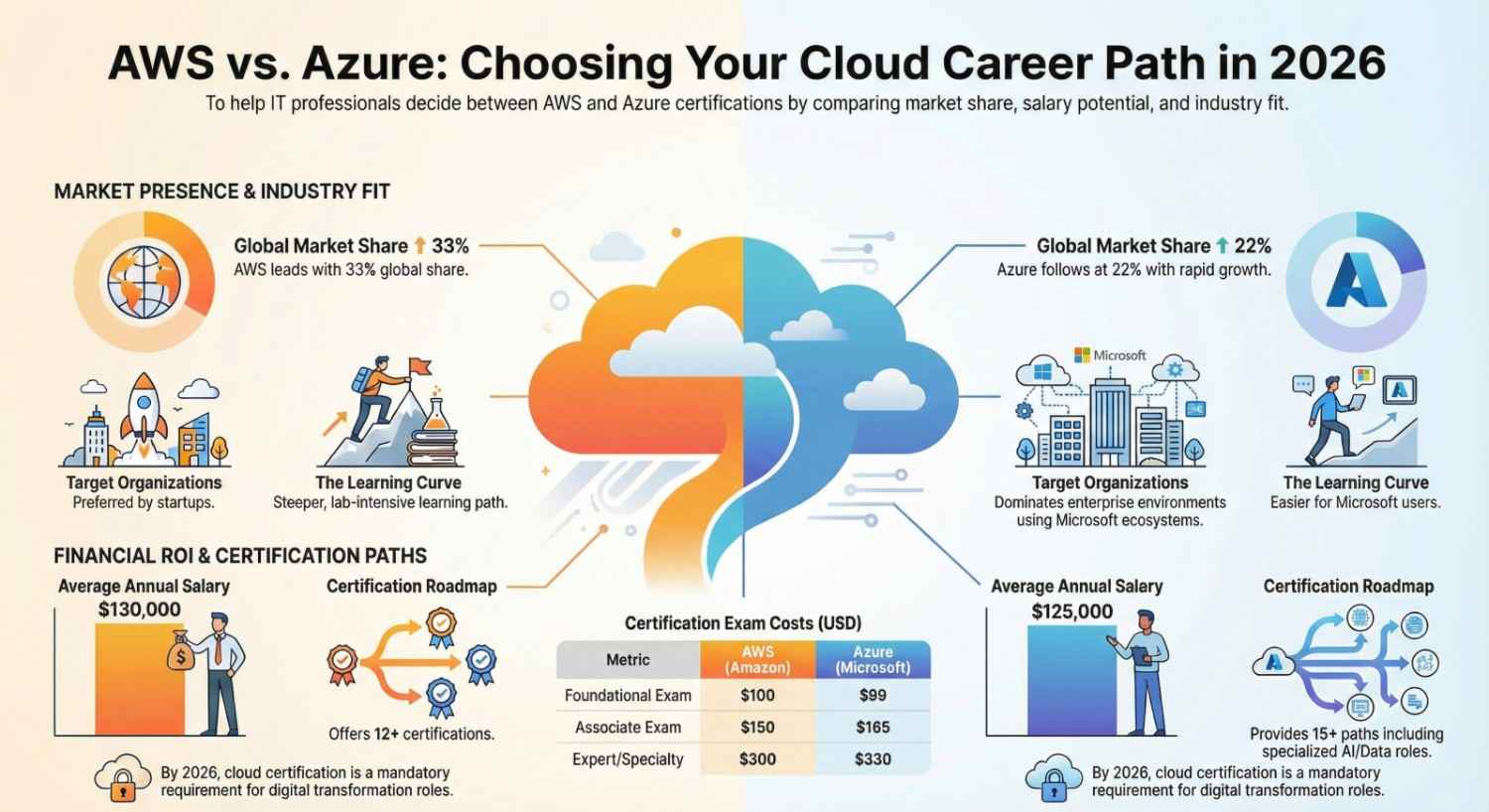
| Feature | AWS Certification | Azure Certification |
|---|---|---|
| Provider | Amazon Web Services | Microsoft Azure |
| Popularity | #1 in cloud market share | Growing fast, especially in enterprise |
| Number of Certifications | 12+ (Foundational, Associate, Professional, Specialty) | 15+ (Fundamental, Associate, Expert, Specialty) |
| Exam Format | Multiple-choice & scenario-based | Multiple-choice & scenario-based |
| Hands-on Labs | Extensive AWS console labs | Extensive Azure portal labs |
Both certifications are recognized globally, but your choice depends on career goals, industry preference, and cloud adoption trends.
AWS vs Azure Certification Cost
When planning your certification path, cost is an important factor. Here’s a breakdown:
- AWS Certification Cost
- Foundational (Cloud Practitioner): $100
- Associate (Solutions Architect, Developer, SysOps): $150
- Professional/Specialty: $300
- Azure Certification Cost
- Fundamentals (AZ-900): $99
- Associate (AZ-104, AZ-204): $165
- Expert/Specialty: $330
Tip: Both platforms offer free study resources, practice exams, and discounts for retakes. AWS has a slight advantage if you’re starting with multiple certifications, thanks to its lower foundational exam fee.
AWS vs Azure Certification Salary
Salary is often the key deciding factor for cloud professionals. Here’s a comparison based on 2026 data:
| Certification | Average Salary (USD/year) |
|---|---|
| AWS Certified Solutions Architect – Associate | $130,000 |
| AWS Certified Developer – Associate | $120,000 |
| Azure Solutions Architect Expert | $125,000 |
| Azure Developer Associate | $115,000 |
Key takeaway: AWS certifications slightly edge out Azure in average salary, especially for solutions architect roles. However, Azure is closing the gap, particularly in enterprise-heavy industries.
AWS vs Azure Certification Path
Understanding the certification path helps you plan your learning journey:
AWS Certification Path
- Foundational: AWS Certified Cloud Practitioner
- Associate: Solutions Architect, Developer, SysOps Administrator
- Professional: Solutions Architect Professional, DevOps Engineer Professional
- Specialty: Security, Machine Learning, Advanced Networking, Data Analytics
Azure Certification Path
- Fundamental: AZ-900 (Azure Fundamentals)
- Associate: Azure Administrator, Developer, Security Engineer
- Expert: Azure Solutions Architect, DevOps Engineer
- Specialty: AI Engineer, Data Engineer, Security Engineer
Tip: If you’re new to cloud, start with the foundational exam. If you already have IT experience, the associate level might be a better starting point.
Key Differences Between AWS and Azure Certifications
| Aspect | AWS | Azure |
|---|---|---|
| Market Share | 33%+ globally | ~22% globally |
| Learning Curve | Slightly steeper for beginners | Easier for Microsoft users |
| Hands-On Practice | AWS Console | Azure Portal & Labs |
| Enterprise Adoption | Startups & large companies | Large enterprises, especially Microsoft shops |
Insight: If your career goal is flexibility across startups and cloud-native companies, AWS may give more options. If you’re targeting enterprise environments with heavy Microsoft ecosystems, Azure might be better.
Which Should You Choose in 2026?
- Choose AWS if:
- You want higher salary potential for cloud roles
- You aim to work in startups or cloud-first companies
- You want extensive hands-on labs and global recognition
- Choose Azure if:
- You plan to work in enterprise environments
- You are already familiar with Microsoft products
- You want a slightly easier learning curve
Pro Tip: Many professionals pursue both certifications to maximize job opportunities and salary potential.
Conclusion
The choice between AWS and Azure certification depends on your career goals, budget, and industry focus. Both platforms are growing rapidly in 2026, and either certification can boost your salary and career opportunities.
By considering AWS vs Azure certification cost, AWS vs Azure certification salary, and the AWS vs Azure certification path, you can make a strategic choice and position yourself as a highly sought-after cloud professional.
- For more information about Cloud Computing you can refer to Jeevi’s page.
- This tutorial is just the beginning learn Cloud Computing hands-on in our complete course. Upgrade your skills.