Module 1: Introduction to Software Testing
This module introduces the core concepts of software testing and explains why testing is essential in the software development process. It helps learners understand how testing improves quality, reliability, and user satisfaction.
Importance of Software Testing – Software testing helps identify defects early, reduce development costs, and ensure the application works as expected in real-world scenarios.
Objectives of Testing – The main goals of testing are to detect defects, verify requirements, reduce risks, and ensure a high-quality product is delivered.
Errors, Defects, Failures – An error is a human mistake, a defect is an issue in the code, and a failure occurs when the system does not behave as expected.
Verification vs Validation – Verification checks whether the product is built correctly, while validation ensures the right product is built based on user needs.
Manual vs Automation Testing – Manual testing is performed by testers without tools, while automation testing uses scripts and tools to execute test cases efficiently.
Module 2: Software Development Life Cycle (SDLC)
This module explains the structured phases involved in software development from planning to maintenance. It also highlights the importance of testing at every stage of the SDLC.
Planning Phase – In this phase, project goals, scope, budget, timeline, and resources are defined to ensure smooth project execution.
Requirements Gathering Phase – Business and user requirements are collected, analyzed, and documented to serve as the foundation for development and testing.
Design Phase – System architecture, workflows, and technical designs are created to define how the application will be built.
Development Phase – Developers write code based on design documents and requirements, transforming ideas into a working application.
Maintenance Phase – Ongoing support is provided to fix bugs, improve performance, and add enhancements after release.
Role of Testing in SDLC – Testing ensures defects are identified early and quality is maintained throughout all development stages.
Module 3: Software Testing Life Cycle (STLC)
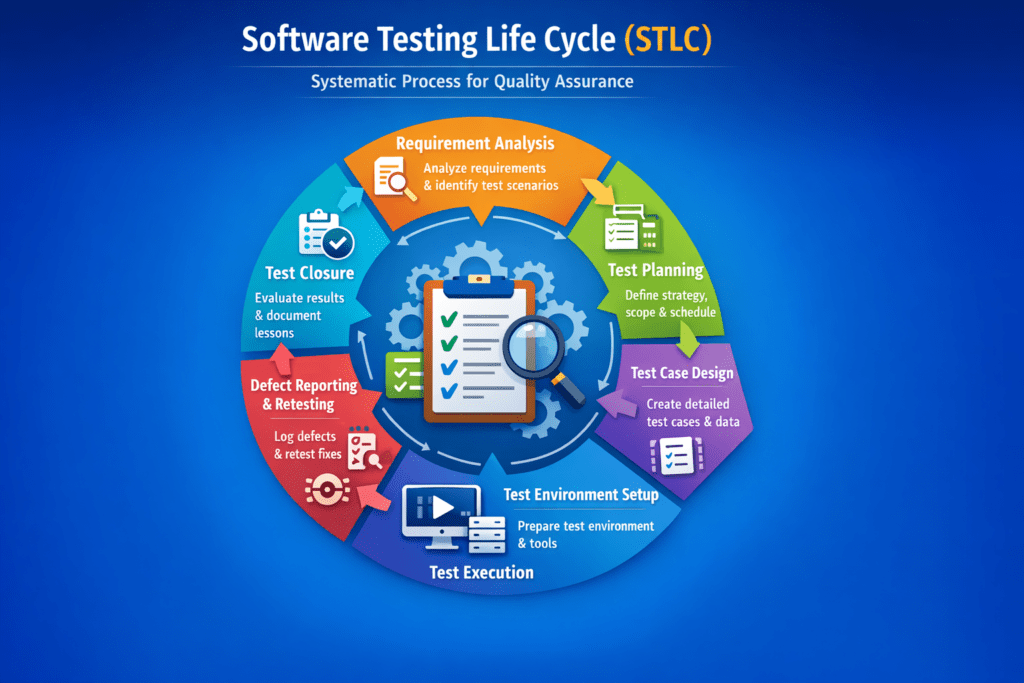
This module focuses on the systematic testing process followed by QA teams to ensure quality delivery. Each phase of STLC defines clear testing activities and outcomes.
Requirement Analysis – Testers analyze requirements to understand functionality, identify test scenarios, and detect ambiguities early.
Test Planning – A detailed test plan is created outlining testing scope, approach, tools, resources, timelines, and risk management.
Test Case Design – Test cases and test data are designed to validate functional and non-functional requirements effectively.
Test Environment Setup – Required hardware, software, network, and test data are prepared to execute test cases smoothly.
Test Execution – Test cases are executed, results are recorded, and any deviations from expected behavior are identified.
Defect Reporting & Retesting – Defects are logged, tracked, fixed by developers, and retested to ensure proper resolution.
Test Closure – Testing activities are evaluated, reports are prepared, and lessons learned are documented.
Module 4: Types of Software Testing
This module explains different testing types used to verify application functionality and performance. It helps testers select the appropriate testing method based on project needs.
Functional Testing – Ensures that the application features work according to specified requirements.
- Unit Testing – Individual components or functions are tested to ensure correct behavior.
- Integration Testing – Verifies interaction and data flow between integrated modules.
- System Testing – Validates the complete system against functional and business requirements.
- End-to-End (E2E) Testing – Tests complete user workflows from start to finish.
- User Acceptance Testing (UAT) – Confirms the system is ready for production use from a business perspective.
Non-Functional Testing – Evaluates how well the system performs under various conditions.
- Performance Testing – Measures speed, responsiveness, scalability, and stability.
- Security Testing – Identifies vulnerabilities and ensures data protection.
- Usability Testing – Evaluates ease of use and user experience.
- Compatibility Testing – Ensures the application works across devices, browsers, and operating systems.
Module 5: Static Testing Techniques
This module focuses on detecting defects without executing the code. It emphasizes early defect prevention through reviews and inspections.
Requirement Reviews – Requirements are reviewed to ensure clarity, completeness, and consistency before development starts.
Design Reviews – Design documents are evaluated to verify technical feasibility and adherence to requirements.
Code Reviews – Developers and testers review code to identify logical errors and coding standard violations.
Walkthroughs – An informal review where the author explains the document or code to the team.
Inspections – A formal review process with defined roles and checklists to detect defects systematically.
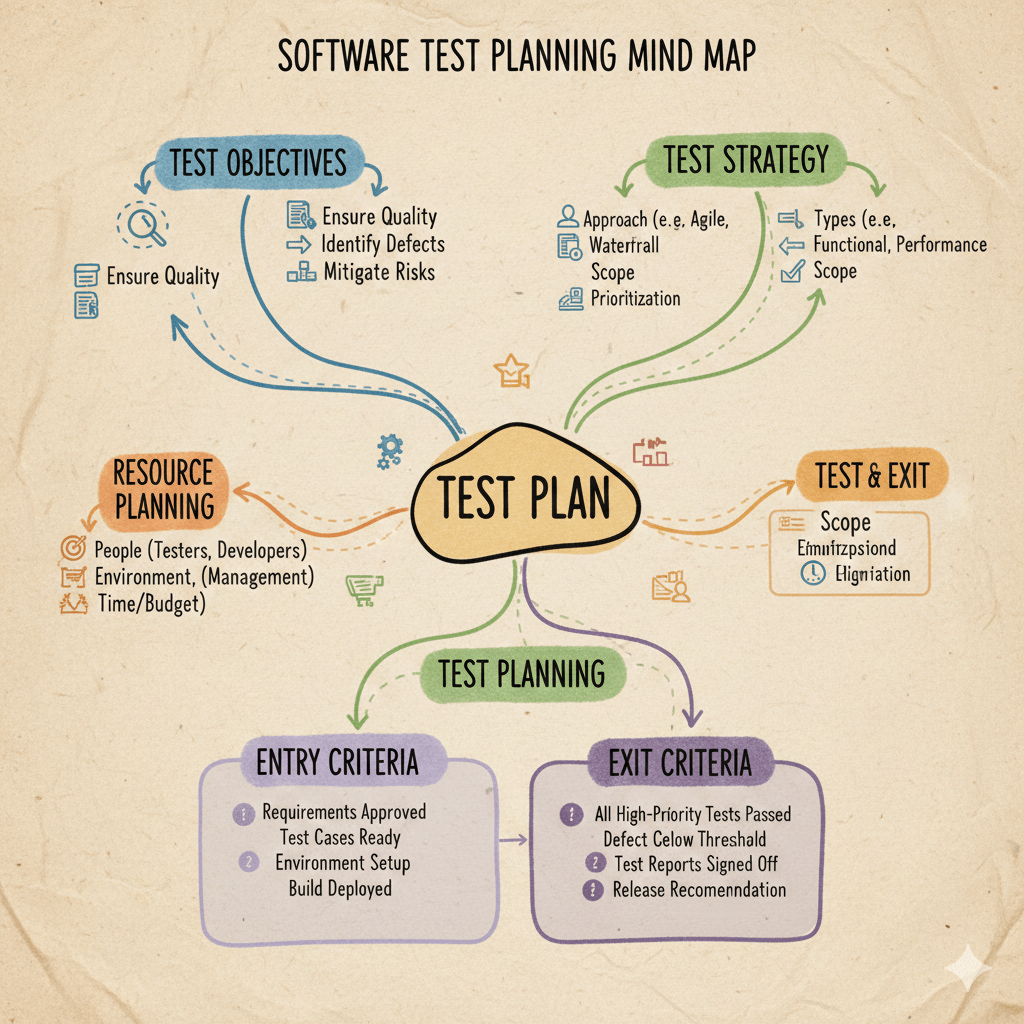
Module 6: Test Planning
This module teaches how to plan and organize testing activities efficiently. A well-defined test plan ensures controlled and effective testing.
Test Objectives & Scope – Clearly defines testing goals and the boundaries of testing activities.
Test Approach – Describes the testing techniques, levels, and types to be used.
Resource & Schedule Planning – Identifies required resources and creates a realistic testing timeline.
Test Plan Document – Serves as a reference document for the entire testing process.
Entry & Exit Criteria – Specifies conditions to start and stop testing activities.
Stop Testing Criteria – Determines when testing can be stopped due to time, cost, or risk factors.