Software development is quietly undergoing a shift. Not a loud “framework of the week” shift but a deeper one. The center of gravity is moving away from syntax mastery and toward intent, taste, and direction. This is where AI vibe coding enters the picture.
Vibe coding isn’t about being lazy. It’s about recognizing that when AI can translate intent into implementation, the developer’s role evolves. You stop typing every detail and start directing outcomes. You move from “how do I write this?” to “what do I want this to feel like when it works?”
This post is structured like a syllabus not because learning should feel academic, but because intent-driven development benefits from progression. Each section builds toward a future where we build with AI (vibe coding edition) as a first-class skill.
Course Overview: What Is Intent-Driven Development?
Intent-driven development is the practice of expressing what you want clearly, contextually, and with taste and letting AI handle much of the mechanical translation.
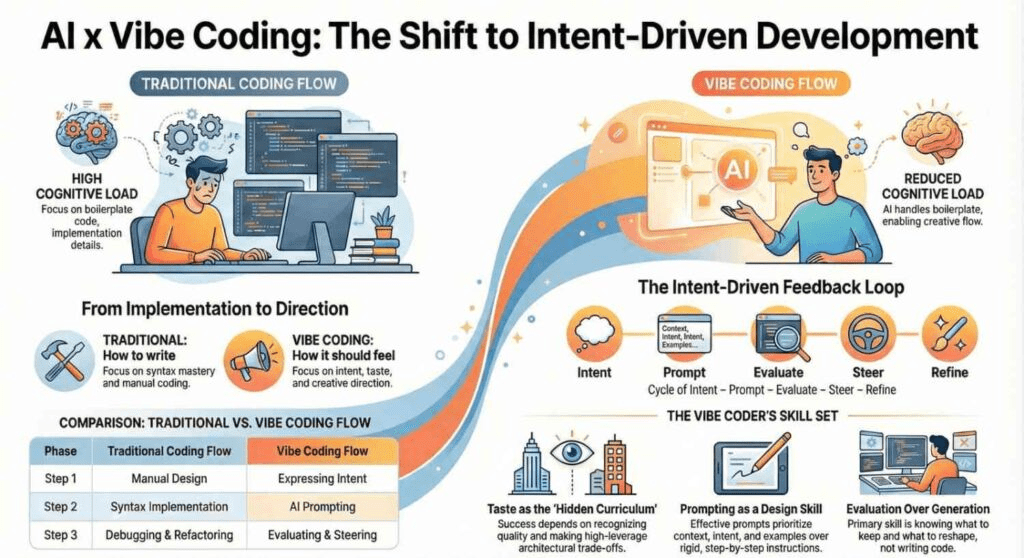
Traditional coding flow:
- Design → Implement → Debug → Refactor
Vibe coding flow:
- Intent → Prompt → Evaluate → Steer → Refine
The difference isn’t speed alone. It’s cognitive load. When AI handles the boilerplate, developers can stay in flow longer, experiment more freely, and focus on product thinking.
This is not hypothetical. Teams are already shipping faster by leaning into AI vibe coding especially when paired with strong feedback loops and good judgment.
Module 1: Foundations of AI Vibe Coding
Before tools and prompts, there’s mindset.
AI vibe coding starts with the assumption that:
- You don’t need to specify everything up front
- Iteration beats precision on the first pass
- “Close enough” is a feature, not a bug
Instead of writing rigid instructions, vibe coding emphasizes:
- Examples over explanations
- Preferences over rules
- Direction over control
Think of AI less as a code generator and more as a junior collaborator with infinite patience. Your job isn’t to micromanage it’s to teach.
Module 2: From Syntax to Intent
For decades, coding education trained us to think in syntax:
- Exact function signatures
- Perfect loops
- Precise conditionals
Intent-driven development flips that.
Now, high-leverage questions look like:
- What should this component feel like to use?
- What edge cases actually matter?
- What trade-offs am I willing to accept?
When you express these clearly, AI fills in the gaps surprisingly well. This is why experienced developers often get better results from AI than beginners not because they type better prompts, but because they have better taste.
Taste is the hidden curriculum of vibe coding.
Module 3: Prompting as a Design Skill
Prompting isn’t magic. It’s communication.
Effective AI vibe coding prompts tend to include:
- Context (what this is and where it lives)
- Intent (what problem it solves)
- Constraints (what to avoid or prioritize)
- Examples (what “good” looks like)
Bad prompts try to control every step.
Good prompts set direction and invite collaboration.
Over time, prompting becomes less about words and more about pattern recognition: you learn how the model responds, where it struggles, and how to steer without friction.
This is where intent-driven development starts to feel natural almost conversational.
Module 4: Build with AI (Vibe Coding Edition)
When you build with AI (vibe coding edition), the workflow changes:
- You prototype faster than you commit
- You explore multiple approaches before choosing one
- You let AI surprise you then you curate the result
Instead of:
“I’ll write this function and see if it works”
You think:
“Let’s explore three ways this could work and refine the best one”
This unlocks:
- Rapid experimentation
- Lower emotional attachment to first drafts
- Better architectural decisions early on
The key skill here isn’t generation it’s evaluation. Knowing what to keep, what to throw away, and what to reshape.
Module 5: Best AI Vibe Coding Tools (and How to Use Them Well)
The best AI vibe coding tools aren’t just the ones that write code they’re the ones that support iteration and context.
Common traits of strong vibe coding tools:
- Persistent context across conversations
- Ability to reason about existing code
- Support for explanation and refactoring
- Low friction between idea and output
But tools alone don’t create good results. Two developers using the same AI can get wildly different outcomes. The difference is how they:
- Frame problems
- Provide feedback
- Reinforce preferences
Think of tools as instruments. Vibe coding is the musician.
Module 6: DeepLearning.ai Vibe Coding and Structured Learning
Platforms like DeepLearning AI have started influencing how developers think about AI not just as users, but as collaborators.
What deeplearning ai vibe coding style learning gets right:
- Emphasis on mental models over memorization
- Focus on how systems learn, not just what they do
- Encouragement to experiment and reflect
This pairs naturally with intent-driven development. When you understand how AI responds to feedback, you stop treating it like a black box and start shaping it intentionally.
The future developer isn’t just someone who writes code they’re someone who understands learning systems.
Module 7: Teaching AI Your Preferences
One of the most underrated aspects of AI vibe coding is training through feedback.
Every time you say:
- “I like this approach, but simplify it”
- “This is correct, but too verbose”
- “Match the style of this existing file”
You’re reinforcing your taste.
Over time, AI outputs start to align more closely with:
- Your coding style
- Your architectural preferences
- Your tolerance for complexity
This is informal training—not fine-tuning in the academic sense, but practical alignment. Intent-driven development thrives on this loop.
Module 8: Guardrails Without Killing the Vibe
A common fear:
“If I rely on vibe coding, won’t my code quality suffer?”
Only if you skip guardrails.
Healthy vibe coding includes:
- Clear constraints
- Occasional manual review
- Strategic refactoring
- Explicit non-goals
The trick is to add structure after exploration, not before. Let AI help you explore the space, then apply discipline where it matters.
Vibe first. Structure second.
Module 9: Ethics, Ownership, and Responsibility
Intent-driven development doesn’t remove responsibility it increases it.
If AI writes code based on your intent:
- You still own the decisions
- You still validate correctness
- You still ship the result
Vibe coding is not abdication. It’s direction with accountability.
This matters especially in:
- Security-sensitive systems
- Data-heavy applications
- User-facing logic
Taste without ethics is just recklessness. A good syllabus includes both.
Final Module: The Future of Coding Is Direction, Not Typing
We’re moving toward a world where:
- Coding looks more like design
- Prompts look more like specs
- Developers act more like directors
AI vibe coding isn’t replacing skill it’s reshaping where skill lives.
The most valuable developers will be the ones who can:
- Express intent clearly
- Evaluate outputs critically
- Guide systems patiently
- Build with AI without losing judgment
This syllabus isn’t about abandoning fundamentals. It’s about layering intent on top of them.
And once you experience intent-driven development, it’s hard to go back.
- Explore Jeevi’s Page for detailed resources.
- This tutorial is only the first step learn GenAI hands-on with our complete course and take your skills to the next level.