Introduction:
Prompt Engineering is the process of designing clear and effective instructions (called prompts) to guide artificial intelligence (AI) models like ChatGPT to produce accurate, useful, and relevant responses. It plays a crucial role in improving how humans interact with AI systems.
In simple terms, prompt engineering means asking AI the right way to get the best answer.
What is a Prompt?
A prompt is the input or instruction given to an AI model. It can be a question, command, statement, or example that guides the AI to generate a response.
Example:
● Basic Prompt: “Explain machine learning.”
● Better Prompt: “Explain machine learning in simple words with examples for beginners.” The second prompt gives clearer guidance, so the response will usually be better.
What is Prompt Engineering?
Prompt Engineering is the process of:
● Designing clear instructions for AI
● Structuring prompts effectively
● Providing context and examples
● Refining prompts for better output
It combines creativity, communication skills, and technical understanding of AI behavior.
Why Prompt Engineering is Important:
- Improves Accuracy:
Clear prompts help AI understand exactly what you want, reducing errors. - Saves Time:
Well-designed prompts avoid repeated corrections or follow-up questions. - Enhances Creativity:
Detailed prompts can produce creative outputs like stories, designs, or ideas. - Better Productivity:
Professionals use prompt engineering for coding, research, writing, marketing, and more.
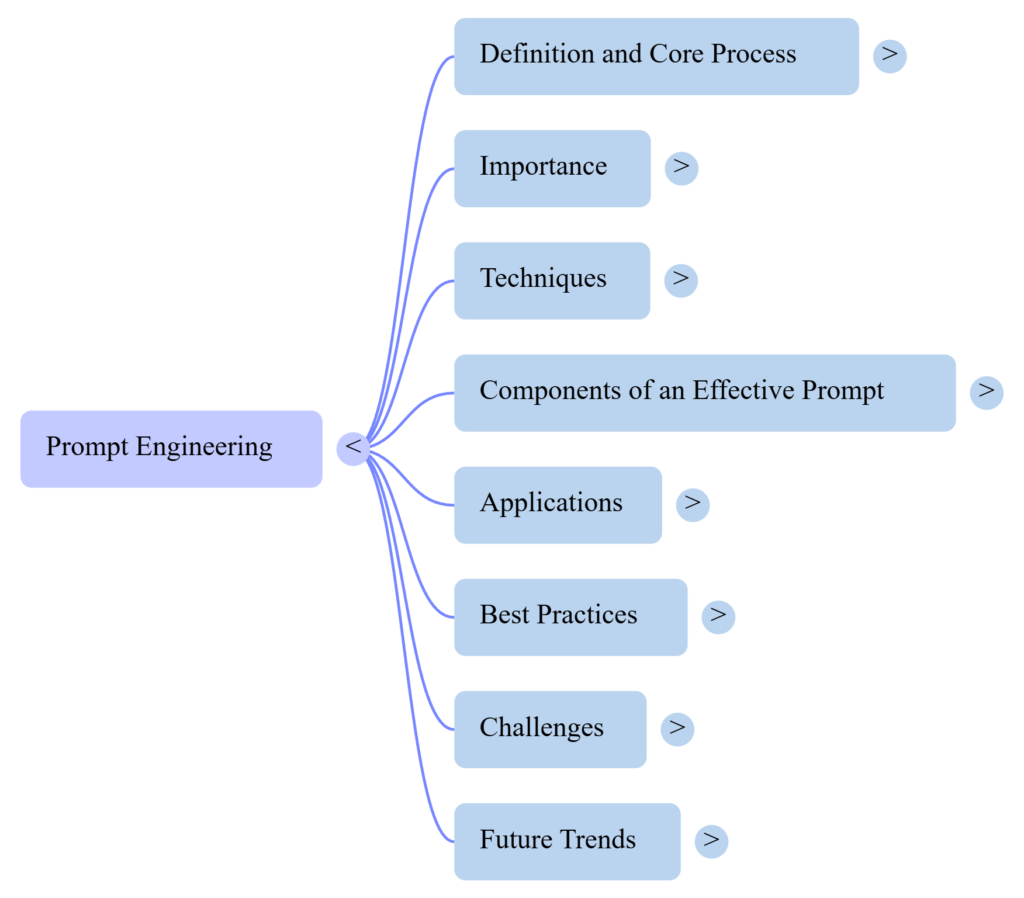
Types of Prompt Engineering Techniques:
Zero-Shot Prompting:
Giving a prompt without examples.
Example: “Translate this sentence into French.”
Few-Shot Prompting:
Providing a few examples before asking the AI.
Example: Showing two translated sentences before asking for another translation.
Chain-of-Thought Prompting:
Encouraging step-by-step reasoning.
Example: “Explain step by step how to solve this math problem.”
Role-Based Prompting:
Assigning a role to AI.
Example: “Act as a data scientist and explain data analysis.”
Applications of Prompt Engineering:
Content Creation:
Blogs, articles, social media posts, scripts, marketing content.
Education:
Tutoring, explanations, quiz generation, research assistance.
Programming:
Code generation, debugging, documentation.
Business Automation:
Customer support chatbots, report generation, email drafting.
Creative Fields:
Story writing, design ideas, music, and visual content generation.
Best Practices for Writing Good Prompts:
● Be clear and specific
● Provide context when needed
● Use examples if possible
● Specify format or tone
● Ask step-by-step explanations when necessary
Understanding Prompts:
A prompt is the input you provide to an AI model. It can be:
● A question
● A command
● A piece of text
● A scenario or instruction
● Examples followed by a request
Example Comparison:
Basic Prompt:
Explain artificial intelligence.
Improved Prompt:
Explain artificial intelligence in simple English for beginners with real-life examples.
The improved prompt provides context, audience level, and expected format — resulting in a more useful response.
Why Prompt Engineering Matters:
- Improves Response Accuracy:
Clear prompts help AI understand user intent, reducing vague or incorrect answers. - Saves Time and Effort:
Instead of multiple corrections, a well-written prompt gives good results immediately. - Enhances Creativity:
Creative prompts can generate stories, marketing ideas, designs, code, or research insights. - Supports Professional Productivity:
Industries like marketing, education, software development, research, and design increasingly rely on AI tools powered by prompt engineering.
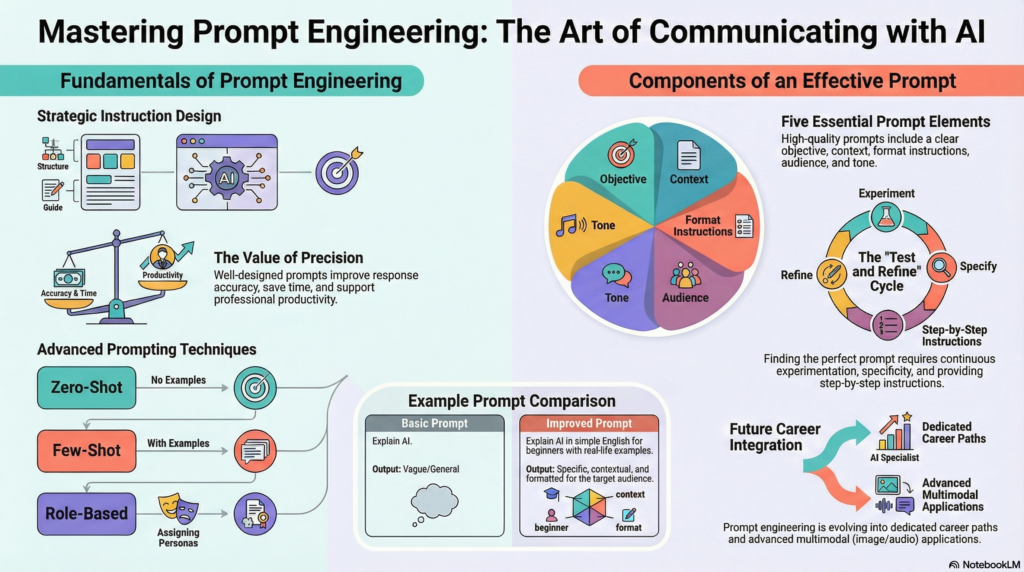
Components of an Effective Prompt:
A good prompt usually includes:
Clear Objective
What exactly you want.
Context
Background information or purpose.
Format Instructions
Examples: bullet points, essay, table, summary.
Audience Specification
Beginner, expert, student, professional, etc.
Tone or Style
Formal, casual, academic, conversational.
Challenges in Prompt Engineering:
Ambiguity in Prompts:
Unclear prompts can produce irrelevant responses.
Bias and Limitations:
AI models may reflect biases from training data.
Context Length Limits:
Long conversations sometimes reduce clarity.
Continuous Experimentation:
Finding the perfect prompt often requires testing.
Best Practices for Effective Prompt Engineering:
● Be specific and detailed
● Provide examples when possible
● Specify output format clearly
● Avoid vague language
● Test and refine prompts
● Include step-by-step instructions when needed
Consistency improves results.
Future of Prompt Engineering:
Prompt engineering is becoming a valuable skill in the AI era. Some future developments include:
● Dedicated prompt engineering careers
● AI-assisted prompt optimization tools
● Integration into education and workplaces
● Advanced multimodal prompting (text, images, audio)
As AI adoption increases, the ability to communicate effectively with AI will be essential.
Conclusion:
Prompt Engineering is a crucial skill for interacting effectively with AI systems. By designing clear, structured, and thoughtful prompts, users can unlock AI’s full potential for productivity, creativity, learning, and innovation. As artificial intelligence continues to evolve, mastering prompt engineering will become increasingly important for individuals and organizations a like.