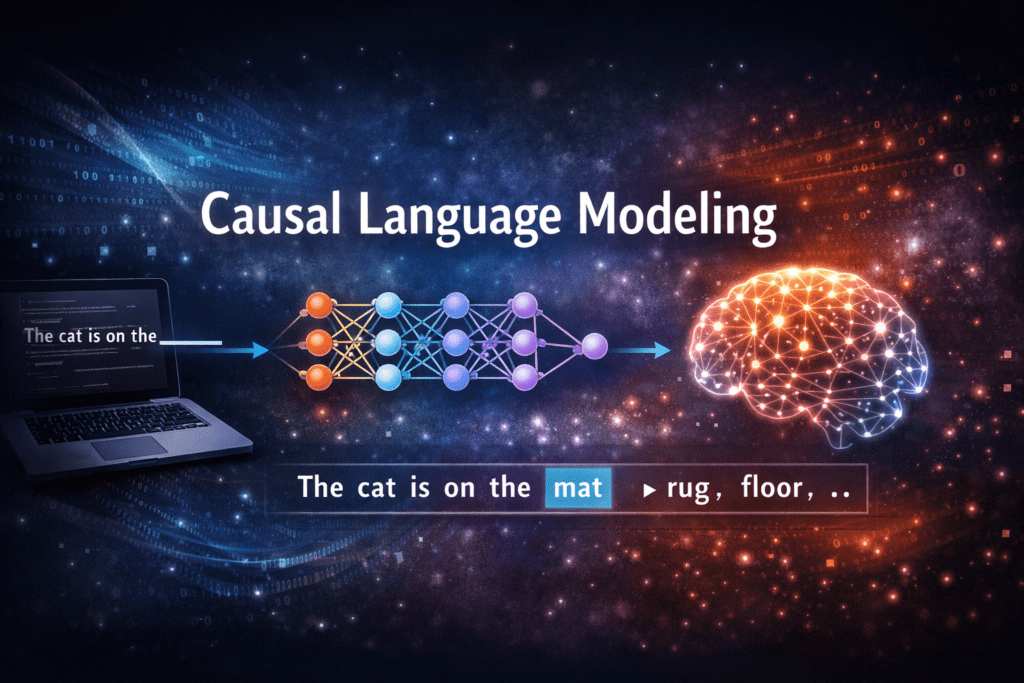
Introduction:
Causal Language Modeling (CLM) is a fundamental training objective used in
modern generative AI models such as GPT. It teaches a model how to generate text one word at a time, based only on past information.
Causal Language Modeling is the core learning objective behind modern
generative AI systems. It enables models to generate coherent, context-aware text by predicting the next token based solely on previous tokens.
What Is Causal Language Modeling?
Causal Language Modeling is a type of language modeling where the model predicts
the next token in a sequence, using only the previous tokens.
Causal Language Modeling is a technique in Natural Language Processing (NLP)
where a model predicts the next word in a sentence using only the previous words.
The model reads text from left to right and never looks at future words.
Simple Definition:
Causal Language Modeling is a method where an AI model learns to
generate text by predicting the next word based only on past words.
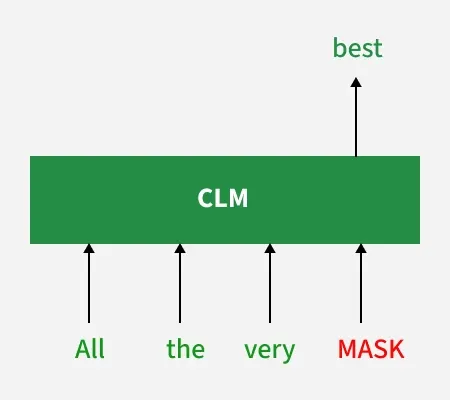
Why Is It Called “Causal”?
The term causal means:
● Future tokens must not influence past prediction
Each word depends only on earlier words
This mimics how humans naturally speak and write.
Example:
“I am learning machine _”
The model predicts:
● “learning”
● “intelligence”
● “models”
…but it cannot see future words.
Mathematical View (Intuition):
A sentence probability is modeled as:
P(w1,w2,…,wn)=∏i=1nP(wi∣w1,…,wi−1)P(w_1, w_2, …, w_n) = \prod_{i=1}^{n} P(w_i
\mid w_1, …, w_{i-1})P(w1,w2,…,wn)=i=1∏nP(wi∣w1,…,wi−1)
Each word depends only on previous words, never on future ones
Role of Causal Language Modeling in Transformers:
Causal Language Modeling plays a core role in Transformer-based architectures,
especially in GPT-style models.
In these models, the decoder-only Transformer uses causal language modeling to
generate text step by step.
A special mechanism called self-attention with causal masking ensures that:
● Each word can attend only to previous words
● Future words are completely hidden
This design allows the model to maintain the natural flow of language generation.
How Causal Language Modeling Works:
Step-by-Step Process:
- Input sentence is tokenized
- Tokens are shifted right
- Model predicts the next token
- Loss is calculated (cross-entropy)
- Parameters are updated
This process is repeated over large text corpora.
Role of Masking in CLM:
CLM uses causal masking (also called look-ahead masking).
Purpose:
● Prevents attention to future tokens
● Ensures left-to-right generation
In Transformers, this is implemented using a triangular attention mask.
Why CLM Is Important:
✔ Enables text generation
✔ Produces fluent sentences
✔ Scales well with large data
✔ Works naturally for dialogue and storytelling
CLM is the reason models like ChatGPT can:
● Write essays
● Answer questions
● Generate code
● Continue conversations
Challenges in Causal Language Modeling:
Despite its power, causal language modeling faces challenges:
● Bias in training data can affect outputs
● Hallucinations, where models generate incorrect facts
● High computational cost during training
Researchers continue to improve these models to make them safer and more reliable
Real-World Impact of Causal Language Modeling:
Causal language modeling has transformed many industries:
Education
● AI tutors
● Automated explanations
● Personalized learning content
Software Development
● Code completion
● Bug explanation
● Documentation generation
Business
● Customer support chatbots
● Email drafting
● Report summarization
CLM in Transformer Architecture:
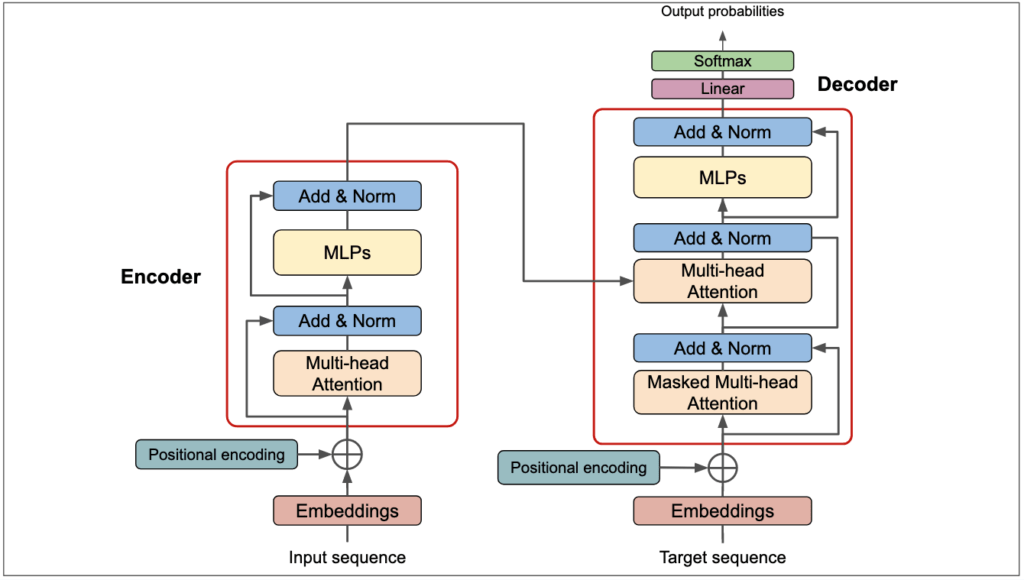
In GPT-style models:
● Input embeddings are created
● Positional embeddings are added
● Causal self-attention is applied
● Output logits predict next token
This stack is repeated across many layers.
Applications of Causal Language Modeling:
● Chatbots
● Story generation
● Code generation
● Autocomplete systems
● AI assistants
Strengths of CLM:
● Simple training objective
● Highly scalable
● Strong generative ability
● Works well with massive datasets
Limitations of CLM:
● Cannot see full sentence context during prediction
● Less effective for classification tasks
● Can generate biased or incorrect text
CLM and Large Language Models (LLMs):
LLMs like GPT are trained using:
● Causal Language Modeling
● Massive text corpora
● Billions of parameters
More data + more parameters = better next-token prediction
Future of Causal Language Modeling:
The future of causal language modeling includes:
● Better reasoning abilities
● Lower training costs
● Improved factual accuracy
● Multimodal learning (text + images + audio)
As models improve, causal language modeling will remain a foundation technique in
AI.
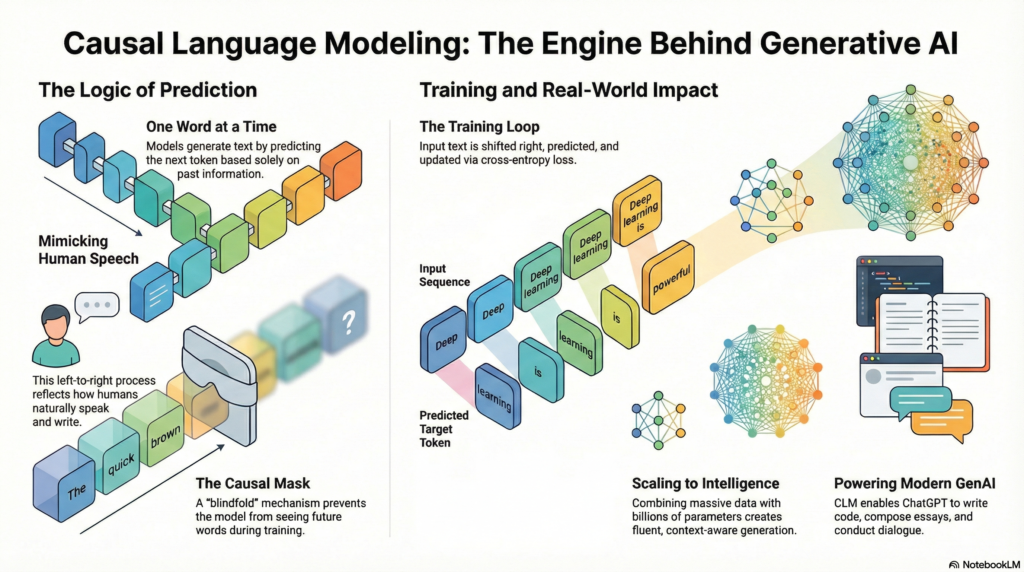
Final Summary:
Causal Language Modeling is a simple idea with powerful results:
- Predict the next word
- Use only past context
- Repeat step by step