
If you’re exploring a future in tech, you’ve probably searched “Cybersecurity vs Ethical Hacking” more than once. Both fields are booming, both pay well, and both protect organizations from digital threats. But while they overlap, they are not the same career path.
So which one should you choose?
In this in-depth guide, we’ll break down:
- What cybersecurity and ethical hacking really mean
- Daily job roles and responsibilities
- Salary comparisons
- Required skills and certifications
- Career growth opportunities
- How to decide which path fits your personality
Let’s dive in.
What Is Cybersecurity?
Cybersecurity is the broad practice of protecting systems, networks, and data from cyber threats. It covers everything from risk management and compliance to threat detection and incident response.
Think of cybersecurity as the entire defense system of an organization.
Common cybersecurity jobs include:
- SOC Analyst (Security Operations Center)
- Security Engineer
- Security Analyst
- Cybersecurity Consultant
- Incident Responder
- Chief Information Security Officer (CISO)
Professionals in a cybersecurity career focus mainly on defensive security preventing, detecting, and responding to attacks.
What Is Ethical Hacking?
Ethical hacking is a specialized branch within cybersecurity that focuses on offensive security. Ethical hackers simulate cyberattacks to identify vulnerabilities before malicious hackers exploit them.
They are often called:
- Penetration Testers
- Red Team Specialists
- Offensive Security Engineers
- Ethical Hackers
An ethical hacking career revolves around legally breaking into systems to improve security.
Ethical hackers are part of what’s commonly known as Red Team vs Blue Team operations:
- Red Team = Attackers (Ethical Hackers)
- Blue Team = Defenders (Cybersecurity Analysts)
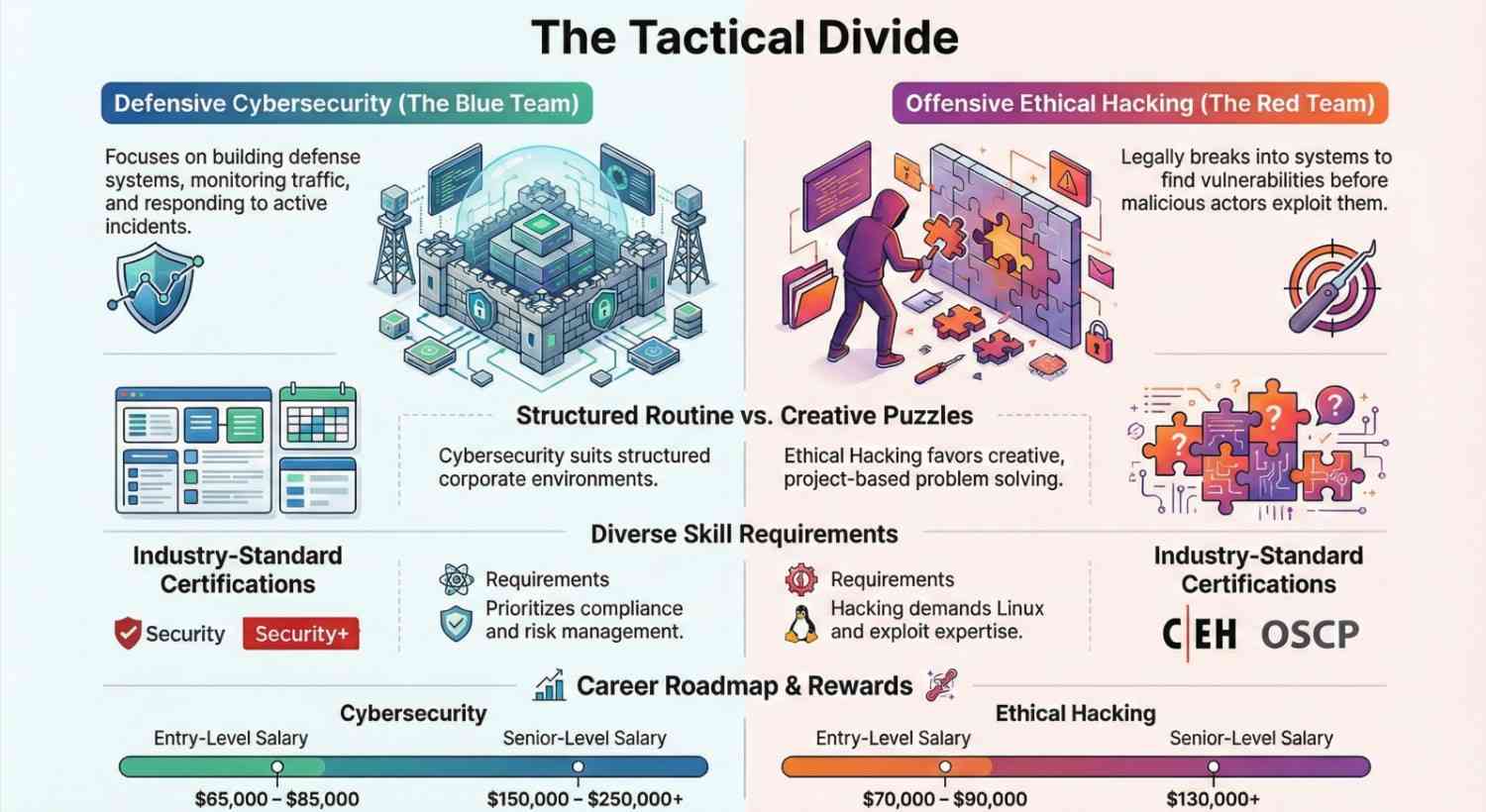
Cybersecurity vs Ethical Hacking: Core Differences
| Feature | Cybersecurity | Ethical Hacking |
|---|---|---|
| Focus | Defensive security | Offensive security |
| Goal | Prevent & respond to attacks | Simulate attacks |
| Work Style | Monitoring & securing systems | Actively exploiting vulnerabilities |
| Roles | SOC Analyst, Security Engineer | Penetration Tester, Red Team |
| Risk Level | Lower | Higher technical exposure |
| Mindset | Protector | Attacker (legally) |
In simple terms:
- Cybersecurity builds the walls.
- Ethical hacking tests how strong those walls are.
Day-to-Day Responsibilities
Cybersecurity Career Daily Tasks
- Monitoring network traffic
- Investigating security alerts
- Responding to incidents
- Implementing firewalls & security tools
- Conducting risk assessments
- Ensuring compliance
Cybersecurity professionals often work in structured environments like corporations, banks, hospitals, or government agencies.
Ethical Hacking Career Daily Tasks
- Conducting penetration testing
- Scanning for vulnerabilities
- Exploiting security flaws
- Writing detailed vulnerability reports
- Participating in bug bounty programs
- Social engineering simulations
Ethical hackers may work for consulting firms, security companies, or as freelancers.
Skills Required: Cybersecurity vs Ethical Hacking
Skills for a Cybersecurity Career
- Network security fundamentals
- SIEM tools (like Splunk)
- Risk management
- Incident response
- Cloud security
- Compliance standards (ISO, NIST)
- Strong analytical thinking
Skills for an Ethical Hacking Career
- Deep understanding of networking
- Linux expertise
- Programming (Python, Bash, sometimes C)
- Web application security
- Exploit development basics
- Reverse engineering
- Creative problem-solving
Ethical hacking requires a more technical and hands-on mindset.
Certifications That Matter
If you’re choosing between cybersecurity vs ethical hacking, certifications can guide your path.
Cybersecurity Certifications
- CompTIA Security+
- CISSP
- CISM
- CCSP
- Certified SOC Analyst
These certifications are ideal for building a cybersecurity career.
Ethical Hacking Certifications
- CEH certification (Certified Ethical Hacker)
- OSCP
- eJPT
- GPEN
The CEH certification is often a starting point, but many professionals consider OSCP more practical for penetration testing roles.
Salary Comparison: Ethical Hacker vs Cybersecurity Professional
Ethical Hacker Salary
- Entry-level: $70,000 – $90,000/year
- Mid-level: $90,000 – $130,000/year
- Senior: $130,000+
Freelance ethical hackers can earn more depending on contracts and bug bounties.
Cybersecurity Salary
- Entry-level: $65,000 – $85,000/year
- Mid-level: $85,000 – $120,000/year
- Senior/CISO: $150,000 – $250,000+
Overall, both ethical hacker salary and cybersecurity salary ranges are competitive and growing.
Job Demand and Market Growth
Cybersecurity is one of the fastest-growing tech sectors globally.
Reasons:
- Increase in ransomware attacks
- Growth in cloud computing
- Remote work vulnerabilities
- Government regulations
There is a significant shortage of skilled professionals in both cybersecurity and ethical hacking.
However:
- Cybersecurity roles are broader and more available.
- Ethical hacking roles are more specialized and competitive.
Personality Fit: Which One Matches You?
Choose Cybersecurity Career if you:
- Prefer structured environments
- Like monitoring and analysis
- Enjoy long-term system improvements
- Want stable corporate growth
- Are interested in management roles
Choose Ethical Hacking Career if you:
- Love solving puzzles
- Think creatively
- Enjoy breaking things (legally)
- Prefer technical deep dives
- Like challenge-based environments
Work Environment Comparison
Cybersecurity
- Corporate offices
- Banks
- Healthcare organizations
- Government agencies
- Remote SOC teams
Ethical Hacking
- Security consulting firms
- Independent freelance
- Startups
- Bug bounty platforms
- Internal Red Teams
Ethical hacking tends to be less routine and more project-based.
Career Growth Path
Cybersecurity Career Path
- IT Support / Network Admin
- SOC Analyst
- Security Engineer
- Security Architect
- CISO
Cybersecurity offers strong leadership opportunities.
Ethical Hacking Career Path
- Junior Penetration Tester
- Penetration Tester
- Red Team Lead
- Offensive Security Specialist
- Security Consultant
Growth depends heavily on technical mastery.
Can You Do Both?
Yes.
Many professionals start in cybersecurity and later move into ethical hacking.
Others begin in penetration testing and transition into security architecture or leadership.
The truth is: ethical hacking is part of cybersecurity.
It’s not Cybersecurity or Ethical Hacking it’s more like Cybersecurity and Ethical Hacking.
Pros and Cons
Cybersecurity Pros
✔ Broader job market
✔ Stable career progression
✔ Management opportunities
✔ Less legal risk
Cybersecurity Cons
✘ Can become routine
✘ Heavy compliance work
Ethical Hacking Pros
✔ Exciting and dynamic
✔ High technical skill growth
✔ Freelance opportunities
✔ Bug bounty income potential
Ethical Hacking Cons
✘ Competitive field
✘ Requires constant upskilling
✘ High-pressure testing deadlines
Final Decision: Which Career Should You Choose?
If you want long-term stability, leadership potential, and broader opportunities, choose a cybersecurity career.
If you want hands-on technical challenges, offensive security work, and flexibility, choose an ethical hacking career.
If you’re still unsure?
Start with cybersecurity fundamentals, then specialize in ethical hacking later.
That path gives you both defensive and offensive knowledge making you extremely valuable in the job market.
Final Thoughts
The debate around Cybersecurity vs Ethical Hacking isn’t about which is better it’s about which aligns with your strengths and goals.
Both careers:
- Pay well
- Are in high demand
- Offer long-term growth
- Protect organizations from cyber threats
The real question is:
Do you want to defend systems or break them to make them stronger?
Either way, the future of digital security needs professionals like you.
- Explore Cybersecurity here, then master it with Jeevi’s resources and our complete Cybersecurity training.
- Explor Ethical Hacking here, then master it with Jeevi’s resources and our complete Ethical Hacking training.