

Introduction:
Artificial Intelligence for IT Operations (AIOps) is the application of
Artificial Intelligence (AI), Machine Learning (ML), and data analytics to
automate and enhance IT operations. It helps organizations monitor,
manage, and optimize complex IT environments more efficiently.
In today’s digital world, businesses depend heavily on cloud computing,
applications, servers, networks, and data centers. These systems generate
a massive amount of data such as logs, metrics, alerts, and events.
Managing and analyzing this data manually is difficult and time-consuming.
Traditional IT operations often struggle with alert overload, slow problem
resolution, and unplanned downtime.
Simple Definition:
Artificial Intelligence for IT Operations (AIOps) is the use of Artificial
Intelligence (AI) and Machine Learning (ML) to automate and improve IT
operations.
Why AIOps is Needed:
Today’s IT infrastructure generates massive amounts of data such as:
- Application logs
- System performance metrics
- Security alerts
- Network events
- User activity data
Manually analyzing this data is slow and error-prone. AIOps helps by:
- Filtering unnecessary alerts
- Detecting real issues quickly
- Reducing human workload
- Preventing system failures
How AIOps Works:
AIOps works through a structured process:
Data Collection:
Data is gathered from various IT systems including applications, servers,
networks, and cloud services.
Data Analysis:
AI and ML models analyze the collected data to detect patterns and
abnormalities.
Event Correlation:
Related alerts are grouped together to identify the actual root cause.
Automation:
The system sends smart alerts or automatically performs corrective
actions.
Core Components of AIOps:
AIOps typically includes the following components:
1.Data Aggregation:
Collects data from multiple IT sources like servers, applications, cloud
platforms, and monitoring tools.
2.Machine Learning Models:
Analyzes patterns in data to detect anomalies and predict failures.
3.Event Correlation:
Connects related alerts to identify the actual root cause of a problem.
4.Automation Engine:
Triggers automated actions such as restarting services or allocating
additional resources.
| Component | Description (Simple Explanation) |
|---|---|
| Monitoring & Observability | Continuously checks systems, servers, and applications to track performance and issues |
| Data Aggregation | Collects logs, metrics, events, and traces from different IT sources |
| Machine Learning & Analytics | Uses AI algorithms to analyze data and find patterns |
| Anomaly Detection | Identifies unusual behavior or errors automatically |
| Automated Incident Response | Automatically fixes or responds to issues without manual work |
| Predictive Insights | Predicts future problems before they happen |
Key Features of AIOps:
- Real-time system monitoring
- Intelligent alert management
- Root Cause Analysis (RCA)
- Predictive analytics
- Self-healing systems
- Automated incident response
Challenges of AIOps:
- Requires high-quality data
- Initial setup cost can be high
- Integration with legacy systems may be complex
- Requires skilled professionals
Use Cases of AIOps:
- Cloud infrastructure monitoring
- Application performance management
- Cybersecurity threat detection
- Data center operations
- IT service management (ITSM)
Key Objectives of AIOps:
The main objectives of AIOps are:
1.Reduce system downtime
2.Improve IT service performance
3.Minimize alert noise
4.Increase operational efficiency
5.Automate repetitive tasks
Advantages of AIOps:
1.Faster problem detection and resolution
2.Reduced downtime and service interruptions
3.Improved system reliability
4.Increased productivity of IT teams
5.Lower operational costs
Key Elements in the Image:
1.AI Brain (Central Intelligence)
The glowing brain represents:
- Artificial Intelligence
- Machine Learning algorithms
- Deep learning models
2.IT Infrastructure
The servers, cloud icons, and dashboards represent:
- Data centers
- Cloud computing platforms
- Applications
- Network systems
3.Logs & Metrics
The screens showing graphs and logs represent:
- System performance monitoring
- Error logs
- CPU & memory usage
- Real-time metrics
- Anomaly Detection
4.Anomaly Detection
The magnifying glass and alert icons show:
- Detection of unusual behavior
- Identification of system issues
- Root Cause Analysis (RCA)
5.Automation & Self-Healing
The robotic arms represent:
- Automatic alerts
- Auto remediation
- Resource scaling
- Self-healing systems
6.Predictive Analytics
The upward graph represents:
- Performance improvement
- Failure prediction
- Business optimization
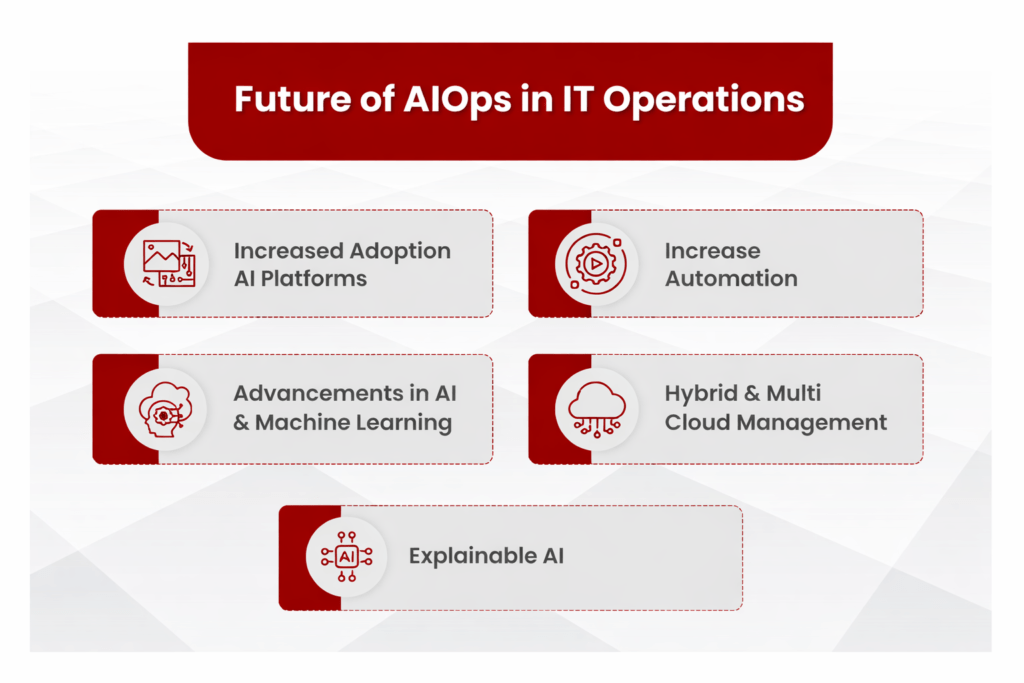
Future Scope of AIOps:
With the growth of digital transformation and hybrid cloud environments,
AIOps will play a critical role in building intelligent IT systems. In the future,
organizations may achieve fully automated and self-managing IT
infrastructures using advanced AI technologies.
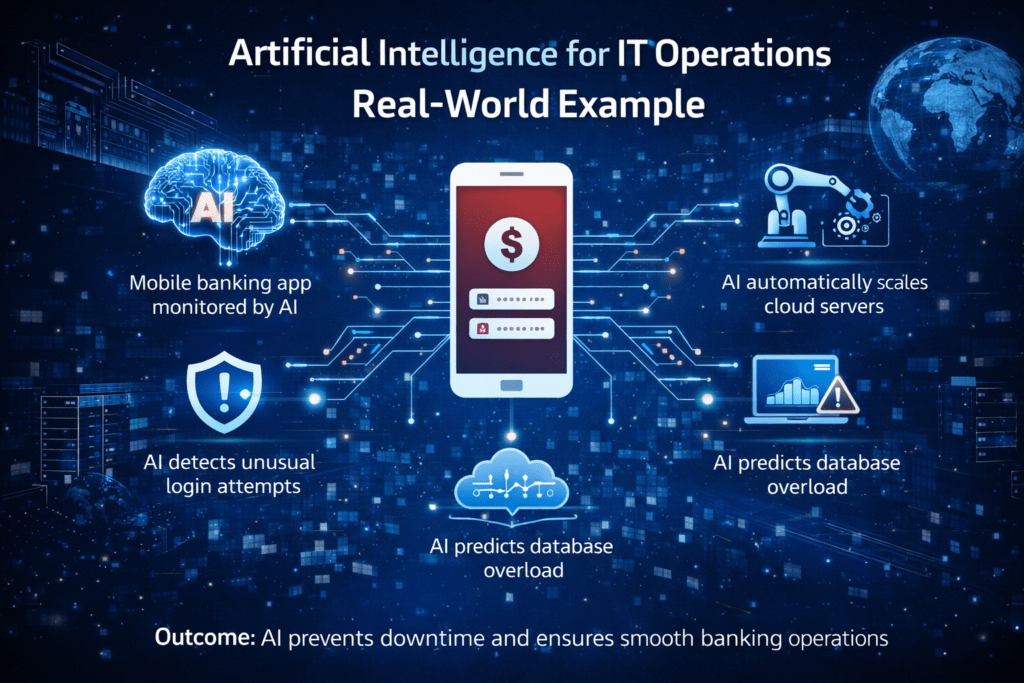
Real-World Example:
For example, if a company’s online shopping website experiences sudden
high traffic, AIOps can:
- Detect abnormal traffic patterns
- Predict possible server overload
- Automatically allocate additional resources
- Prevent website crash
Conclusion:
Artificial Intelligence for IT Operations (AIOps) is transforming IT
management by combining AI, machine learning, and automation. It helps
organizations manage complex IT infrastructures efficiently, reduce
downtime, and improve overall performance. As technology evolves, AIOps
will play a crucial role in building intelligent and automated IT environments.




