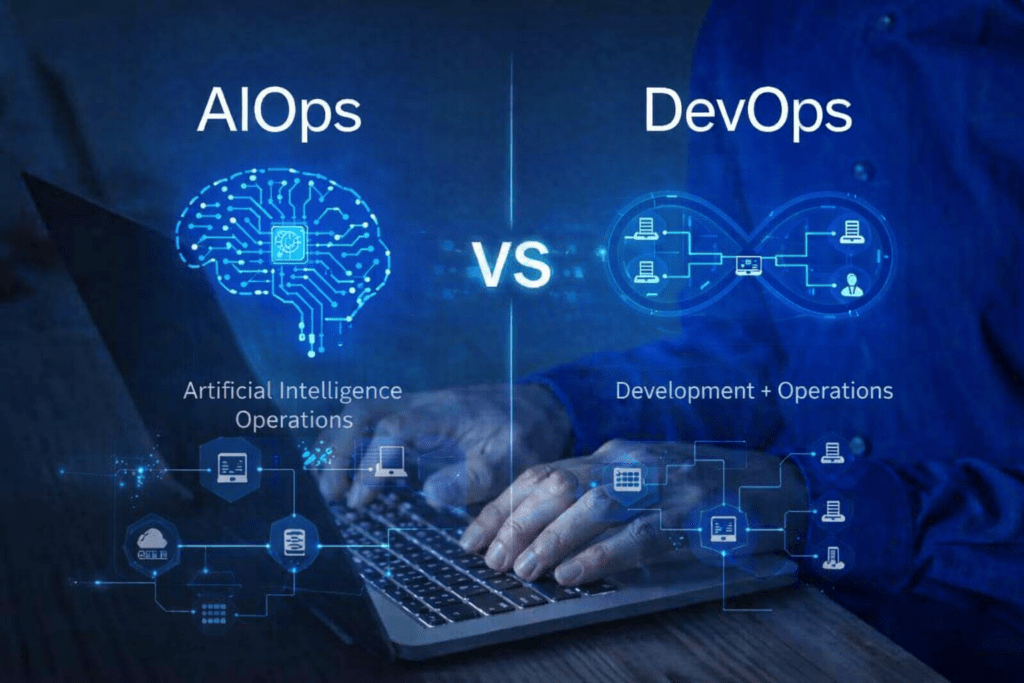
Introduction:
In today’s fast-moving digital world, organizations aim to deliver software
quickly while maintaining stable and reliable IT systems. Two important
concepts that help achieve this goal are DevOps and AIOps.
While DevOps focuses on improving collaboration and accelerating
software delivery, AIOps enhances IT operations using Artificial Intelligence
and automation. Understanding the difference between these two helps
organizations implement them effectively.
DevOps – In Detail
Definition:
DevOps is a combination of Development (Dev) and Operations (Ops)
that promotes collaboration, automation, and continuous delivery of
software.
Main Objective:
To deliver high-quality software faster and more reliably.
Key Practices:
- Continuous Integration (CI)
- Continuous Deployment (CD)
- Infrastructure as Code (IaC)
- Automated Testing
- Monitoring & Feedback
Popular DevOps Tools:
- Git
- Jenkins
- Docker
- Kubernetes
- Ansible
- Terraform
Benefits of DevOps:
- Faster release cycles
- Improved collaboration
- Reduced deployment failures
- Quick bug fixes
- Increased productivity
AIOps – In Detail
Definition:
AIOps stands for Artificial Intelligence for IT Operations. It applies AI
and Machine Learning to automate monitoring, detect issues, and improve
system performance.
Main Objective:
To reduce downtime and automate IT incident management.
- Reduce downtime and ensure system stability
- Automate IT incident detection and response
- Enable automated remediation for faster recovery
- Improve operational efficiency using AI automation
Popular AIOps Platforms:
- Splunk ITSI
- IBM Watson AIOps
- Dynatrace
- Moogsoft
- Datadog
Benefits of AIOps:
- Reduced alert noise
- Faster problem resolution
- Predictive maintenance
- Lower operational cost
- Self-healing systems
Key Functions of AIOps:
- Real-time monitoring
- Intelligent alert filtering
- Predictive analytics
- Event correlation
- Automated remediation
AIOps is mainly about intelligent automation and predictive IT
management.
Key Differences Between AIOps and DevOps:
| Feature | AIOps | DevOps |
|---|---|---|
| Main Focus | Uses AI/ML to automate IT operations | Combines development & operations for faster delivery |
| Objective | Reduce downtime and automate incident management | Speed up software development and deployment |
| Technology | AI, Machine Learning, Big Data analytics | CI/CD, automation tools, collaboration practices |
| Approach | Proactive (predict issues before failure) | Continuous integration & continuous delivery |
| Primary Use | IT operations monitoring and automation | Software development lifecycle improvement |
| Automation Type | Intelligent automation using AI | Process automation using DevOps tools |
| Problem Handling | Predicts and auto-resolves incidents | Detects issues during development/testing |
| Outcome | Better system reliability and uptime | Faster releases and improved collaboration |
When to Use DevOps?
- When improving development speed
- When implementing CI/CD pipelines
- Technology-driven solution
- When increasing collaboration between teams
- When reducing release cycles
When to Use AIOps?
- When managing complex IT infrastructure
- When handling large volumes of alerts
- When reducing downtime
- When predicting system failures
Real-World Scenario Comparison:
Scenario: Banking Mobile Application Launch
DevOps Role:
- Develop application features
- Automate testing
- Deploy app using CI/CD
- Ensure smooth release
AIOps Role:
- Monitor server performance
- Detect unusual login activity
- Predict database overload
- Automatically scale cloud servers
- Prevent service outage
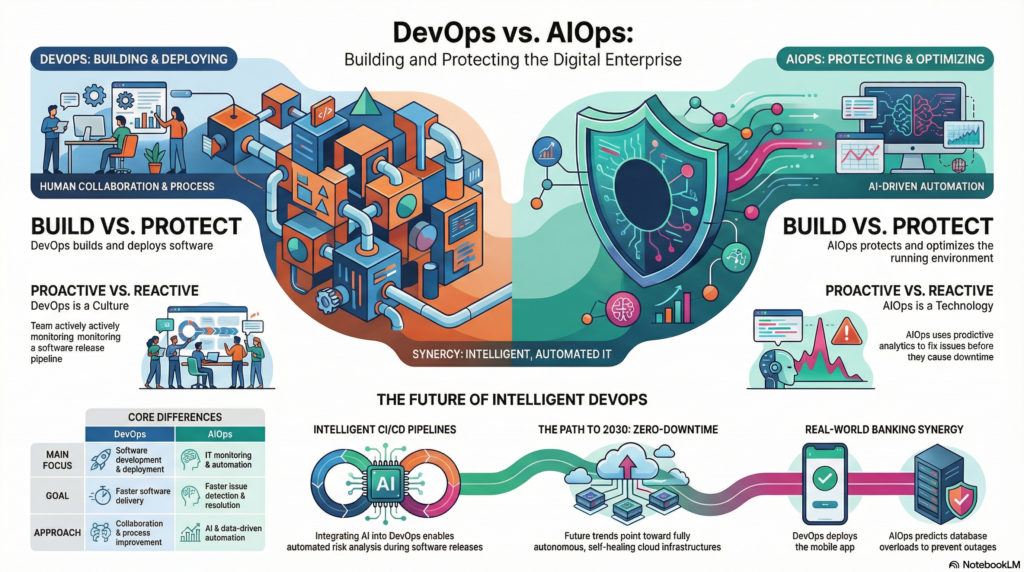
Integration of AIOps with DevOps (AIOps + DevOps =
Intelligent DevOps):
Modern organizations combine both approaches:
- DevOps ensures rapid innovation.
- AIOps ensures operational stability.
- Together they enable autonomous digital enterprises.
This integration leads to:
- Intelligent CI/CD pipelines
- AI-based deployment risk analysis
- Automated performance optimization
- Predictive release management
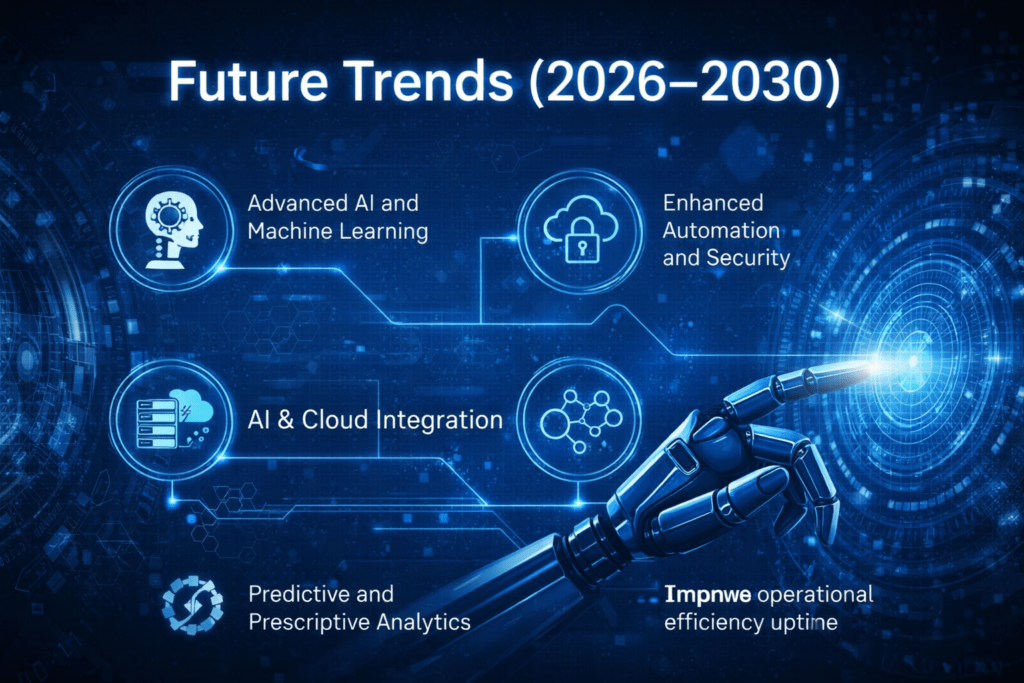
Future Trends (2026–2030):
- AI-driven CI/CD pipelines
- Fully autonomous IT systems
- Zero-downtime deployments
- Self-healing cloud infrastructures
- AI-assisted DevOps engineers
AIOps will become a critical extension of DevOps in large enterprises.
Conclusion:
DevOps and AIOps serve different but complementary purposes in modern
IT environments. DevOps focuses on accelerating software development
through collaboration and automation, while AIOps enhances IT operations
using Artificial Intelligence and predictive analytics. Organizations that
successfully combine both can achieve faster innovation, improved
reliability, and reduced operational costs.