If you’re starting your journey into full stack development, you might feel overwhelmed by the number of technologies to learn. This step-by-step full stack course syllabus for beginners is designed to take you from absolute basics to job-ready skills in a structured, practical way.
Whether you’re a student, career switcher, or aspiring software developer, this roadmap will help you understand exactly what to learn and in what order.
What Is Full Stack Development?
A full stack developer is someone who can build both the frontend (user interface) and backend (server-side logic) of a web application. This includes working with databases, APIs, authentication, and deployment.
In simple terms:
- Frontend Development → What users see and interact with
- Backend Development → How the application works behind the scenes
- Database Management → Where data is stored
- Deployment & DevOps → Making the application live
Now, let’s break down the beginner-friendly full stack developer syllabus step by step.
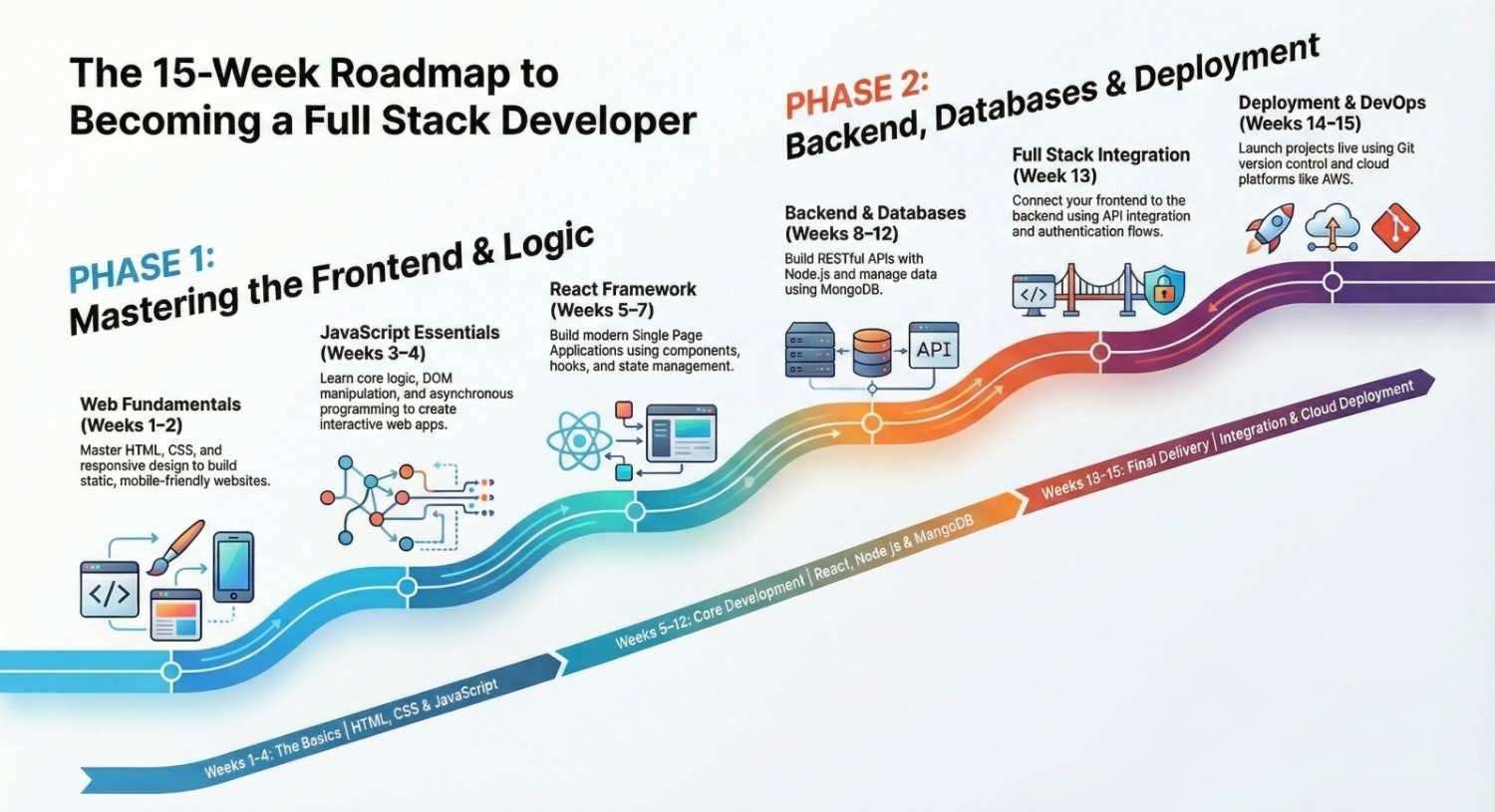
Step 1: Web Development Fundamentals (Weeks 1–2)
Before jumping into frameworks, you must understand the basics.
1.1 How the Web Works
- What is HTTP/HTTPS?
- What is a browser?
- What is a client-server model?
- Introduction to REST APIs
1.2 HTML (HyperText Markup Language)
- Tags, elements, attributes
- Forms and input fields
- Semantic HTML
- Accessibility basics
1.3 CSS (Cascading Style Sheets)
- Selectors and properties
- Box model
- Flexbox
- CSS Grid
- Responsive design with media queries
Goal: Build static responsive websites.
Keywords covered: full stack course syllabus, web development basics, HTML CSS for beginners, responsive web design.
Step 2: JavaScript Fundamentals (Weeks 3–4)
JavaScript is the foundation of modern full stack development.
2.1 Core JavaScript Concepts
- Variables and data types
- Functions
- Arrays and objects
- Loops and conditionals
- ES6 features
2.2 DOM Manipulation
- Selecting elements
- Event handling
- Form validation
- Dynamic content updates
2.3 Asynchronous JavaScript
- Callbacks
- Promises
- Async/Await
- Fetch API
Goal: Build interactive web applications.
Keywords covered: JavaScript for beginners, full stack developer roadmap, learn JavaScript step by step.
Step 3: Frontend Framework (Weeks 5–7)
Modern web development requires a frontend library like React.
3.1 React Basics
- Components
- JSX
- Props and State
- Event handling
3.2 React Advanced Topics
- Hooks (useState, useEffect)
- Routing
- Conditional rendering
- Forms handling
3.3 State Management
- Context API
- Basic global state concepts
Goal: Build a single-page application (SPA).
Mini Project Ideas:
- To-Do App
- Weather App
- Blog UI
Keywords covered: React full stack course syllabus, frontend development roadmap, SPA development.
Step 4: Backend Development (Weeks 8–10)
Now you’ll learn how to build servers and APIs.
Most beginner courses use Node.js with Express.js.
4.1 Node.js Basics
- What is Node.js?
- Modules and NPM
- File system
4.2 Express.js
- Creating a server
- Routing
- Middleware
- REST API creation
4.3 Authentication
- JWT basics
- Password hashing
- Login & signup APIs
Goal: Build a RESTful API.
Keywords covered: backend development syllabus, Node.js course roadmap, Express.js tutorial for beginners.
Step 5: Database Management (Weeks 11–12)
A full stack developer must understand databases.
5.1 SQL vs NoSQL
- Relational databases
- Non-relational databases
5.2 MongoDB Basics
Many beginner MERN courses use MongoDB.
- Collections and documents
- CRUD operations
- Mongoose ORM
5.3 Database Design
- Relationships
- Indexing basics
- Data modeling
Goal: Connect backend APIs to a database.
Keywords covered: database syllabus for beginners, MongoDB full stack course, CRUD operations tutorial.
Step 6: Connecting Frontend & Backend (Week 13)
Now combine everything.
- API integration
- Handling errors
- Authentication flow
- Protected routes
Goal: Build a complete full stack application.
Capstone Project Ideas:
- E-commerce website
- Social media app
- Job portal
Step 7: Deployment & DevOps Basics (Weeks 14–15)
Learning deployment makes you job-ready.
Deployment Concepts
- What is hosting?
- Environment variables
- Production builds
Cloud & Hosting
Deploy on platforms like:
- Vercel
- Render
- Amazon Web Services
Version Control
- Git basics
- Branching
- GitHub workflow
Goal: Make your full stack project live.
Keywords covered: deploy full stack app, DevOps basics for beginners, cloud deployment roadmap.
Suggested 15-Week Beginner Full Stack Course Timeline
| Weeks | Module |
|---|---|
| 1–2 | HTML + CSS |
| 3–4 | JavaScript |
| 5–7 | React |
| 8–10 | Node.js + Express |
| 11–12 | Database (MongoDB) |
| 13 | Integration |
| 14–15 | Deployment |
Skills You Will Gain
By completing this full stack developer course syllabus for beginners, you will:
- Build responsive frontend applications
- Develop RESTful APIs
- Manage databases
- Implement authentication
- Deploy real-world projects
You’ll be ready for:
- Junior Full Stack Developer roles
- Frontend Developer jobs
- Backend Developer positions
- Freelancing opportunities
Bonus: Optional Advanced Modules
After completing the beginner roadmap, consider learning:
- TypeScript
- Testing (Jest)
- Docker
- System Design basics
- CI/CD pipelines
These skills increase your salary potential and make your profile stand out.
Conclusion
This step-by-step full stack course syllabus for beginners provides a structured and practical learning path. Instead of jumping randomly between tutorials, follow this roadmap module by module and focus on building real-world projects.
Consistency, hands-on practice, and project building are the keys to becoming a successful full stack developer. If you dedicate 3–4 hours daily, you can become job-ready within 4–6 months.
Start small, build consistently, and deploy your projects your full stack developer career begins today.
- If you want to explore Full Stack, start your training here.