Introduction:
Zero-Shot Learning (ZSL) is a machine learning approach that enables a model to recognize or understand new classes or tasks without being explicitly trained on them. Instead of learning from direct examples, the model uses prior knowledge, semantic relationships, and descriptive information to make intelligent predictions.
For example, if a model has learned about animals like horses and understands the concept of “black-and-white stripes”, it can correctly identify a zebra even if it has never seen one before.
- Image and object recognition
- Natural language processing
- Recommendation systems
- AI assistants and chatbots
Overall, Zero-Shot Learning helps build more flexible, scalable, and intelligent AI systems that can handle new situations without additional training.
What is Zero-Shot Learning?
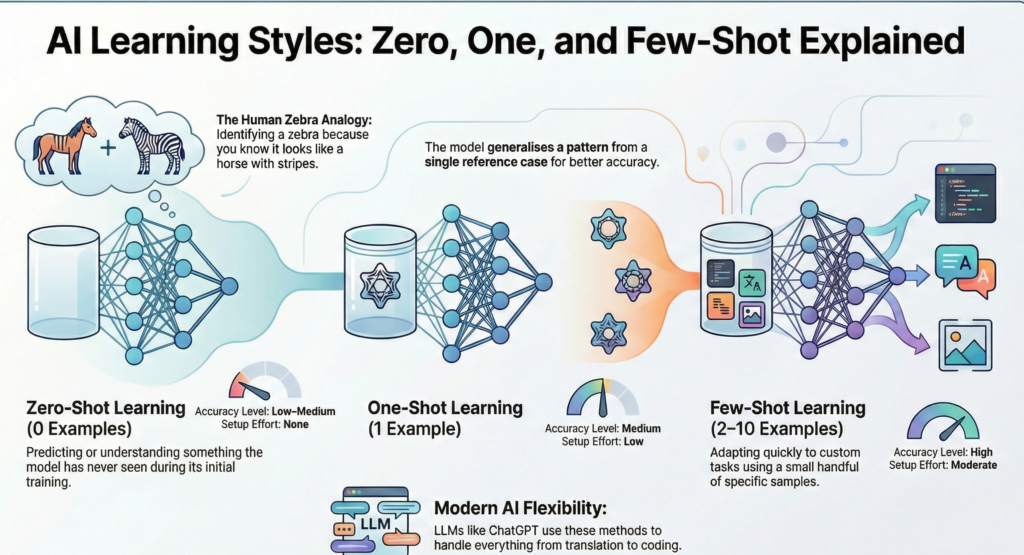
Zero-Shot Learning (ZSL) means a model can predict or understand something it has
NEVER seen during training.
Zero examples given:
Still able to give correct output
That’s why it’s called “Zero-Shot”.
Simple Example (Human Style):
You’ve never seen a zebra before.
But someone tells you:
● It looks like a horse
● It has black and white stripes
Next time you see it, you say:
“Oh, that must be a zebra!”
This is zero-shot learning.
Zero-Shot Learning – Simple Example (Human Style):
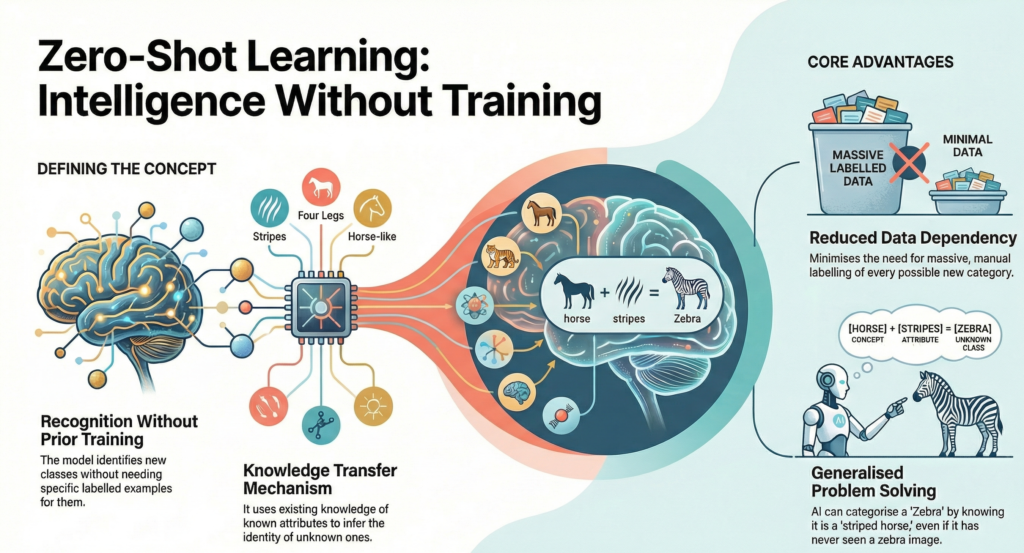
Zero-Shot Learning is best understood using how humans learn new things.
Example 1: Animal Recognition:
You have never seen a giraffe before.
But someone tells you:
● It is an animal
● It has a very long neck
● It looks like a deer
● It eats leaves from tall trees
Later, you see such an animal in a zoo.
You immediately say:
“This must be a giraffe.”
You identified it without seeing any training examples
This is Zero-Shot Learning
Example 2: New Word Understanding:
You’ve never heard the word “snowstorm”.
But you know:
● snow = frozen rain
● storm = heavy weather
So you understand:
“snowstorm” means heavy snowfall with strong wind
You learned the meaning without anyone teaching you directly.
✔ Zero examples
✔ Used existing knowledge
✔ Correct understanding
Example 3: Job Role Guessing:
You hear the job title “Cloud Architect” for the first time.
You know:
● Cloud = online servers
● Architect = designer
So you guess:
“A person who designs cloud systems”
Even without training or experience — you understood it.
Zero-Shot Learning
Example 4: Food Identification:
You’ve never eaten sushi before.
But someone says:
● It is Japanese food
● Made of rice + raw fish
● Rolled using seaweed
When you see it on a plate, you identify it correctly.
Learned without experience → Zero-Shot
Key Idea from Human Examples:
Humans:
● use descriptions
● connect with existing knowledge
● reason logically
AI does the same thing in Zero-Shot Learning.
Link to AI (Easy Connection):
Human:
“Horse + black-white stripes = Zebra”
AI:
“Text features + semantic meaning = New class prediction”
Same logic
AI Example:
Model is trained on:
● Cat● Dog
● Horse
Model has never seen “zebra”
But if the model knows:
● Zebra = horse + stripes
Then it can correctly identify a zebra.
Zero-Shot Learning in NLP:
Example prompt:
“Translate this English sentence to French:”
Even if the model:
● was not trained on this exact sentence It can still translate correctly.
Another example:
“Classify this text as positive or negative”
Without extra training → model still works.
How Zero-Shot Learning Works:
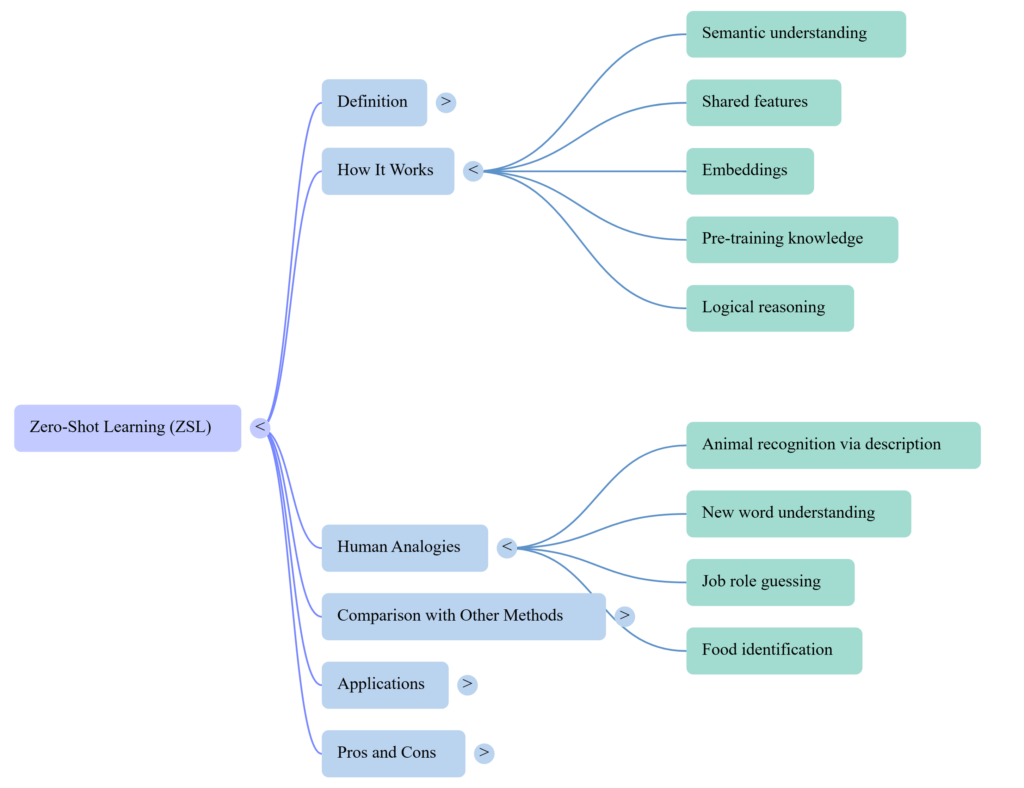
It uses:
● Semantic understanding
● Shared features
● Embeddings
● Pre-training knowledge
Models learn relationships, not just memorization.
Zero-Shot vs One-Shot vs Few-Shot Learning:
| Aspect | Zero-Shot Learning | One-Shot Learning | Few-Shot Learning |
|---|---|---|---|
| Definition | Model predicts new classes without seeing any training examples | Model learns from only one example per class | Model learns from a small number of examples per class |
| Training Data | No labeled examples for new classes | One labeled example | 2–20 labeled examples (small dataset) |
| Learning Method | Uses semantic understanding, descriptions, or prior knowledge | Compares similarity with the single example | Learns patterns from a small set of samples |
| Flexibility | Very high | Moderate | High |
| Accuracy | Lower compared to others | Better than zero-shot | Higher than one-shot and zero-shot |
| Example | Identifying a “zebra” using description (striped horse-like animal) | Recognizing a person after seeing one photo | Recognizing an object after seeing a few images |
| Use Cases | NLP tasks, large AI models, classification without data | Face recognition, signature verification | Medical imaging, rare object detection, custom AI models |
| Data Requirement | None for new class | Very minimal | Small amount of data |
Overview:
These three learning styles describe how many examples a model needs to understand or
perform a task.
Advantages:
● No training data needed
● Very flexible
● Fast to use
Limitations:
● Less accurate for complex tasks
● Depends heavily on clear instructions
In Modern AI (LLMs):
● ChatGPT uses:
○ Zero-Shot → basic tasks
○ Few-Shot → better accuracy
● Fine-Tuning → large datasets (beyond few-shot)
Where Zero-Shot Learning is Used
Where Zero-Shot Learning is Used:
ChatGPT & LLMs
Image classification
Text classification
Question answering
Language translation
Conclusion:
Zero-Shot, One-Shot, and Few-Shot learning differ based on the number of
examples provided, balancing flexibility, accuracy, and data requirements.