
Machine learning is one of the fastest-growing fields in technology. Companies across industries use machine learning to automate processes, predict outcomes, and create intelligent systems.
If you’re wondering how to become a Machine Learning Engineer, this guide will walk you through a complete machine learning engineer roadmap, including the skills, tools, projects, and learning stages required to succeed in this career.
Whether you’re a beginner or someone transitioning into AI, this roadmap will help you understand exactly what to learn and when.
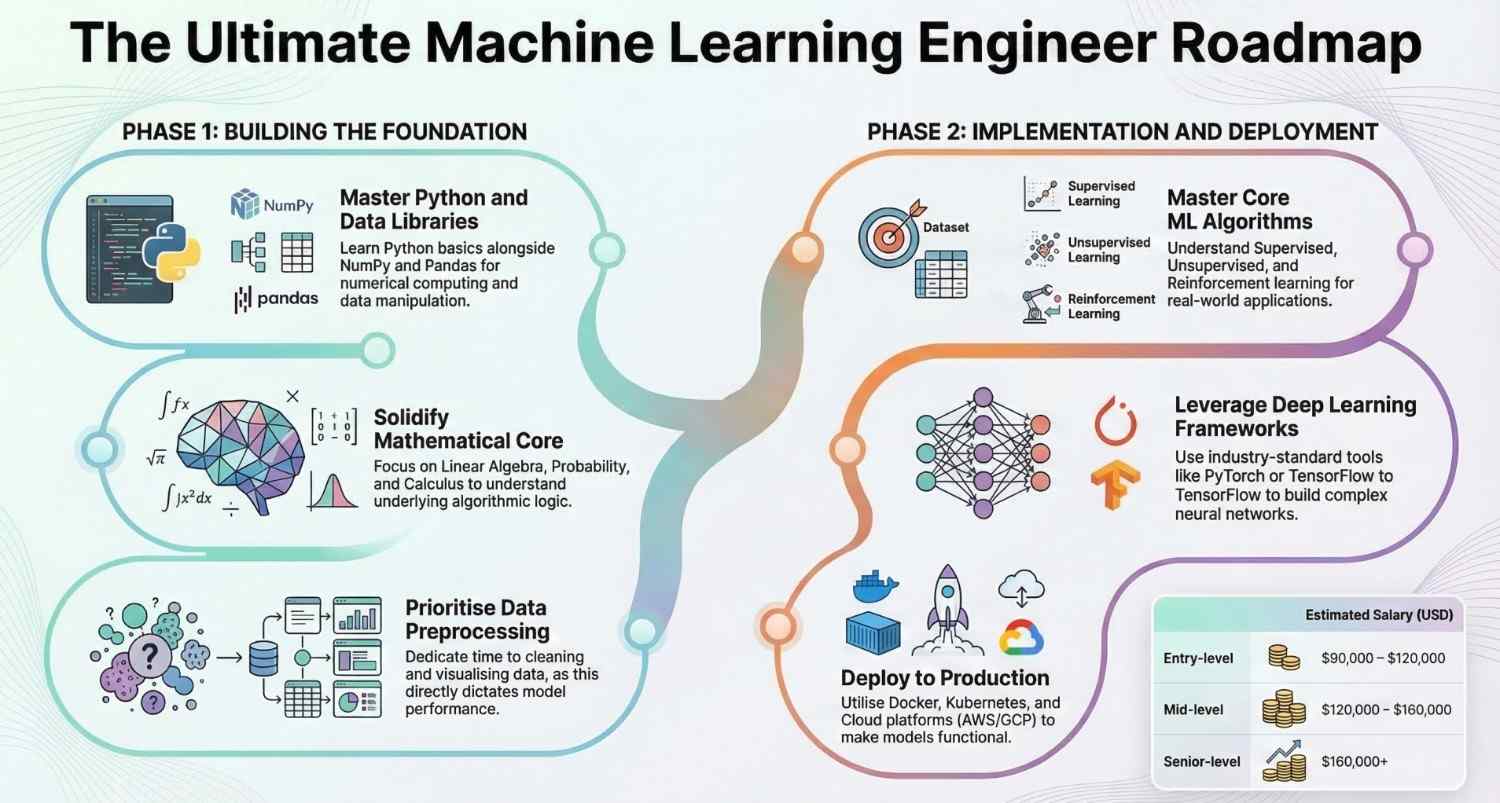
What is Machine Learning?
Machine learning is a field of Artificial Intelligence (AI) where computers learn patterns from data and make predictions without being explicitly programmed.
Popular examples include:
- Netflix recommendation systems
- Fraud detection in banking
- Self-driving cars
- Chatbots and virtual assistants
Machine learning systems rely heavily on data, algorithms, and mathematical models.
Who is a Machine Learning Engineer?
A Machine Learning Engineer is responsible for:
- Building machine learning models
- Training algorithms using data
- Deploying models into production
- Improving model performance
Unlike data scientists who focus more on analysis, ML engineers focus on building scalable ML systems.
Typical responsibilities include:
- Data preprocessing
- Feature engineering
- Model training
- Model evaluation
- Model deployment
Machine learning engineers combine skills from software engineering, statistics, and data science.
Machine Learning Engineer Roadmap (Step-by-Step)
Let’s break down the roadmap into 8 major stages.
1. Learn Programming (Python First)
Programming is the foundation of machine learning.
The most popular language in ML is Python because it has a huge ecosystem of ML libraries.
Important concepts to learn:
- Variables and data types
- Loops and conditionals
- Functions and modules
- Object-oriented programming
- File handling
Useful Python libraries for ML include:
- NumPy for numerical computing
- Pandas for data manipulation
- Matplotlib for data visualization
- Seaborn for statistical visualization
Mastering Python will make the rest of the machine learning journey easier.
2. Learn Mathematics for Machine Learning
Mathematics forms the backbone of machine learning algorithms.
Important topics include:
Linear Algebra
Used in vectors, matrices, and neural networks.
Key concepts:
- Vectors
- Matrices
- Matrix multiplication
- Eigenvalues and eigenvectors
Probability and Statistics
Machine learning models rely on statistical concepts.
Important areas:
- Probability distributions
- Mean, variance, standard deviation
- Hypothesis testing
- Bayesian probability
Calculus
Optimization techniques rely on calculus.
One of the most important concepts is Gradient Descent, which helps models minimize error during training.
3. Learn Data Handling and Data Analysis
Data is the fuel for machine learning models.
Machine learning engineers spend a significant amount of time:
- Cleaning data
- Transforming datasets
- Exploring patterns in data
You should learn:
- Data preprocessing
- Data visualization
- Handling missing values
- Feature engineering
Tools widely used in data analysis:
- Jupyter Notebook
- Pandas
- Matplotlib
Understanding datasets and preparing them properly can dramatically improve model performance.
4. Understand Machine Learning Algorithms
Machine learning algorithms allow computers to learn from data.
They are usually divided into three categories:
Supervised Learning
In supervised learning, models learn from labeled data.
Popular algorithms:
- Linear Regression
- Logistic Regression
- Decision Tree
- Random Forest
- Support Vector Machine
Used for tasks like:
- House price prediction
- Spam detection
- Credit risk prediction
Unsupervised Learning
These algorithms work with unlabeled data.
Common techniques:
- Clustering
- Dimensionality reduction
Popular algorithms:
- K-Means Clustering
- Principal Component Analysis
Applications include:
- Customer segmentation
- Anomaly detection
Reinforcement Learning
In reinforcement learning, an agent learns through rewards and penalties.
Applications include:
- Robotics
- Game AI
- Self-driving systems
5. Learn Machine Learning Frameworks
Frameworks simplify building and training machine learning models.
Popular ML frameworks include:
- Scikit-learn – best for beginners
- TensorFlow – production-grade ML
- PyTorch – popular in research
These frameworks provide ready-to-use implementations of ML algorithms.
6. Learn Deep Learning
Deep learning is a subset of machine learning that uses neural networks.
Key concept:
- Artificial Neural Network
Types of neural networks include:
- Convolutional Neural Network for image processing
- Recurrent Neural Network for sequential data
Deep learning powers technologies like:
- Face recognition
- Voice assistants
- Autonomous vehicles
7. Build Machine Learning Projects
Projects are essential to becoming a machine learning engineer.
They help you:
- Apply theoretical knowledge
- Build a portfolio
- Gain real-world experience
Beginner ML projects:
- House price prediction
- Movie recommendation system
- Spam email detection
- Sentiment analysis
Intermediate projects:
- Image classifier
- Chatbot using NLP
- Stock price prediction
Hosting projects on GitHub helps showcase your work to employers.
8. Learn Model Deployment
Building a model is only part of the job. ML engineers must also deploy models into production.
Important skills include:
- API development
- Cloud computing
- Containerization
Tools to learn:
- Docker
- Kubernetes
- AWS
- Google Cloud Platform
Deployment makes machine learning models usable in real applications.
Essential Skills for Machine Learning Engineers
A successful ML engineer should develop both technical and soft skills.
Technical skills:
- Python programming
- Data structures and algorithms
- Statistics and probability
- Machine learning algorithms
- Deep learning frameworks
- Cloud deployment
Soft skills:
- Problem-solving
- Critical thinking
- Communication
- Collaboration
Machine Learning Career Opportunities
Machine learning skills open doors to many careers:
- Machine Learning Engineer
- AI Engineer
- Data Scientist
- NLP Engineer
- Computer Vision Engineer
Industries using ML include:
- Healthcare
- Finance
- E-commerce
- Autonomous vehicles
- Cybersecurity
Machine Learning Salary
Machine learning engineers are among the highest-paid professionals in tech.
Typical salary ranges:
Entry-level: $90,000 – $120,000
Mid-level: $120,000 – $160,000
Senior-level: $160,000+
In India, ML engineers can earn ₹10 LPA to ₹40 LPA depending on experience.
Best Resources to Learn Machine Learning
Some of the best platforms to learn ML include:
- Coursera
- edX
- Kaggle
- DeepLearning.AI
Practice datasets and competitions on Kaggle can significantly improve your ML skills.
Final Thoughts
Becoming a machine learning engineer requires dedication and continuous learning. The field evolves quickly, with new algorithms and tools emerging every year.
If you follow this machine learning engineer roadmap, focus on building projects, and stay curious about new technologies, you can build a successful career in AI and machine learning.
Start small, stay consistent, and keep building.
The future of technology is intelligent and machine learning engineers are the ones building it.
- If you want to explore machine learning, click here and start your journey today.