
Machine Learning has become one of the most important technologies of the modern digital world. From recommendation systems to self-driving cars, machine learning powers many intelligent applications that we use daily.
However, before building machine learning models, one important question arises:
Which programming language should you learn for machine learning?
In this guide, we will explore the best programming languages for machine learning, their advantages, real-world applications, and which language is best suited for beginners, researchers, and professionals.
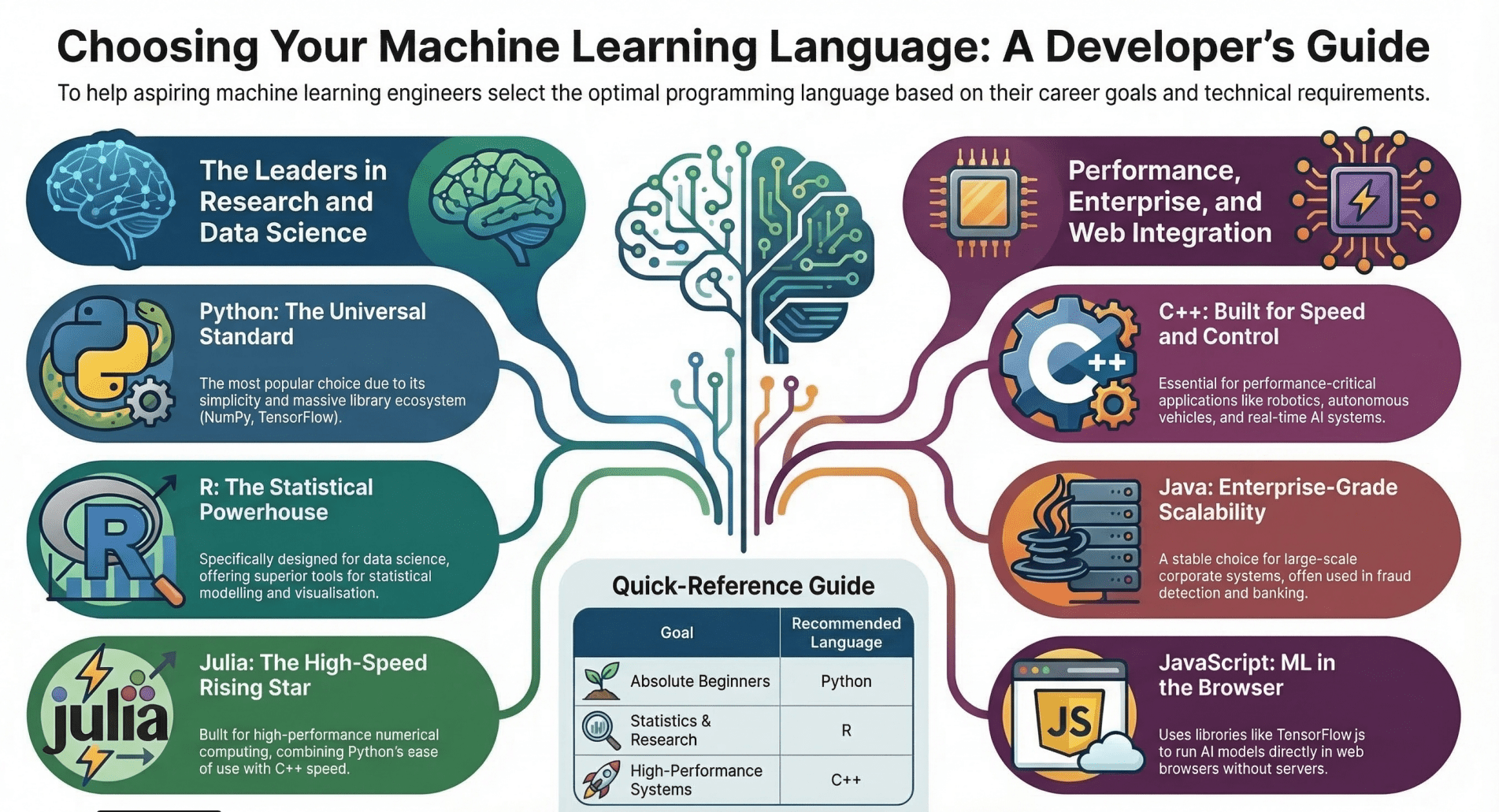
Why Programming Languages Matter in Machine Learning
Programming languages are the tools used to design, build, and deploy machine learning models. A good ML programming language should provide:
- Strong libraries and frameworks
- Good performance and scalability
- Community support
- Easy integration with other tools
The right language can make development faster and more efficient.
1. Python – The Most Popular Language for Machine Learning
The most widely used programming language for machine learning is Python.
Python dominates the machine learning ecosystem due to its simplicity, readability, and massive collection of ML libraries.
Why Python is Best for Machine Learning
- Easy to learn and beginner-friendly
- Large community support
- Thousands of machine learning libraries
- Strong integration with AI frameworks
Popular Python Libraries for Machine Learning
Some of the most powerful machine learning libraries include:
- NumPy – Numerical computing
- Pandas – Data analysis and manipulation
- Scikit-learn – Machine learning algorithms
- TensorFlow – Deep learning framework
- PyTorch – Neural network research framework
Companies Using Python for ML
Major companies rely on Python for machine learning development, including:
- Netflix
- Spotify
Use Cases
Python is widely used for:
- Data science
- Natural language processing
- Deep learning
- Computer vision
Because of its ecosystem, Python is usually the first choice for beginners learning machine learning.
- Ready to learn Python? Click here and begin your coding journey.
2. R – Best Language for Statistical Machine Learning
Another powerful language for machine learning and statistical computing is R.
R is widely used by statisticians and data scientists for data analysis and visualization.
Advantages of R
- Excellent statistical analysis capabilities
- Powerful visualization tools
- Designed specifically for data science
Popular R Libraries
- Caret – Machine learning models
- RandomForest – Random forest algorithms
- ggplot2 – Advanced data visualization
Use Cases
R is commonly used in:
- Academic research
- Data analysis
- Statistical modeling
- Bioinformatics
While Python is more popular in production environments, R remains a strong choice for statistical machine learning tasks.
3. Java – Enterprise Machine Learning Applications
Java is another important language in the machine learning ecosystem.
Java is widely used in large-scale enterprise systems because of its performance, scalability, and stability.
Advantages of Java for ML
- Platform independence
- Strong performance
- Suitable for large systems
Java ML Libraries
Popular Java machine learning tools include:
- Weka – Machine learning algorithms
- Deeplearning4j – Deep learning library
Use Cases
Java is often used in:
- Fraud detection systems
- Banking applications
- Recommendation engines
Because many enterprise systems are built in Java, integrating machine learning into those systems becomes easier.
- Interested in JAVA for beginners? Click here to explore.
4. C++ – High Performance Machine Learning
For performance-critical applications, developers often use C++.
C++ provides:
- High execution speed
- Low-level memory control
- Efficient resource management
Why C++ is Used in Machine Learning
Many machine learning frameworks are actually built using C++ because of its performance.
Examples include:
- TensorFlow (core components)
- OpenCV for computer vision
Use Cases
C++ is commonly used in:
- Robotics
- Game AI
- Real-time systems
- Autonomous vehicles
Although powerful, C++ has a steeper learning curve compared to Python.
5. Julia – The Rising Language for Machine Learning
A newer language gaining popularity in the ML community is Julia.
Julia was designed specifically for high-performance numerical computing.
Advantages of Julia
- Extremely fast performance
- Designed for scientific computing
- Simple syntax similar to Python
Julia Machine Learning Libraries
Examples include:
- Flux.jl – Deep learning framework
- MLJ.jl – Machine learning toolkit
Use Cases
Julia is used in:
- Scientific computing
- Financial modeling
- Research environments
Although still growing, Julia is considered one of the future languages for machine learning.
6. JavaScript – Machine Learning in the Browser
Most people associate JavaScript with web development, but it is also becoming popular in machine learning.
JavaScript allows developers to run ML models directly in the browser.
Popular JavaScript ML Libraries
- TensorFlow.js
- Brain.js
Advantages
- Runs ML models in the browser
- Enables AI-powered web apps
- No server required for some models
Use Cases
JavaScript ML is used for:
- Image recognition in web apps
- Browser-based AI tools
- Interactive AI applications
How to Choose the Right Machine Learning Language
Choosing the best language depends on your goals.
For Beginners
The best choice is:
- Python
Because it has:
- Simple syntax
- Massive ML ecosystem
- Beginner-friendly tutorials
For Data Science and Statistics
A good choice is:
- R
Especially for statistical modeling.
For High-Performance Systems
Better options include:
- C++
- Java
For Research and Scientific Computing
Consider:
- Julia
Machine Learning Tools Every Developer Should Learn
Along with programming languages, ML engineers should also learn important tools such as:
- Jupyter Notebook – Interactive ML development
- Git – Version control
- Docker – Containerization for ML deployment
These tools help manage machine learning workflows effectively.
Future of Programming Languages in Machine Learning
Machine learning continues to evolve rapidly. While Python currently dominates the ecosystem, other languages are gaining traction due to performance improvements and specialized features.
Trends shaping the future include:
- Faster ML frameworks
- AutoML platforms
- AI-assisted coding tools
- Edge machine learning
Developers who learn multiple ML languages will have a significant advantage in the future job market.
Final Thoughts
Choosing the right programming language is the first step toward building a successful machine learning career.
Among all available languages, Python remains the most popular choice due to its powerful ecosystem, ease of use, and extensive community support.
However, languages like R, Java, C++, and Julia also play important roles depending on the use case.
If you’re starting your machine learning journey, focus on learning Python first, build real projects, and gradually explore other languages as your expertise grows.
Machine learning is shaping the future of technology and the right programming language will help you build that future.
- Build intelligent systems and smart applications — start learning machine learning here.