
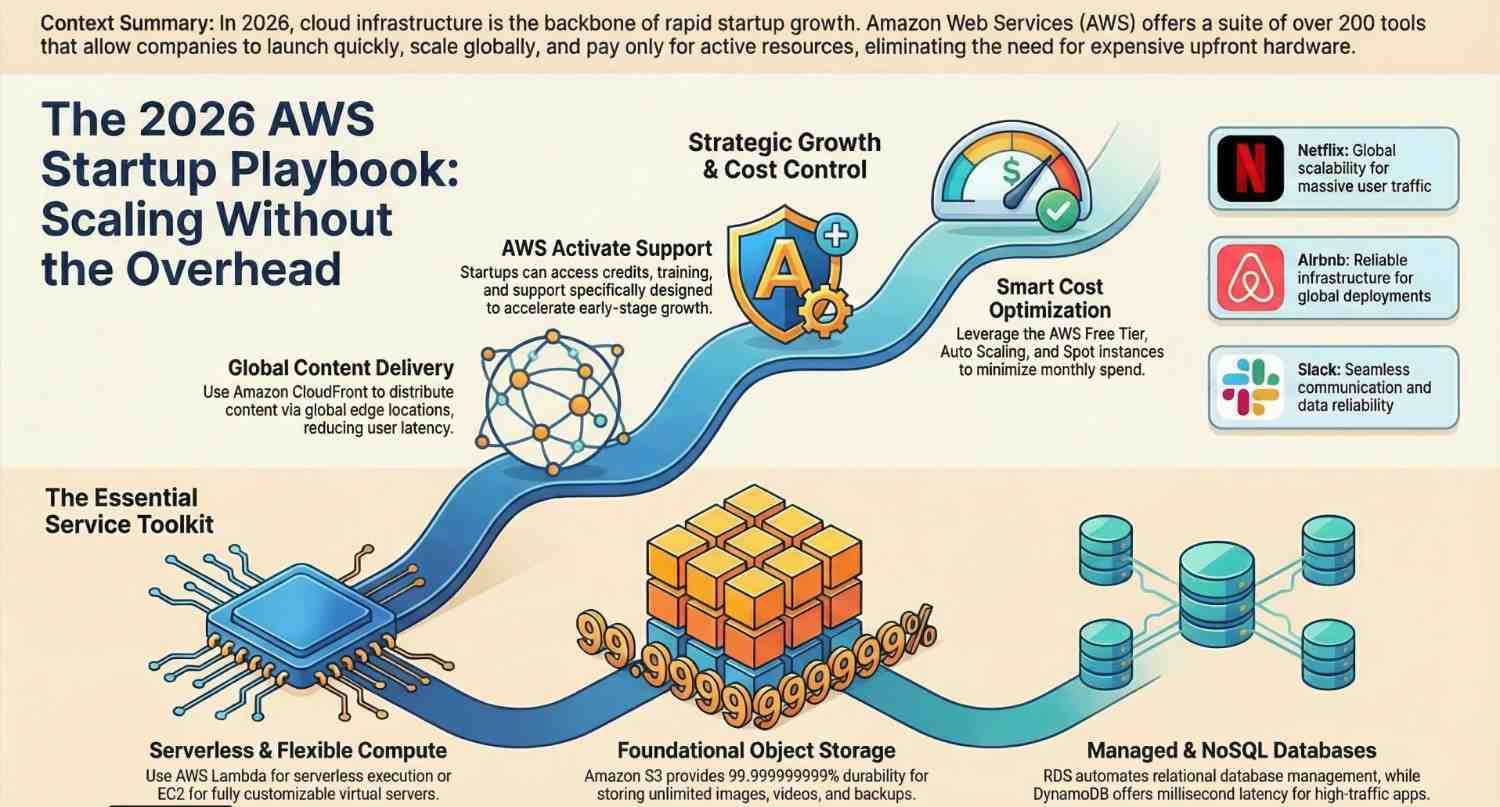
Startups in 2026 are growing faster than ever, and cloud infrastructure plays a major role in enabling that growth. Instead of investing in expensive servers and hardware, startups can now build scalable applications using cloud platforms like Amazon Web Services.
Amazon Web Services (AWS) provides over 200 cloud services including computing, storage, networking, machine learning, analytics, and security tools. Many successful startups rely on AWS because it allows them to launch products quickly, scale globally, and only pay for the resources they use.
In this guide, we will explore the best AWS services for startups in 2026, why they matter, and how they help companies build scalable and cost-effective cloud infrastructure.
Why Startups Choose AWS in 2026
Before exploring specific services, it’s important to understand why AWS remains one of the most popular cloud platforms for startups.
1. Pay-As-You-Go Pricing
Startups often operate on limited budgets. AWS allows companies to pay only for what they use instead of paying for expensive infrastructure upfront.
2. Global Infrastructure
AWS operates in multiple regions and availability zones around the world, enabling startups to deploy applications close to users and improve performance.
3. Scalability
Startups can start with small resources and scale automatically when traffic increases.
4. Startup Support Programs
Programs like AWS Activate provide credits, training, and support specifically for startups.
Key Categories of AWS Services for Startups
To understand the ecosystem better, AWS services can be divided into several categories:
- Compute services
- Storage services
- Database services
- Networking services
- Security services
- Machine learning services
- DevOps and monitoring tools
Let’s explore the most important services in each category.
1. Amazon EC2 – Flexible Cloud Computing
One of the most popular AWS services for startups is Amazon EC2.
EC2 (Elastic Compute Cloud) allows startups to run virtual servers in the cloud. Instead of purchasing physical machines, developers can launch instances within minutes.
Key Benefits
- Scalable virtual machines
- Multiple instance types for different workloads
- Full control over operating systems
- Easy integration with other AWS services
Use Cases
Startups use EC2 for:
- Hosting web applications
- Running backend services
- Hosting APIs
- Running machine learning workloads
EC2 is especially useful for startups that require flexibility and customization.
2. AWS Lambda – Serverless Computing
Serverless architecture has become extremely popular, and AWS Lambda is a core part of this movement.
Lambda allows developers to run code without managing servers. AWS automatically handles scaling, availability, and infrastructure.
Advantages
- No server management
- Automatic scaling
- Pay only for execution time
- Easy integration with other AWS services
Common Startup Use Cases
- API backends
- Event-driven systems
- Image processing
- Automation workflows
For startups looking to reduce operational complexity, Lambda is one of the best AWS services available.
3. Amazon S3 – Scalable Object Storage
Data storage is essential for every application. Amazon S3 is one of the most widely used storage services in the cloud.
Amazon S3 provides highly durable object storage that can store virtually unlimited data.
Features
- 99.999999999% durability
- Secure data storage
- Versioning and lifecycle management
- Global accessibility
Startup Use Cases
Startups commonly use S3 for:
- Storing images and videos
- Hosting static websites
- Data backups
- Data lakes for analytics
Because of its scalability and reliability, S3 is considered a foundational AWS service.
4. Amazon RDS – Managed Database Service
Databases are critical for most applications. Managing them manually can be difficult for startups.
Amazon RDS simplifies database management by providing fully managed relational databases.
Supported Databases
RDS supports several popular engines including:
- MySQL
- PostgreSQL
- MariaDB
- Oracle
- SQL Server
Benefits for Startups
- Automated backups
- High availability
- Automatic patching
- Easy scaling
Using RDS allows startups to focus on building products instead of managing infrastructure.
5. Amazon DynamoDB – Serverless NoSQL Database
For applications requiring high performance at scale, Amazon DynamoDB is a powerful solution.
DynamoDB is a fully managed NoSQL database designed for applications that need low latency and high throughput.
Key Features
- Single-digit millisecond latency
- Automatic scaling
- Built-in security
- Serverless architecture
Common Startup Use Cases
- Mobile applications
- Gaming platforms
- Real-time analytics
- IoT systems
Many large-scale applications rely on DynamoDB for performance and scalability.
6. Amazon CloudFront – Content Delivery Network
Application performance is critical for user experience.
Amazon CloudFront is a content delivery network (CDN) that distributes content across global edge locations.
Benefits
- Faster content delivery
- Reduced latency
- Built-in DDoS protection
- Improved application performance
Startups use CloudFront to deliver:
- Images
- Videos
- Web content
- APIs
7. AWS Elastic Beanstalk – Simplified Application Deployment
Deploying applications can be complex, especially for small teams.
AWS Elastic Beanstalk simplifies the process by automatically handling infrastructure management.
Supported Platforms
- Node.js
- Python
- Java
- PHP
- Ruby
- .NET
Advantages
- Automatic scaling
- Load balancing
- Monitoring
- Simplified deployment
Elastic Beanstalk allows developers to deploy applications quickly without worrying about infrastructure setup.
8. Amazon VPC – Secure Networking
Security and network isolation are essential for cloud infrastructure.
Amazon VPC allows startups to create isolated networks within AWS.
Key Features
- Private IP addressing
- Network access control
- Secure communication between services
- Custom routing configurations
VPC helps startups maintain secure and controlled cloud environments.
9. Amazon CloudWatch – Monitoring and Logging
Monitoring applications is essential for performance and reliability.
Amazon CloudWatch provides real-time monitoring, logging, and alerting.
Capabilities
- Monitor resource usage
- Track application logs
- Create custom alarms
- Analyze performance metrics
With CloudWatch, startups can detect issues early and maintain application stability.
10. AWS SageMaker – Machine Learning Platform
AI and machine learning are becoming essential for modern startups.
Amazon SageMaker enables developers to build, train, and deploy machine learning models at scale.
Benefits
- Managed ML infrastructure
- Prebuilt algorithms
- Scalable training
- Model deployment tools
Startups use SageMaker for:
- recommendation systems
- predictive analytics
- natural language processing
- computer vision applications
AWS Cost Optimization Tips for Startups
Even though AWS is flexible, startups should optimize costs.
Use the AWS Free Tier
The AWS free tier allows startups to experiment with services without paying.
Use Auto Scaling
Scale infrastructure based on demand to avoid paying for unused resources.
Monitor Usage
Use tools like CloudWatch to track resource consumption.
Choose the Right Pricing Models
Reserved instances and spot instances can significantly reduce costs.
Real-World Startups Using AWS
Many successful startups have built their infrastructure using AWS.
Some notable examples include:
- Airbnb
- Netflix
- Slack
These companies leverage AWS services to handle massive user traffic and deliver reliable applications worldwide.
Final Thoughts
Cloud computing has transformed how startups build and scale applications. With services like Amazon EC2, AWS Lambda, and Amazon S3, startups can build powerful infrastructure without large upfront investments.
In 2026, the ability to launch quickly, scale globally, and control costs is essential for startup success. AWS offers a comprehensive ecosystem that supports innovation, experimentation, and rapid growth.
By selecting the right AWS services, startups can focus on what truly matters building products, acquiring customers, and growing their business.