

Python is one of the most popular programming languages in the world. If you’re starting your coding journey, building projects is the best way to learn Python programming and improve your skills quickly.
Instead of only reading tutorials, beginners should try simple Python projects that teach real-world problem solving. In this guide, you’ll discover the top 10 Python projects for beginners that are easy to build and help you understand important Python concepts like variables, loops, functions, and file handling.
Whether you’re learning Python for web development, automation, or data science, these projects will help you build a strong foundation.
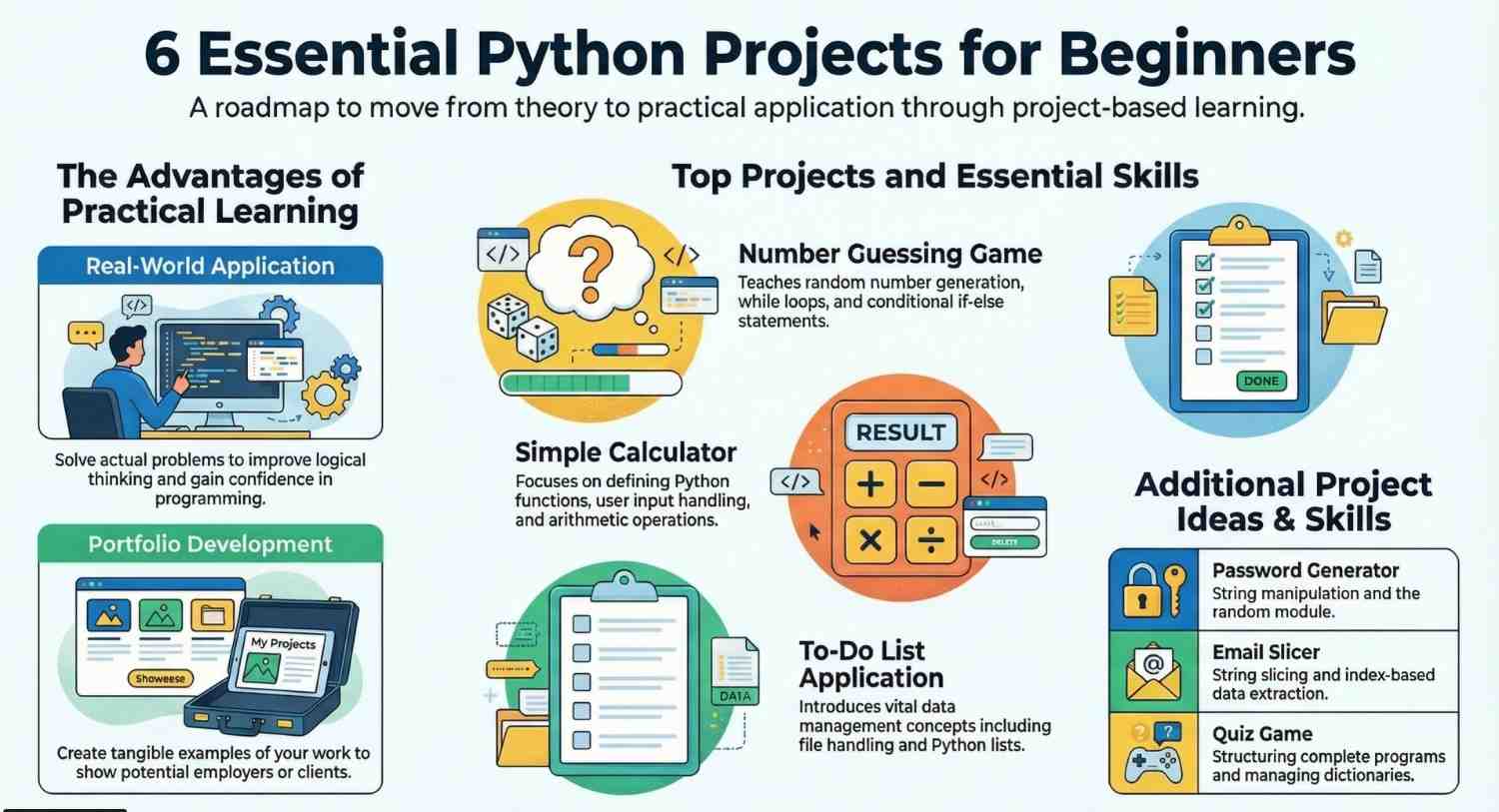
Why Beginners Should Build Python Projects
Many new programmers make the mistake of only watching tutorials. But coding projects helps you:
- Apply Python concepts in real scenarios
- Improve logical thinking and problem-solving
- Build a portfolio for jobs or freelancing
- Gain confidence in programming
If you want to learn Python fast, start building projects from day one.
1. Number Guessing Game
The Number Guessing Game is one of the best beginner Python projects because it teaches:
- Random number generation
- Loops
- Conditional statements
Project Idea
The computer selects a random number, and the user must guess the correct number within a limited number of attempts.
Skills You’ll Learn
randommodulewhileloopsif-elseconditions
Example Code
import random number = random.randint(1, 100) guess = None while guess != number: guess = int(input(“Guess a number between 1 and 100: “)) if guess number: print(“Too high!”) else: print(“Correct!”)This simple Python game helps beginners understand loops and conditions in Python.
2. Simple Calculator
A Python calculator project helps beginners understand how to work with functions and user input.
Features
- Addition
- Subtraction
- Multiplication
- Division
Skills You’ll Learn
- Python functions
- User input handling
- Conditional statements
Example Code
def add(a, b): return a + b def subtract(a, b): return a – b def multiply(a, b): return a * b def divide(a, b): return a / b num1 = float(input(“Enter first number: “)) num2 = float(input(“Enter second number: “)) print(“Addition:”, add(num1, num2)) print(“Subtraction:”, subtract(num1, num2)) print(“Multiplication:”, multiply(num1, num2)) print(“Division:”, divide(num1, num2))This project teaches the basics of Python functions and arithmetic operations.
3. To-Do List Application
A To-Do List project in Python is a great beginner project that helps you understand file handling and data storage.
Features
- Add tasks
- View tasks
- Delete tasks
Skills You’ll Learn
- Lists in Python
- File handling
- User interaction
This project can later be expanded into a GUI application using Tkinter.
4. Password Generator
A Python password generator creates strong passwords automatically.
Why This Project Is Useful
Cybersecurity is important, and this project teaches you how to generate random secure passwords.
Skills You’ll Learn
- Python
randommodule - String manipulation
- Loops
Example Code
import random import string length = 10 characters = string.ascii_letters + string.digits + string.punctuation password = ”.join(random.choice(characters) for i in range(length)) print(“Generated Password:”, password)This project introduces randomization and Python string libraries.
5. Contact Book
A Contact Book application stores and manages user contacts.
Features
- Add contact
- Search contact
- Delete contact
- View all contacts
Skills You’ll Learn
- Python dictionaries
- CRUD operations
- Data organization
This is one of the most practical Python beginner projects.
6. Random Story Generator
The Random Story Generator creates funny or creative stories using predefined words.
Example Concept
The program randomly picks:
- Character name
- Place
- Action
Skills You’ll Learn
- Lists
- Random selections
- String formatting
This is a fun Python project for beginners.
7. Dice Rolling Simulator
A Dice Rolling Simulator mimics rolling a real dice.
Skills You’ll Learn
- Random number generation
- Loops
- User interaction
Example Code
import random while True: input(“Press Enter to roll the dice”) print(“Dice:”, random.randint(1,6)) play_again = input(“Roll again? (y/n): “) if play_again != ‘y’: breakThis project helps beginners understand loops and randomness in Python.
8. Email Slicer
An Email Slicer project extracts the username and domain from an email address.
Example
Input:
[email protected]Output:
Username: john Domain: gmail.comExample Code
email = input(“Enter your email: “) username = email[:email.index(“@”)] domain = email[email.index(“@”)+1:] print(“Username:”, username) print(“Domain:”, domain)This project teaches Python string slicing and indexing.
9. Countdown Timer
A Countdown Timer in Python counts down from a given number of seconds.
Skills You’ll Learn
timemodule- Loops
- Formatting output
Example Code
import time seconds = int(input(“Enter seconds: “)) while seconds: mins, secs = divmod(seconds, 60) timer = f”{mins}:{secs}” print(timer) time.sleep(1) seconds -= 1 print(“Time’s up!”)This project helps beginners understand time-based programs in Python.
10. Quiz Game
A Python Quiz Game asks questions and tracks the user’s score.
Features
- Multiple questions
- Score tracking
- User input
Skills You’ll Learn
- Lists and dictionaries
- Conditional logic
- Game logic development
This project helps beginners understand how to structure a complete Python program.
Tips to Improve Your Python Projects
If you want to make these beginner Python projects better, try these improvements:
- Add error handling
- Create a GUI using Tkinter
- Store data in files or databases
- Upload your projects to GitHub
Building projects consistently is the fastest way to master Python programming.
Final Thoughts
Python is a powerful and beginner-friendly programming language. By building these top Python projects for beginners, you will learn essential programming concepts and gain real-world experience.
Start with small projects like the Number Guessing Game or Calculator, then gradually move to larger applications like To-Do Lists and Quiz Games.
The more projects you build, the faster you’ll become confident in Python development.
If you’re serious about learning Python, try to complete one project every week and continuously improve your code.
Happy coding!
- Ready to learn Python? Click here and begin coding today.




