
Cloud-native adoption has exploded, and with it, Kubernetes bills. While Kubernetes offers unmatched flexibility and scalability, many teams quickly realize that without cost discipline, it can quietly drain budgets.
This guide dives deep into real-world Kubernetes cost optimization strategies, packed with practical techniques, tools, and SEO-focused insights to help you reduce cloud spend without sacrificing performance.
Why Kubernetes Costs Spiral Out of Control
Before optimizing, it’s important to understand where costs come from:
- Over-provisioned resources (CPU/memory)
- Idle workloads and unused clusters
- Inefficient autoscaling
- Expensive storage and networking
- Lack of visibility into usage
Kubernetes doesn’t optimize costs by default it optimizes availability and scalability.
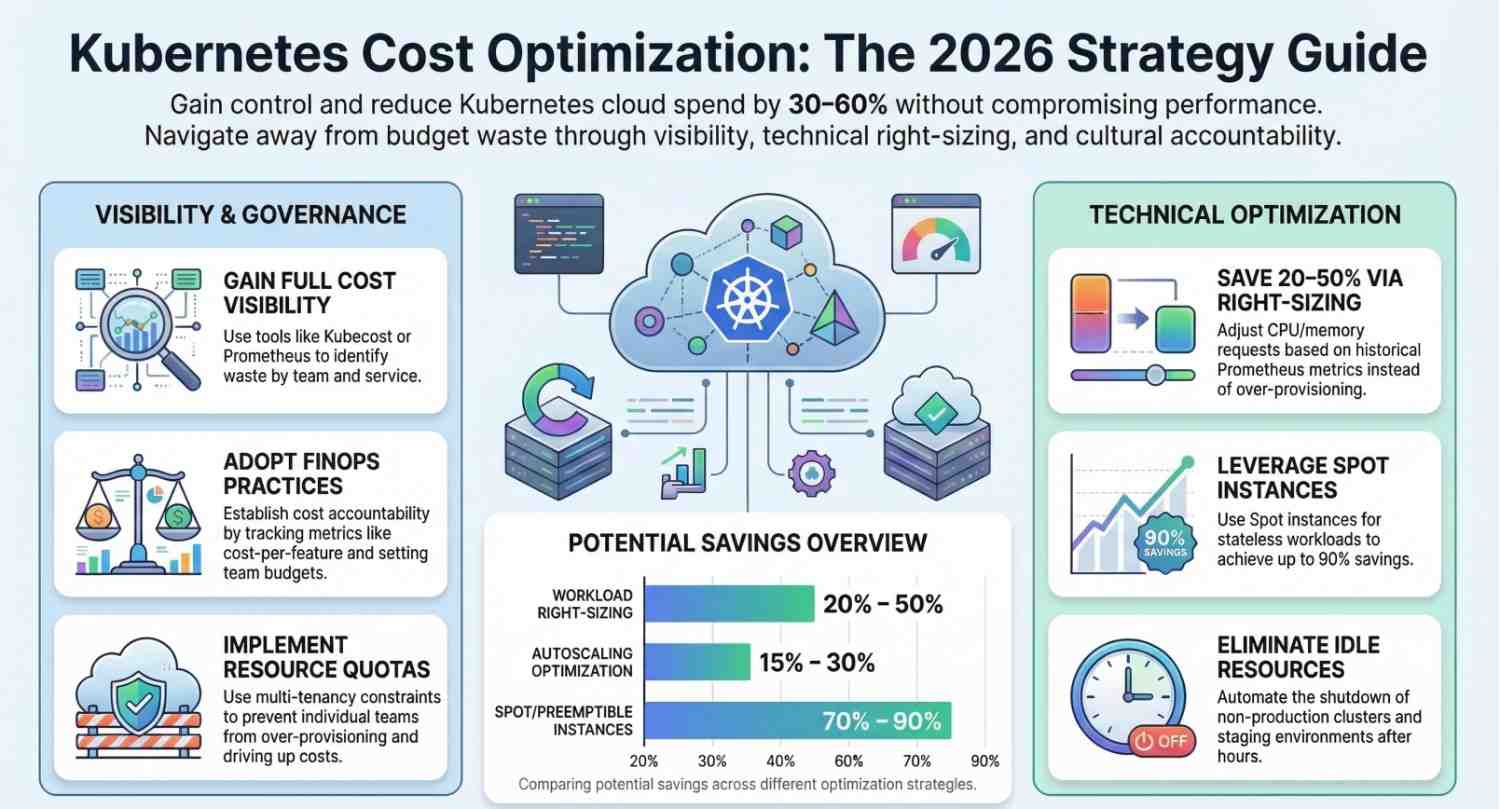
Step 1: Gain Full Cost Visibility
You can’t optimize what you can’t see.
Tools to use:
- Kubecost
- Prometheus
- Grafana
Best practices:
- Break down costs by namespace, team, and service
- Track cost per deployment
- Identify idle or zombie workloads
Real-world insight: Many teams discover 30–40% waste just by turning on cost monitoring.
Step 2: Right-Size Your Workloads
Over-provisioning is the #1 cost killer.
Common mistake:
resources: requests: cpu: “2” memory: “4Gi”…but actual usage is only 20%.
Fix:
- Use historical metrics from Prometheus
- Adjust requests/limits based on real usage
- Continuously review workloads
Pro tip:
Use tools like:
- Vertical Pod Autoscaler
Result: Save 20–50% on compute costs.
Step 3: Optimize Autoscaling (HPA + Cluster Autoscaler)
Autoscaling is powerful but misconfigured, it wastes money.
Key components:
- Horizontal Pod Autoscaler (HPA)
- Cluster Autoscaler
Strategy:
- Scale based on real metrics, not just CPU
- Integrate with OpenTelemetry for better signals
- Avoid aggressive scaling policies
Mistake to avoid:
- Scaling too quickly → unnecessary nodes spin up
Real-world result: Proper tuning reduces costs by 15–30%.
Step 4: Eliminate Idle Resources
Idle resources = pure waste.
What to look for:
- Unused namespaces
- Old dev/test environments
- Idle LoadBalancers
- Detached volumes
Solutions:
- Automate shutdown for non-prod clusters
- Use scheduled scaling (e.g., turn off at night)
Tools:
- Kubernetes CronJob
Example:
- A company saved $10K/month by shutting down staging clusters after hours.
Step 5: Optimize Storage Costs
Storage is often overlooked.
Common issues:
- Overuse of premium SSDs
- Unused persistent volumes
Best practices:
- Use cheaper storage tiers for non-critical workloads
- Delete unused PVCs regularly
- Compress logs
Bonus:
- Use lifecycle policies for backups
Step 6: Reduce Networking Costs
Networking costs can skyrocket in cloud environments.
Cost drivers:
- Cross-zone traffic
- External LoadBalancers
- Data egress
Optimization tips:
- Co-locate services to reduce cross-zone traffic
- Use internal services where possible
- Replace LoadBalancers with ingress controllers like:
- NGINX Ingress Controller
Real-world savings: Up to 25% reduction in networking costs.
Step 7: Use Spot / Preemptible Instances
One of the most powerful cost-saving strategies.
Benefits:
- Up to 70–90% cheaper than on-demand instances
Trade-offs:
- Instances can terminate anytime
Best use cases:
- Batch jobs
- Stateless workloads
- CI/CD pipelines
Tools:
- Karpenter
Pro tip:
Use a mixed node pool strategy (on-demand + spot).
Step 8: Adopt FinOps Practices
Cost optimization isn’t just technical it’s cultural.
Key practices:
- Set budgets per team
- Implement cost accountability
- Regular cost reviews
Metrics to track:
- Cost per request
- Cost per user
- Cost per feature
Step 9: Use Efficient CI/CD Pipelines
CI/CD pipelines often waste compute.
Optimize with:
- Argo CD
- Tekton
Tips:
- Avoid running full pipelines on every commit
- Use caching aggressively
- Clean up ephemeral environments
Step 10: Multi-Tenancy & Resource Quotas
Prevent teams from overusing resources.
Use:
- Resource quotas
- Limit ranges
Benefits:
- Fair usage
- Prevents runaway costs
Real-World Case Study
A mid-sized SaaS company running Kubernetes on AWS reduced costs by 45% in 3 months by:
- Implementing Kubecost
- Right-sizing workloads
- Moving 60% workloads to spot instances
- Eliminating idle clusters
Final Thoughts
Kubernetes cost optimization isn’t a one-time task it’s an ongoing process. The combination of visibility, automation, and cultural change delivers the best results.
If you implement even half of these strategies, you can realistically cut your Kubernetes bill by 30–60% without impacting performance.