
In a world increasingly powered by data and automation, decision-making is no longer a purely human domain. From recommending what movie you should watch next to helping doctors diagnose diseases, systems built on Artificial Intelligence are shaping choices at every level.
This raises an important question: Who actually makes better decisions AI or humans?
The answer isn’t as simple as choosing one over the other. It depends on context, complexity, and the type of decision being made. Let’s explore this in depth.
What Does “Good Decision-Making” Mean?
Before comparing, we need to define what a good decision is. Typically, it involves:
- Accuracy
- Speed
- Consistency
- Ethical consideration
- Adaptability
Both humans and AI excel in some of these areas but struggle in others.
How AI Makes Decisions
AI systems rely on algorithms, data, and models especially techniques from Machine Learning and Data Science.
How It Works:
- Analyze large datasets
- Identify patterns
- Make predictions or recommendations
For example:
- Fraud detection in banking
- Recommendation engines (Netflix, Amazon)
- Self-driving car navigation
Strengths of AI Decision-Making
1. Data-Driven Accuracy
AI can process millions of data points quickly, leading to highly informed decisions.
2. Speed
AI makes decisions in milliseconds far faster than humans.
3. Consistency
AI doesn’t get tired, emotional, or distracted.
4. Pattern Recognition
It can detect patterns humans might miss.
Limitations of AI
- Lack of common sense
- Dependence on data quality
- Bias in training data
- Limited ethical reasoning
AI doesn’t understand decisions it calculates them.
How Humans Make Decisions
Human decision-making is shaped by experience, intuition, and emotion.
Key Factors:
- Personal experience
- Emotional intelligence
- Social and cultural awareness
- Ethical reasoning
Strengths of Human Decision-Making
1. Emotional Intelligence
Humans understand feelings, relationships, and social cues.
2. Creativity & Intuition
We can make decisions even with incomplete data.
3. Ethical Judgment
Humans consider morality, fairness, and long-term impact.
4. Context Awareness
We adapt decisions based on situations and nuances.
Limitations of Humans
- Bias and subjectivity
- Emotional influence
- Limited data processing capacity
- Inconsistency
Humans don’t always make rational decisions.
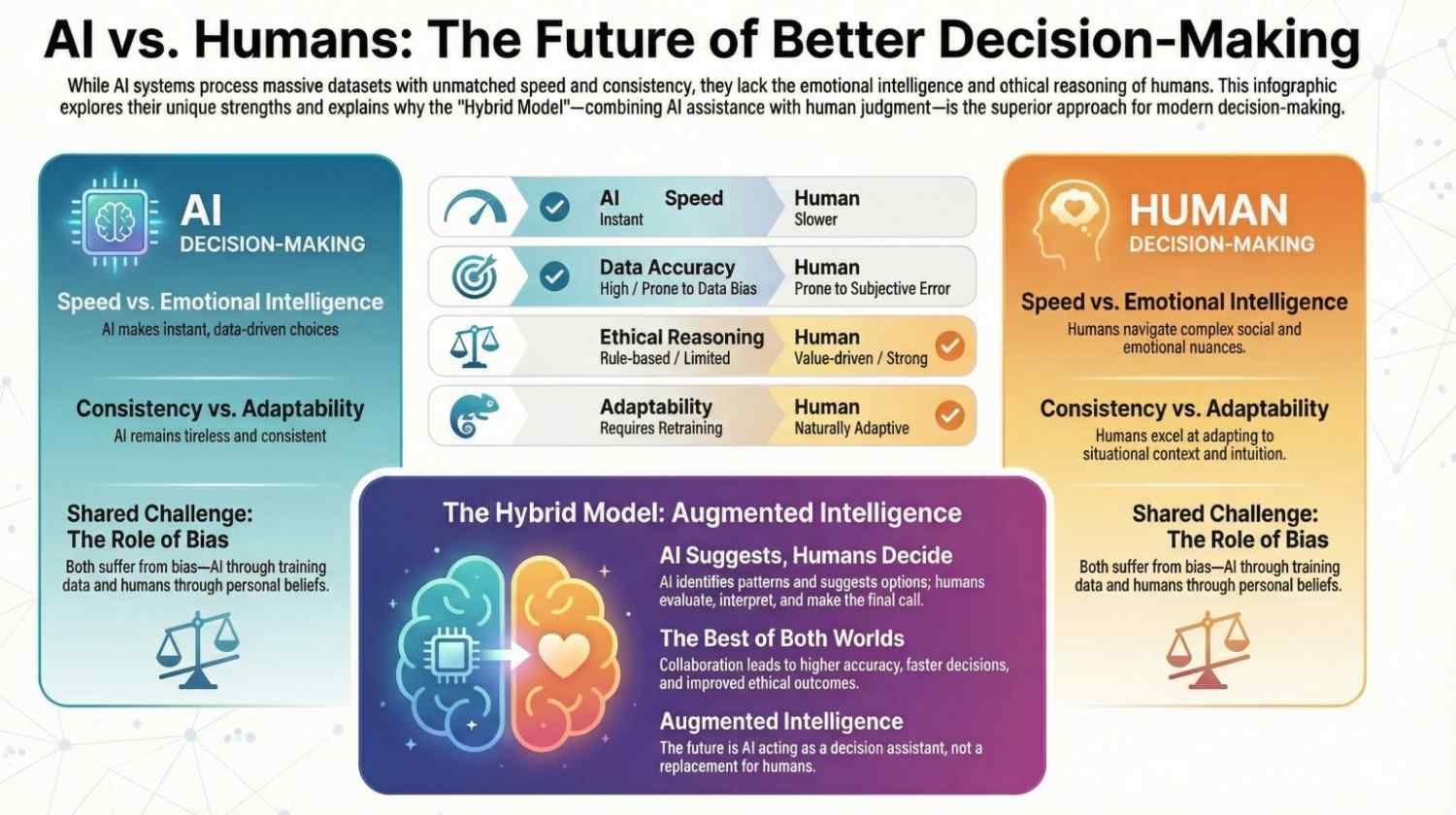
AI vs Humans: Side-by-Side Comparison
1. Speed
- AI: Instant
- Humans: Slower
Winner: AI
2. Accuracy (Data-Heavy Tasks)
- AI: High accuracy with good data
- Humans: Prone to error
Winner: AI
3. Emotional & Social Decisions
- AI: Limited
- Humans: Strong
Winner: Humans
4. Ethical Decisions
- AI: Rule-based, limited
- Humans: Value-driven
Winner: Humans
5. Consistency
- AI: Always consistent
- Humans: Varies
Winner: AI
6. Adaptability
- AI: Needs retraining
- Humans: Naturally adaptive
Winner: Humans
Real-World Examples
Healthcare
AI can analyze medical data and detect diseases faster.
But doctors (humans) make final decisions considering patient history and emotions.
Best approach: AI + Human collaboration
Finance
AI detects fraud instantly using patterns.
Humans handle complex financial decisions and ethical considerations.
Self-Driving Cars
AI reacts faster than humans.
But in ethical dilemmas (e.g., accident decisions), human judgment is still critical.
The Role of Bias
Both AI and humans suffer from bias but in different ways.
- Human Bias: Personal beliefs, emotions
- AI Bias: Biased training data
This makes fairness a shared challenge in decision-making.
The Hybrid Model: Best Decisions Come from Collaboration
The smartest organizations today don’t choose AI or humans they use both.
Example Workflow:
- AI analyzes data and suggests options
- Humans evaluate, interpret, and decide
This combination leads to:
- Better accuracy
- Improved ethics
- Faster decisions
Future of Decision-Making
As Artificial Intelligence continues to evolve, AI will become even more powerful in decision support.
However:
- Humans will remain essential for judgment and ethics
- AI will act as a decision assistant, not a replacement
We are moving toward a future of augmented intelligence, not artificial dominance.
Final Verdict: Who Makes Better Decisions?
AI is better at data-driven, fast, and repetitive decisions
Humans are better at emotional, ethical, and complex decisions
The Truth:
Neither is superior in all situations. The best decisions come from combining both.
Conclusion
Decision-making is no longer a battle between humans and machines. It’s a partnership.
With the power of Machine Learning and human intuition, we can make smarter, faster, and more responsible choices.
So instead of asking:
❌ “Who makes better decisions?”
Start asking:
✅“How can humans and AI make better decisions together?”
Dive into the world of AI click here.




