
Python has become one of the most popular programming languages in the world but is it actually a good choice for web development in 2026?
The short answer: Yes, Python is excellent for web development but it depends on what you’re building.
In this in-depth guide, we’ll explore:
- Where Python shines in web development
- Its limitations
- Popular frameworks
- Real-world use cases
- And whether you should choose it over alternatives
Why Python Is Used for Web Development
Python wasn’t originally designed just for web apps but its simplicity and flexibility made it a natural fit.
🔹 Key Reasons Developers Choose Python
1. Easy to Learn and Use
Python’s syntax is clean and beginner-friendly.
Example:
print(“Hello, World!”)Compared to other languages, Python reduces complexity making development faster.
2. Massive Ecosystem
Python has thousands of libraries for:
- Web development
- Databases
- Authentication
- APIs
This means you rarely build things from scratch.
3. Strong Community Support
Python has one of the largest developer communities in the world.
If you face a problem, chances are someone has already solved it.
4. Fast Development Speed
Python allows rapid prototyping.
Startups love this because:
- MVPs can be built quickly
- Features can be tested faster
Popular Python Web Frameworks
Frameworks make web development easier and structured. Python has some of the best.
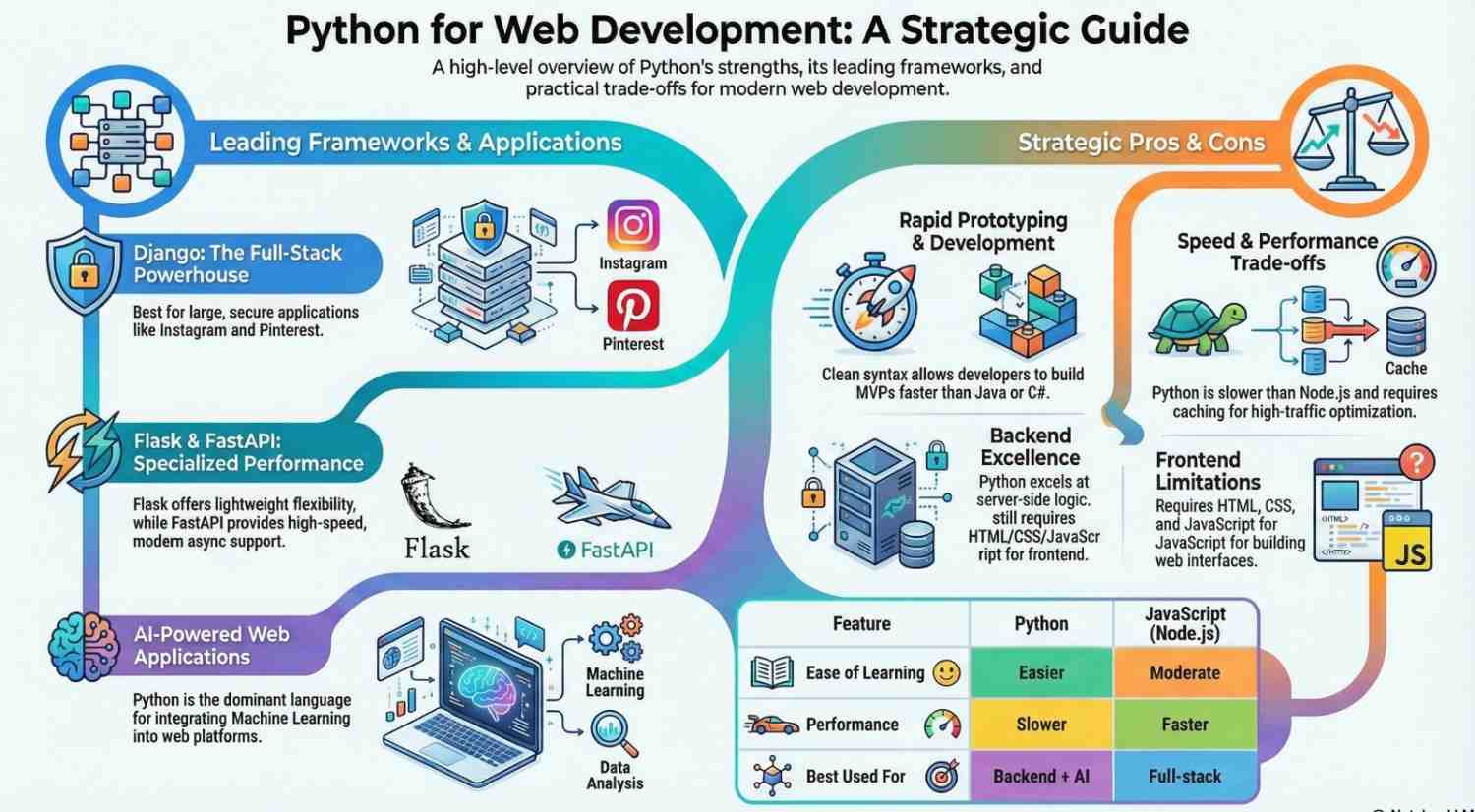
Django The Full-Stack Powerhouse
Django
Best For:
- Large applications
- Scalable platforms
- Secure web apps
Features:
- Built-in admin panel
- Authentication system
- ORM (database handling)
Used By:
If you want an “all-in-one” solution, Django is a top choice.
Flask Lightweight & Flexible
Flask
Best For:
- Small to medium apps
- APIs
- Microservices
Features:
- Minimal setup
- Highly customizable
Flask gives you freedom but requires more decisions.
FastAPI — Modern & High Performance
FastAPI
Best For:
- APIs
- High-performance backend services
Features:
- Very fast (comparable to Node.js)
- Built-in data validation
- Async support
FastAPI is becoming the go-to for modern backend systems.
What Can You Build with Python?
Python is versatile you can build almost anything web-related.
Types of Applications
- Blogs & CMS platforms
- E-commerce websites
- REST APIs
- SaaS applications
- AI-powered web apps
Real-World Examples
Some of the biggest platforms use Python:
- Instagram (backend with Django)
- Spotify (data + backend services)
- Dropbox (core infrastructure)
These prove Python can scale to millions of users.
Advantages of Python for Web Development
1. Rapid Development
Python reduces boilerplate code.
You build faster than with Java or C#
2. Beginner-Friendly
Perfect for:
- Students
- Career switchers
3. Great for AI Integration
Python dominates:
- Machine Learning
- AI
If your web app involves AI, Python is a huge advantage.
4. Strong Backend Capabilities
Handles:
- Databases
- APIs
- Authentication
Very efficiently.
5. Scalability (With the Right Setup)
With proper architecture, Python apps can scale globally.
Limitations of Python in Web Development
Let’s be honest Python is not perfect.
1. Slower Than Some Languages
Compared to:
- Node.js
- Go
Python can be slower due to its interpreted nature.
2. Not Ideal for Frontend
Python is mainly used for backend.
You’ll still need:
- HTML
- CSS
- JavaScript
3. Hosting Can Be Tricky
Some shared hosting platforms don’t support Python well.
4. High-Traffic Optimization Required
For large-scale apps:
- You need caching
- Load balancing
Python vs Other Web Technologies
Python vs JavaScript (Node.js)
| Feature | Python | JavaScript |
|---|---|---|
| Ease of Learning | Easier | Moderate |
| Performance | Slower | Faster |
| Backend | Excellent | Excellent |
| Frontend | No | Yes |
JavaScript is better for full-stack; Python is better for backend + AI.
Python vs Java
- Python: Faster development
- Java: Better performance
Python wins for startups; Java wins for enterprise systems.
Python vs PHP
- Python: Cleaner, modern
- PHP: Widely used in legacy systems
Python is more future-proof.
Is Python Good for Web Development in 2026?
Absolutely Python is still a strong choice.
Why It’s Still Relevant
- Growing demand for AI-powered apps
- Rise of APIs and microservices
- Strong frameworks like FastAPI
Python Web Development in India
Python demand is increasing rapidly.
Common Roles:
- Backend Developer
- API Developer
- Full Stack Developer
Salary Range:
- Freshers: ₹3 – ₹6 LPA
- Mid-level: ₹6 – ₹15 LPA
- Senior: ₹15+ LPA
Combining Python with DevOps or AI can significantly increase salary.
When Should You Choose Python?
Choose Python if:
- You are a beginner
- You want fast development
- You are building APIs
- You plan to integrate AI
When You Should Avoid Python
Avoid Python if:
- You need ultra-high performance (real-time apps)
- You want frontend-only development
- You are building heavy real-time systems like gaming engines
How to Start Web Development with Python
Step-by-Step Roadmap:
- Learn Python basics
- Understand HTML, CSS, JavaScript
- Pick a framework:
- Django (full-stack)
- Flask (simple apps)
- FastAPI (APIs)
- Build projects:
- Blog app
- REST API
- Deploy your app
Future of Python in Web Development
- More async frameworks (FastAPI growth)
- AI-powered web apps
- Increased cloud integration
Python is evolving not fading.
Final Verdict
So, is Python good for web development?
Yes but with context.
Best For:
- Backend development
- APIs
- AI-integrated applications
Not Ideal For:
- Frontend
- Ultra high-performance systems
Final Thought
Python is not just “good” it’s strategically powerful when used in the right place.
If you combine:
- Python
- Web frameworks
- Cloud/DevOps
You’ll have one of the most in-demand skill sets in tech today.
- Ready to learn Python? Your journey starts here.




