
The UI/UX design field in India has grown rapidly over the last decade, driven by the explosion of digital products, startups, and global tech expansion. Whether it’s a fintech app, an e-commerce platform, or a SaaS dashboard, companies are investing heavily in user experience. This demand has created a common and important question among aspiring designers:
Do degree holders earn more than self-taught UI/UX designers in India?
The answer isn’t as straightforward as it might seem. While education plays a role, it’s not the only factor influencing salary. Skills, portfolio, experience, and business impact often outweigh formal qualifications in this field.
Let’s break it down in detail.
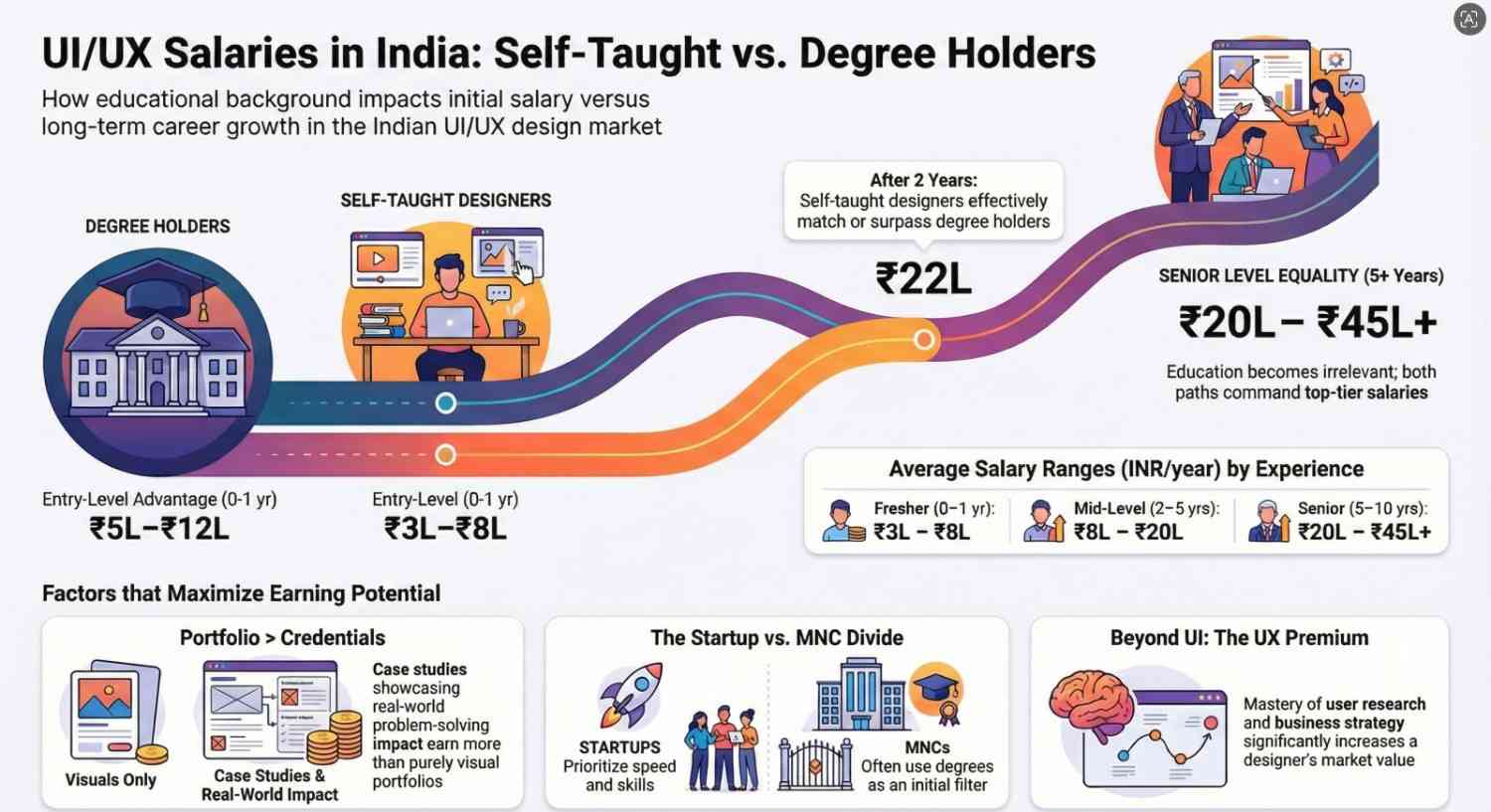
Understanding UI vs UX Roles First
Before diving into salary comparisons, it’s important to understand the distinction:
- UI Designers (User Interface) focus on visual elements colors, typography, layout, and overall aesthetics.
- UX Designers (User Experience) work on usability, research, user journeys, and product functionality.
In many Indian companies, especially startups, these roles are merged into a single UI/UX Designer position.
The Indian UI/UX Salary Landscape
In India, salaries vary widely based on:
- City (Bangalore, Chennai, Pune, Hyderabad)
- Company type (startup vs MNC)
- Skill level
- Experience
Here’s a general salary range:
| Experience Level | Salary Range (INR/year) |
|---|---|
| Fresher (0–1 yr) | ₹3L – ₹8L |
| Mid-Level (2–5 yrs) | ₹8L – ₹20L |
| Senior (5–10 yrs) | ₹20L – ₹45L+ |
Now, let’s compare how self-taught designers vs degree holders fit into this.
Who Are Self-Taught UI/UX Designers?
Self-taught designers learn through:
- Online courses
- YouTube tutorials
- Bootcamps
- Practice projects
- Freelancing
They often use tools like Figma, Adobe XD, and Sketch to build real-world skills.
Advantages of Self-Taught Designers
1. Practical Skill Focus
They tend to focus heavily on hands-on work and real projects.
2. Faster Entry into Industry
No need to spend 3–4 years in a formal degree.
3. Strong Portfolio Orientation
Their success depends on showcasing real work, making portfolios stronger.
4. Adaptability
They often stay updated with the latest tools and trends.
Who Are Degree Holder Designers?
Degree holders usually come from:
- Design schools (NID, IIT, private institutes)
- Bachelor’s in Design (B.Des)
- Human-Computer Interaction (HCI) programs
Advantages of Degree Holders
1. Structured Learning
They understand design theory, psychology, and research deeply.
2. Strong Foundation in UX Thinking
User research, usability testing, and design systems are often well covered.
3. Campus Placements
Institutions often provide direct access to companies.
4. Brand Value of Colleges
Top institutions carry credibility.
Salary Comparison: Self-Taught vs Degree Holders
Entry-Level (0–2 Years)
Degree Holders:
- ₹5L – ₹12L (especially from top colleges)
- Better chances in campus placements
Self-Taught Designers:
- ₹3L – ₹8L
- Depends heavily on portfolio quality
Verdict:
Degree holders often start with higher salaries initially.
Mid-Level (2–5 Years)
Degree Holders:
- ₹10L – ₹20L
- Growth depends on performance
Self-Taught Designers:
- ₹8L – ₹22L
- Can surpass degree holders with strong portfolios
Verdict:
The gap starts shrinking significantly.
Senior Level (5+ Years)
Degree Holders:
- ₹20L – ₹40L+
Self-Taught Designers:
- ₹20L – ₹45L+
Verdict:
At this stage, skills and impact matter more than education.
What Actually Determines Salary (More Than Degree)
1. Portfolio Quality
A strong portfolio matters more than a degree.
Employers look for:
- Case studies
- Problem-solving approach
- Real-world impact
2. Tool Mastery
Knowledge of tools like:
- Figma
- Adobe XD
- Sketch
…can significantly influence hiring decisions.
3. UX Thinking & Research Skills
Designers who can:
- Conduct user research
- Analyze data
- Improve user journeys
…often earn more than purely visual designers.
4. Company Type
Top companies pay significantly higher salaries.
Examples include:
- Zoho
- Infosys
- TCS
Product-based companies and startups usually pay more than service-based firms.
5. Communication & Business Understanding
Designers who understand:
- Business goals
- Product strategy
- Stakeholder communication
…often move faster into higher-paying roles.
Real-World Hiring Trends in India
Here’s what’s actually happening in the industry:
Startups Prefer Skills Over Degrees
Most startups don’t care about degrees they care about:
- Portfolio
- Speed
- Problem-solving
MNCs May Prefer Degrees Initially
Large companies sometimes use degrees as a filtering criterion.
Freelancing Rewards Skill Only
Clients don’t ask for degrees they want results.
Challenges Faced by Each Group
Self-Taught Designers
- Harder to get first job
- No structured guidance
- Need to prove credibility
Degree Holders
- Expensive education
- Sometimes lack practical exposure
- May rely too much on academic projects
How Self-Taught Designers Can Close the Salary Gap
If you’re self-taught, here’s how to compete:
1. Build Case Study-Based Portfolio
Show real problem-solving, not just visuals.
2. Work on Real Projects
Freelance, internships, or personal projects.
3. Learn UX Research
Go beyond UI design.
4. Network Actively
LinkedIn, communities, design events.
5. Specialize
Example: SaaS UX, mobile UX, fintech UX.
How Degree Holders Can Maximize Salary
If you have a degree:
1. Focus on Practical Skills
Don’t rely only on theory.
2. Build Industry-Level Portfolio
Not just academic work.
3. Learn Modern Tools
Stay updated with tools like Figma.
4. Gain Real Experience Early
Internships and live projects matter.
The Big Truth: Degree vs Skill
Here’s the reality of the UI/UX industry:
- A degree helps you start faster
- Skills help you grow faster
- Portfolio helps you earn more
After 3–5 years, no one cares whether you are self-taught or degree holder.
They care about:
- What you’ve built
- How you think
- What impact you created
Final Verdict
So, who earns more?
- Short-term: Degree holders
- Long-term: Whoever has better skills and portfolio
UI/UX design is one of the few careers where self-taught designers can reach top salaries without formal education.
Conclusion
The Indian UI/UX industry is becoming increasingly merit-driven. While a degree can give you a head start, it’s not a guarantee of long-term success. Self-taught designers may start slower, but they often catch up and even surpass degree holders through strong portfolios and real-world experience.
If you’re choosing between the two paths, the best approach is simple:
Learn deeply, build consistently, and focus on solving real user problems.
Because in the end, design is not about where you learned it’s about what you can create.
- Curious about UI/UX? Tap here to begin.