
Generative AI is no longer just a buzzword it’s reshaping how marketers create content, analyze data, and scale campaigns. From writing blog posts to generating images and automating customer interactions, this technology is becoming a core part of modern digital marketing.
In this guide, you’ll learn how generative AI works, broken down in simple terms, and how marketers can actually use it to gain a competitive edge.
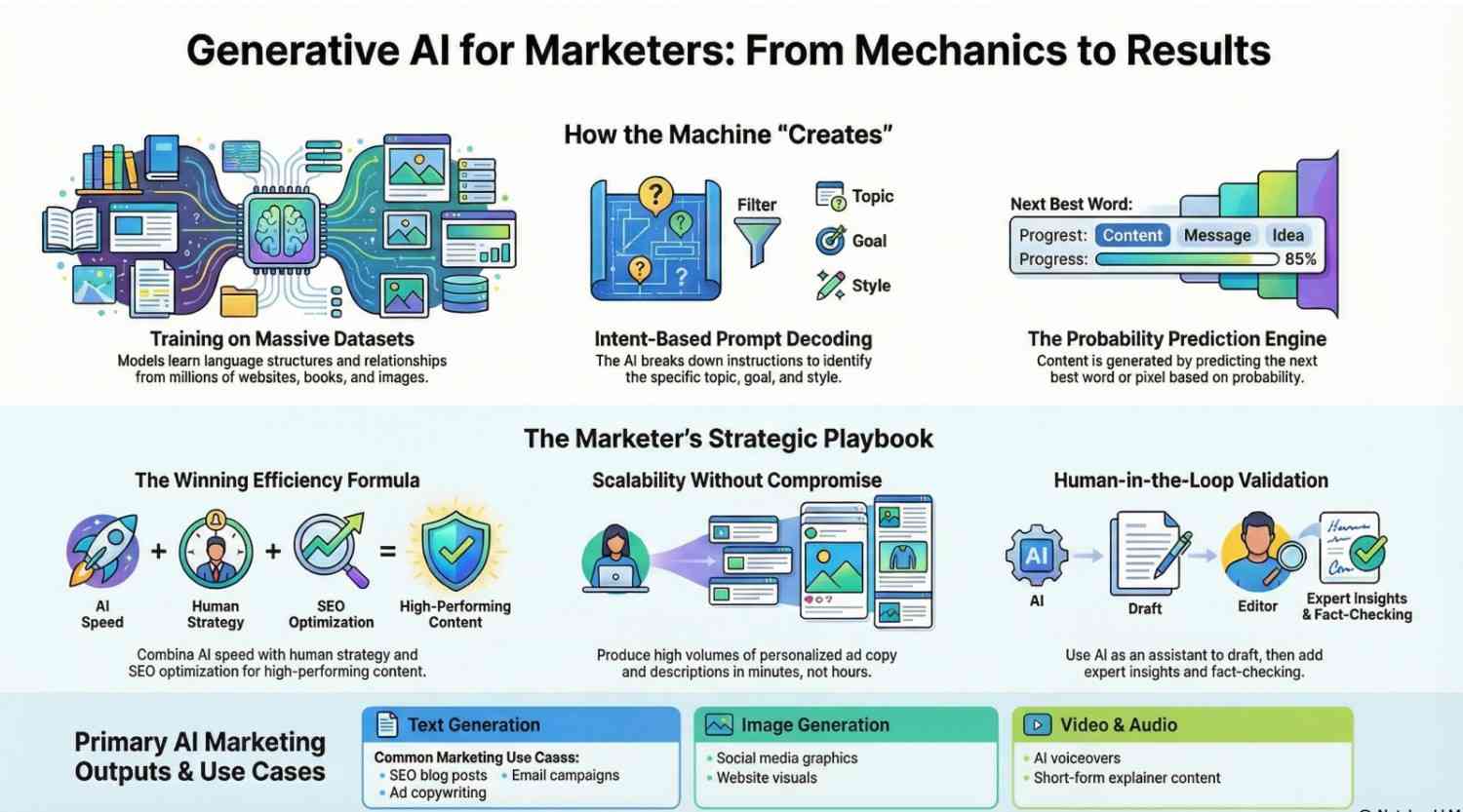
What is Generative AI?
Generative AI refers to artificial intelligence systems that can create new content including text, images, audio, and video based on patterns learned from existing data.
Unlike traditional AI, which focuses on analyzing or predicting, generative AI produces original outputs that mimic human creativity.
Examples include:
- Writing blog posts
- Creating ad copy
- Generating product descriptions
- Designing visuals
- Producing chat responses
Why Marketers Should Care
Generative AI helps marketers:
- Scale content production quickly
- Reduce costs
- Personalize campaigns
- Improve SEO performance
- Test multiple variations of content
In short, it allows you to do more in less time, without sacrificing quality if used correctly.
The Core Concept: How Generative AI Works
At its core, generative AI works through three main steps:
1. Training on Massive Data
AI models are trained on huge datasets that include:
- Websites
- Books
- Articles
- Images
- Conversations
The model learns patterns, language structures, and relationships between words or elements.
Think of it like a marketer who has read millions of blog posts and ads.
2. Understanding Prompts
When you give AI a prompt (instruction), it:
- Breaks down your input
- Identifies intent
- Predicts what kind of response is expected
For example:
“Write an SEO blog intro about email marketing”
The AI understands:
- Topic → email marketing
- Goal → blog intro
- Style → SEO-friendly
3. Generating Output (Prediction Engine)
Generative AI doesn’t “think” like humans it predicts the next best word or element based on probability.
It generates content step-by-step:
- Word by word (for text)
- Pixel by pixel (for images)
This is why prompts matter so much the better your input, the better the output.
Key Technologies Behind Generative AI
1. Large Language Models (LLMs)
These models power AI writing tools.
They:
- Understand language context
- Generate human-like text
- Adapt tone and style
2. Neural Networks
Inspired by the human brain, neural networks help AI:
- Recognize patterns
- Learn relationships
- Improve over time
3. Transformers (The Game Changer)
Transformer architecture allows AI to:
- Understand context better
- Process entire sentences (not just word-by-word sequences)
- Generate more coherent responses
How Generative AI Creates Content (Step-by-Step Example)
Let’s say you ask AI:
“Write a product description for running shoes”
Here’s what happens:
- It identifies keywords: product, running shoes, description
- It recalls patterns from similar content
- It predicts structure:
- Headline
- Features
- Benefits
- It generates text aligned with marketing intent
All this happens in seconds.
Types of Generative AI Marketers Use
Text Generation
- Blog posts
- Emails
- Ads
- Social media captions
Image Generation
- Ad creatives
- Social media graphics
- Website visuals
Video & Audio
- AI voiceovers
- Short-form videos
- Explainer content
Real-World Marketing Use Cases
1. SEO Content Creation
Generate:
- Blog posts
- Meta descriptions
- Keyword ideas
Tip: Always edit AI content to add originality and expertise.
2. Ad Copywriting
Create multiple variations of:
- Facebook ads
- Google Ads
- Landing page headlines
3. Email Marketing
AI can:
- Personalize subject lines
- Write full campaigns
- Segment messaging
4. Social Media Content
Generate:
- Daily posts
- Hooks
- Hashtags
5. Product Descriptions
Especially useful for:
- E-commerce stores
- Large inventories
Benefits of Generative AI for Marketers
Speed & Efficiency
Create content in minutes instead of hours.
Scalability
Produce content at scale without hiring large teams.
Cost Reduction
Lower content production costs.
Personalization
Tailor content to different audience segments.
Limitations You Must Know
Generative AI is powerful but not perfect.
Lack of Original Thinking
AI generates based on existing patterns, not true creativity.
Possible Inaccuracies
Sometimes it produces incorrect or outdated information.
Generic Content Risk
Without editing, content may feel repetitive or bland.
Best Practices for Marketers
1. Use AI as an Assistant, Not a Replacement
Combine:
- AI speed
- Human creativity
2. Write Better Prompts
Instead of:
“Write a blog”
Use:
“Write a 1000-word SEO blog on email marketing for beginners with examples”
3. Add Human Expertise
Include:
- Case studies
- Personal insights
- Real data
4. Optimize for SEO
Ensure:
- Keyword placement
- Internal linking
- Proper headings
5. Fact-Check Content
Always verify important claims before publishing.
The Future of Generative AI in Marketing
Generative AI will continue to evolve in areas like:
- Hyper-personalization
- Voice search optimization
- AI-driven customer journeys
- Automated campaign management
Marketers who adopt early will gain a significant competitive advantage.
Final Thoughts
Generative AI is transforming marketing by making content creation faster, smarter, and more scalable. But the real power lies in how you use it.
The winning formula is simple:
AI + Human Strategy + SEO Optimization = High-Performing Content
If you treat generative AI as a tool not a replacement you’ll unlock its full potential and stay ahead in the digital marketing game.
- Curious about Generative AI? Click here and unlock its potential.