
Artificial intelligence is transforming marketing but terms like Generative AI, Machine Learning, and Deep Learning are often used interchangeably. While they’re related, they’re not the same.
Understanding the differences isn’t just technical knowledge it helps you choose the right tools, strategies, and investments for your marketing efforts.
This guide breaks everything down in simple terms, with practical examples tailored for marketers.
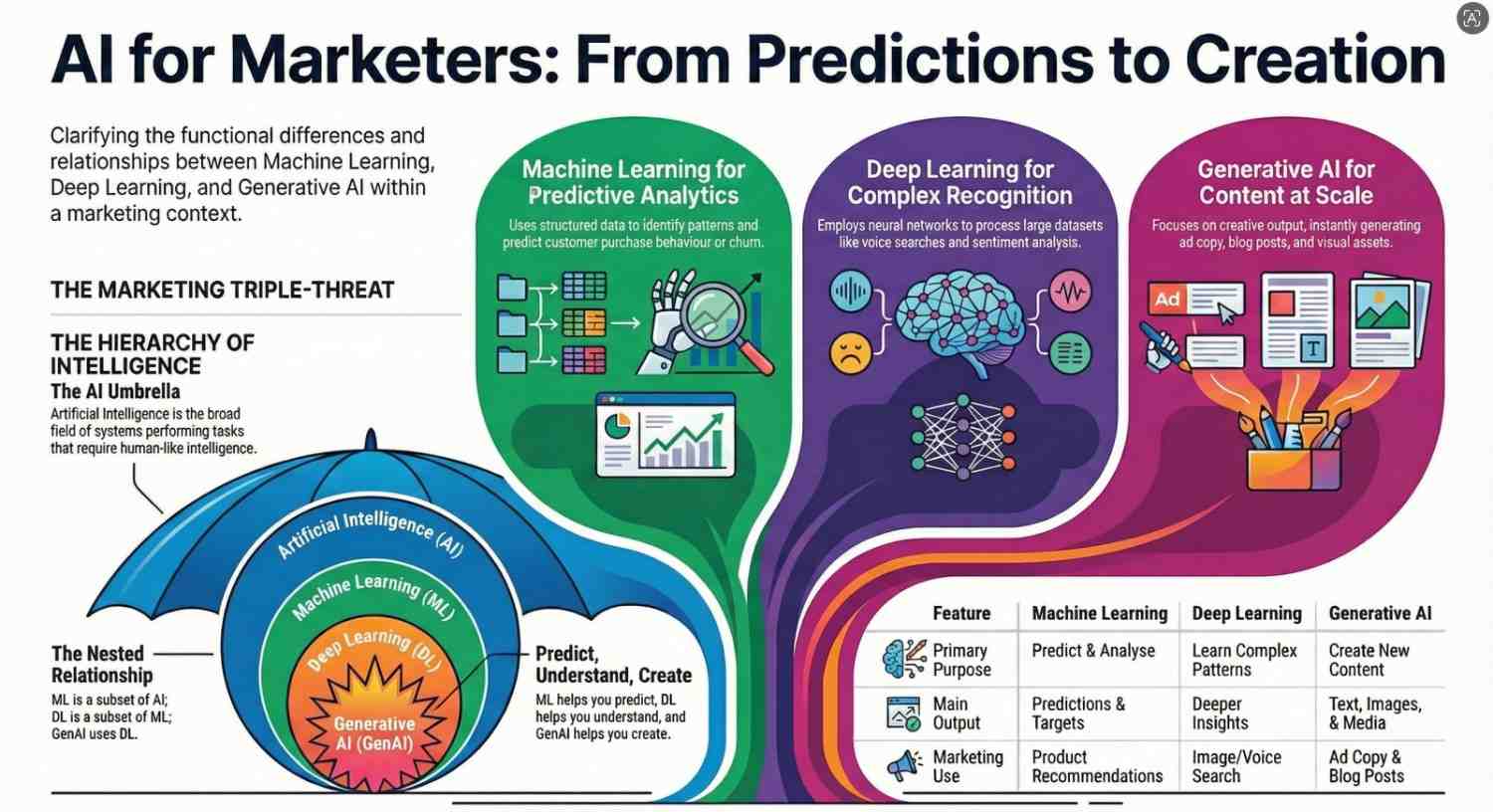
What is Artificial Intelligence (AI)?
Before diving in, let’s clarify the big picture.
Artificial Intelligence (AI) is the broad field of creating systems that can perform tasks that normally require human intelligence, such as:
- Understanding language
- Recognizing patterns
- Making decisions
Within AI, there are subsets:
- Machine Learning (ML)
- Deep Learning (DL)
- Generative AI (GenAI)
Think of it like this:
AI = The umbrella
ML = A subset of AI
DL = A subset of ML
Generative AI = A specialized application (often powered by DL)
What is Machine Learning?
Machine Learning is a type of AI where systems learn from data instead of being explicitly programmed.
How it works:
- You provide data
- The system identifies patterns
- It makes predictions based on those patterns
Example:
If you run an e-commerce store:
- ML can predict which products customers are likely to buy
- It can recommend items based on past behavior
Common Marketing Uses:
- Customer segmentation
- Recommendation engines
- Predictive analytics
- Email targeting
Key idea:
Machine Learning = Learning from data to make decisions or predictions
What is Deep Learning?
Deep Learning is a more advanced form of Machine Learning that uses neural networks inspired by the human brain.
What makes it different?
- It processes large amounts of data
- It automatically learns complex patterns
- It doesn’t need as much manual feature selection
Example:
- Image recognition (detecting objects in photos)
- Voice assistants understanding speech
- Language translation
Marketing Applications:
- Voice search optimization
- Image-based product search
- Sentiment analysis from customer reviews
Key idea:
Deep Learning = Advanced Machine Learning using neural networks
What is Generative AI?
Generative AI is a type of AI that creates new content instead of just analyzing data.
What it can generate:
- Blog posts
- Ad copy
- Images
- Videos
- Code
How it works:
Generative AI uses Deep Learning models (like large language models) to:
- Understand context
- Predict what comes next
- Generate human-like outputs
Example:
You give a prompt:
“Write a product description for a smartwatch”
It generates original content instantly.
Marketing Applications:
- SEO blog writing
- Ad copy creation
- Social media content
- Email campaigns
Key idea:
Generative AI = Creating new content using AI
Key Differences (Simple Comparison)
| Feature | Machine Learning | Deep Learning | Generative AI |
|---|---|---|---|
| Purpose | Predict & analyze | Learn complex patterns | Create new content |
| Data Usage | Structured data | Large & complex data | Massive training datasets |
| Human Input | Moderate | Low | Depends on prompts |
| Output | Predictions | Insights | Text, images, media |
| Examples | Product recommendations | Image recognition | Blog writing, AI art |
Relationship Between Them
Here’s the simplest way to understand it:
- Machine Learning is the foundation
- Deep Learning is a more powerful version of ML
- Generative AI uses Deep Learning to create content
Think of it like:
- ML = Learning
- DL = Deep understanding
- GenAI = Creative output
Real-World Marketing Example
Let’s say you run a digital marketing campaign.
Using Machine Learning:
- Predict which audience will convert
- Optimize ad targeting
Using Deep Learning:
- Analyze customer sentiment from reviews
- Understand voice search queries
Using Generative AI:
- Create ad copy
- Generate blog posts
- Design creatives
Together, they form a powerful marketing system.
Benefits for Marketers
1. Better Decision-Making
- ML helps you predict trends
- DL helps you understand behavior
2. Content at Scale
- Generative AI allows massive content creation
3. Personalization
- Tailor content and recommendations for each user
4. Automation
- Reduce manual effort across campaigns
Limitations to Consider
Machine Learning
- Requires clean, structured data
- Needs human guidance
Deep Learning
- Data-intensive
- Requires computational power
Generative AI
- Can produce inaccurate content
- Needs human editing
- Risk of generic outputs
When to Use What (Marketing Perspective)
Use Machine Learning when:
- You want predictions
- You analyze customer data
- You optimize campaigns
Use Deep Learning when:
- You work with images, voice, or large datasets
- You need deeper insights
Use Generative AI when:
- You create content
- You scale marketing output
- You need speed and creativity
SEO Perspective: Why This Matters
Understanding these differences helps you:
Improve Content Strategy
- Use GenAI for content creation
- Use ML for keyword insights
Boost Rankings
- Combine AI tools with human expertise
Scale Faster
- Automate repetitive SEO tasks
Future Trends
The future of AI in marketing is a combination of all three:
- AI-generated personalized websites
- Real-time content creation
- Predictive + creative automation
- AI-driven SEO strategies
Marketers who understand these technologies will have a huge competitive advantage.
Final Thoughts
Let’s simplify everything:
- Machine Learning helps you predict
- Deep Learning helps you understand deeply
- Generative AI helps you create
The real power comes when you combine all three.
Instead of choosing one, smart marketers use:
Data (ML) + Intelligence (DL) + Creativity (GenAI)
That’s how modern marketing wins.
- Want to explore Machine Learning? Click here to learn more.
- Want to explore AI? Click here to learn more.