
Deep learning is one of the most exciting and transformative technologies of our time. From voice assistants that understand your commands to recommendation systems that know what you want to watch next, deep learning is quietly shaping the way we interact with the digital world. But what exactly is deep learning, and how does it work?
In this beginner-friendly guide, we’ll break down deep learning into simple concepts, explore how it differs from traditional machine learning, and understand why it has become so powerful.
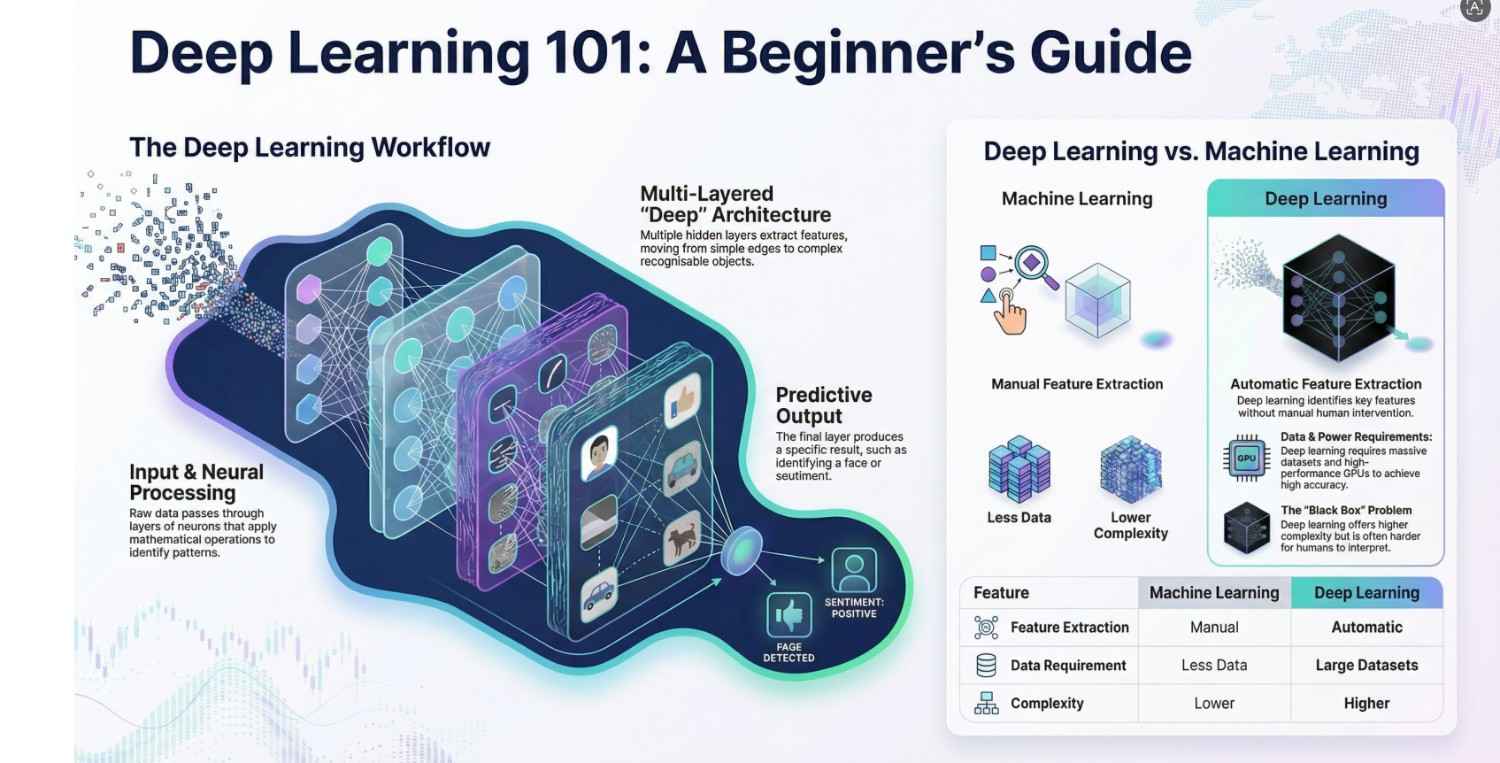
What is Deep Learning?
Deep learning is a subset of machine learning that uses structures called neural networks to learn from data. These neural networks are inspired by the human brain, which is made up of billions of interconnected neurons.
In simple terms, deep learning allows computers to learn patterns directly from raw data such as images, text, or audio without needing explicit programming for every task.
For example:
- Recognizing faces in photos
- Translating languages
- Detecting spam emails
- Powering chatbots and virtual assistants
All of these are made possible using deep learning.
Why is it Called “Deep” Learning?
The word “deep” refers to the number of layers in a neural network.
A basic neural network might have:
- An input layer
- One hidden layer
- An output layer
But deep learning models have multiple hidden layers, sometimes dozens or even hundreds. These layers allow the model to learn increasingly complex patterns.
Think of it like this:
- First layer: detects simple features (edges in an image)
- Middle layers: detect shapes or objects
- Final layers: recognize complex structures (like a face)
The deeper the network, the more complex the patterns it can learn.
How Does Deep Learning Work?
At its core, deep learning involves three main steps:
1. Input Data
The model receives raw data such as:
- Images
- Text
- Audio
2. Processing Through Layers
The data passes through multiple layers of neurons. Each neuron:
- Takes input values
- Applies a mathematical operation
- Passes the result to the next layer
3. Output Prediction
Finally, the model produces an output, such as:
- “This is a cat”
- “This email is spam”
- “Positive sentiment”
Understanding Neural Networks
A neural network is the backbone of deep learning.
Key Components:
1. Neurons
Each neuron is a small mathematical function that processes input and produces output.
2. Weights and Biases
These are parameters the model learns during training. They determine how important each input is.
3. Activation Functions
Activation functions decide whether a neuron should “fire” or not. Common examples include:
- ReLU (Rectified Linear Unit)
- Sigmoid
- Tanh
What is Training in Deep Learning?
Training is the process of teaching a neural network to make accurate predictions.
Here’s how it works:
- The model makes a prediction
- The prediction is compared to the actual result
- The error (called loss) is calculated
- The model adjusts its weights to reduce the error
This process repeats many times until the model becomes accurate.
This adjustment process is powered by an algorithm called backpropagation.
Deep Learning vs Machine Learning
Although deep learning is part of machine learning, there are key differences:
| Feature | Machine Learning | Deep Learning |
|---|---|---|
| Feature Extraction | Manual | Automatic |
| Data Requirement | Less data | Large datasets |
| Performance | Moderate | High (with enough data) |
| Complexity | Lower | Higher |
In traditional machine learning, humans must manually define features. In deep learning, the model automatically learns them.
Popular Deep Learning Frameworks
To build deep learning models, developers use specialized tools and libraries. Some popular ones include:
- TensorFlow – Developed by Google, widely used in production
- PyTorch – Popular among researchers and beginners
- Keras – Easy-to-use high-level API
These frameworks simplify the process of building and training neural networks.
Types of Deep Learning Models
Different types of neural networks are used for different tasks:
1. Feedforward Neural Networks
The simplest type where data flows in one direction.
2. Convolutional Neural Networks (CNNs)
Used mainly for image processing tasks like:
- Image recognition
- Object detection
3. Recurrent Neural Networks (RNNs)
Designed for sequential data such as:
- Text
- Speech
4. Transformers
Modern architectures used in advanced language models for tasks like translation and text generation.
Real-World Applications of Deep Learning
Deep learning is everywhere. Here are some real-world examples:
1. Healthcare
- Disease detection from medical images
- Drug discovery
2. Finance
- Fraud detection
- Algorithmic trading
3. Entertainment
- Movie recommendations
- Music suggestions
4. Autonomous Vehicles
- Self-driving cars use deep learning to understand surroundings
5. Natural Language Processing
- Chatbots
- Language translation
- Text summarization
Advantages of Deep Learning
- High accuracy for complex tasks
- Automatic feature extraction
- Works well with large datasets
- Can handle unstructured data like images and text
Challenges of Deep Learning
Despite its power, deep learning has some limitations:
1. Requires Large Data
Deep learning models need huge datasets to perform well.
2. Computationally Expensive
Training models often requires powerful GPUs.
3. Lack of Interpretability
It’s often difficult to understand how the model makes decisions (also called the “black box” problem).
4. Overfitting
Models may perform well on training data but poorly on new data.
Future of Deep Learning
The future of deep learning is incredibly promising. Some trends to watch include:
- More efficient models requiring less data
- Integration with other technologies like robotics
- Advances in explainable AI
- Growth of multimodal systems (text + image + audio)
As computing power increases and data becomes more available, deep learning will continue to evolve and impact industries worldwide.
How to Get Started with Deep Learning
If you’re a beginner, here’s a simple roadmap:
- Learn Python programming
- Understand basic mathematics (linear algebra, probability)
- Study machine learning fundamentals
- Start with frameworks like PyTorch or TensorFlow
- Work on small projects (e.g., image classifier)
Consistency and practice are key.
Final Thoughts
Deep learning is a powerful technology that enables machines to learn from data in ways that were once thought impossible. While it may seem complex at first, understanding its basic concepts can open the door to countless opportunities.
Whether you want to build intelligent applications, work in AI research, or simply understand how modern technology works, deep learning is a great place to start.