
Aptitude rounds are often the first and most crucial filter in IT placements. No matter how strong your coding skills are, failing to clear the aptitude round means you won’t even get a chance to showcase them. The good news? Aptitude is highly learnable with the right strategy, consistency, and practice.
This roadmap will guide you step-by-step on how to prepare for aptitude effectively, even if you’re starting from scratch.
Why Aptitude Matters in IT Placements
Most IT companies use aptitude tests to evaluate:
- Problem-solving ability
- Logical thinking
- Numerical accuracy
- Time management skills
These tests are designed to quickly filter candidates, so speed and accuracy matter more than deep theoretical knowledge.
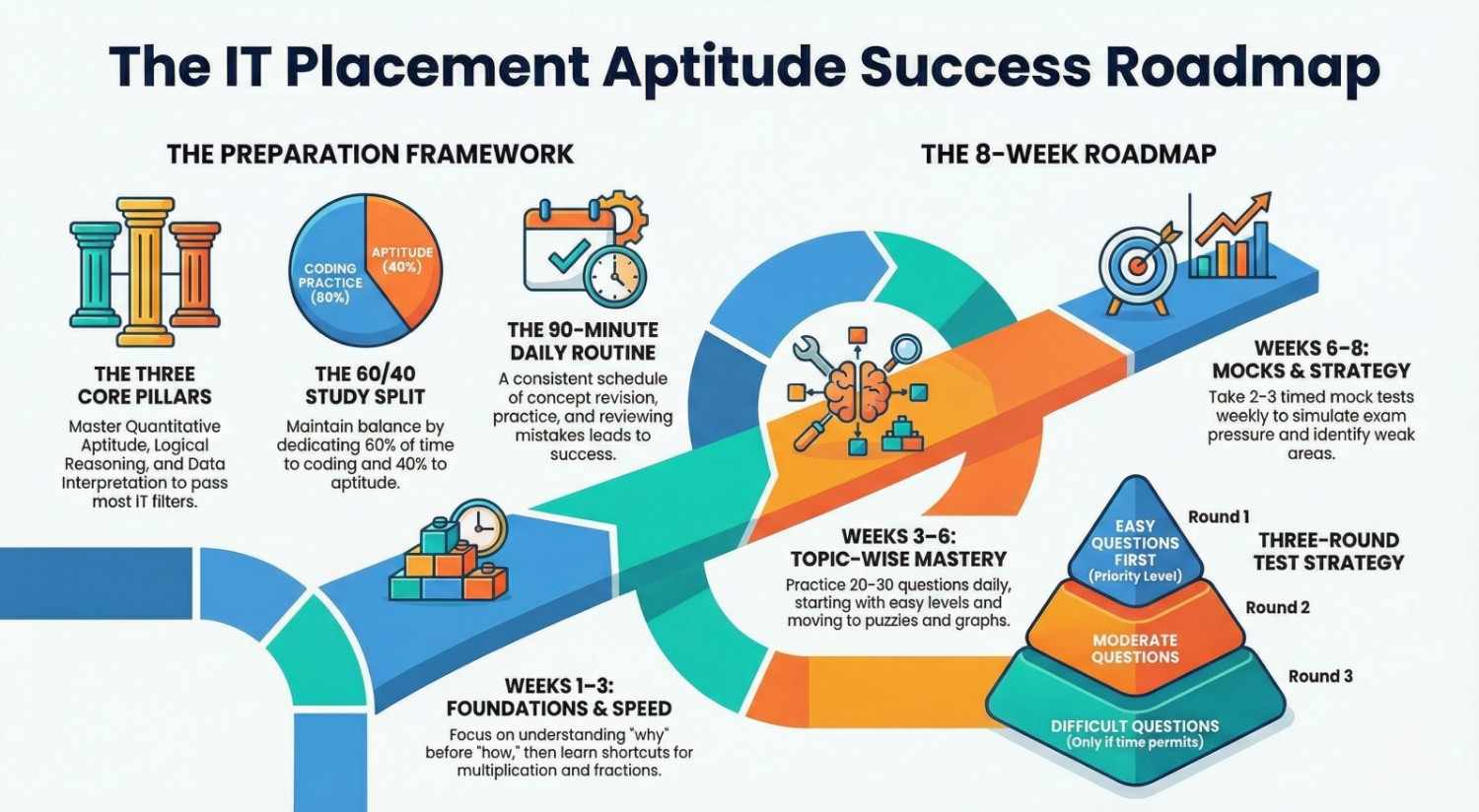
Step 1: Understand the Aptitude Syllabus
Before starting preparation, you need clarity on what to study. IT aptitude tests typically include three main sections:
1. Quantitative Aptitude
- Percentages
- Profit and Loss
- Time and Work
- Time, Speed, and Distance
- Ratios and Proportions
- Averages
- Number Systems
2. Logical Reasoning
- Seating Arrangements
- Puzzles
- Coding-Decoding
- Blood Relations
- Series (number/alphabet)
3. Data Interpretation
- Bar graphs
- Pie charts
- Tables
- Line graphs
Focus first on understanding the structure before jumping into practice.
Step 2: Build Strong Fundamentals (Week 1–2)
If your basics are weak, shortcuts won’t help. Start with concept clarity.
What to do:
- Learn formulas and basic concepts
- Solve simple problems slowly
- Focus on understanding “why,” not just “how”
Example:
Instead of memorizing percentage tricks, understand:
- What is 10% of a number?
- How percentage relates to fractions
Goal:
Build confidence in solving basic-level questions without confusion.
Step 3: Learn Shortcuts and Tricks (Week 2–3)
Once fundamentals are clear, speed becomes important.
Focus Areas:
- Multiplication shortcuts
- Percentage-to-fraction conversions
- Square and cube tricks
- Approximation techniques
Why this matters:
Aptitude tests are time-bound. Solving faster gives you a huge advantage.
Tip:
Don’t overuse tricks blindly use them only when you fully understand them.
Step 4: Topic-Wise Practice (Week 3–5)
Now it’s time to practice extensively.
Strategy:
- Pick one topic per day
- Solve 20–30 questions
- Start with easy → medium → hard
Example Plan:
- Day 1: Percentages
- Day 2: Profit and Loss
- Day 3: Time and Work
- Day 4: Logical puzzles
Key Rule:
Consistency beats intensity. Daily practice matters more than occasional long sessions.
Step 5: Focus on Logical Reasoning (Parallel Practice)
Many students underestimate reasoning but it’s equally important.
How to prepare:
- Practice puzzles daily
- Learn patterns in coding-decoding
- Use diagrams for seating arrangements
Tip:
Logical reasoning improves with exposure. The more questions you solve, the better you get.
Step 6: Master Data Interpretation (Week 5–6)
Data Interpretation (DI) tests both speed and accuracy.
Approach:
- Start with simple graphs
- Practice calculation-heavy questions
- Learn approximation techniques
Common mistake:
Spending too much time on one DI set. Always move on if stuck.
Step 7: Take Timed Mock Tests (Week 6 onwards)
This is where real preparation begins.
Why mocks are important:
- Simulate real exam conditions
- Improve time management
- Identify weak areas
Strategy:
- Take 2–3 mock tests per week
- Analyze mistakes after each test
- Track your progress
Important:
Mock analysis is more important than the test itself.
Step 8: Analyze and Improve Weak Areas
After every mock test:
- Identify topics where you made mistakes
- Re-learn concepts if needed
- Practice similar questions
Example:
If you struggle with time and work:
- Revisit formulas
- Solve 10–15 extra questions
Goal:
Turn weak areas into strengths.
Step 9: Develop a Test Strategy
Having knowledge isn’t enough you need a smart test strategy.
Key Tips:
- Attempt easy questions first
- Skip time-consuming questions
- Avoid guesswork if there’s negative marking
- Keep track of time
Ideal Approach:
- First round: Solve easy questions
- Second round: Attempt moderate ones
- Final round: Try difficult ones (if time permits)
Step 10: Daily Practice Routine (Recommended)
Here’s a simple daily schedule:
- 20 minutes: Concept revision
- 30 minutes: Quant practice
- 20 minutes: Logical reasoning
- 20 minutes: Data interpretation
- 10 minutes: Review mistakes
Total: ~1.5–2 hours daily
Even 60–90 minutes consistently can give great results.
Common Mistakes to Avoid
1. Ignoring Basics
Jumping directly to shortcuts without understanding concepts leads to confusion.
2. Lack of Practice
Reading solutions is not enough you must solve questions yourself.
3. Poor Time Management
Spending too long on one question can ruin your score.
4. Skipping Mock Tests
Mocks are essential to understand real exam pressure.
5. Not Analyzing Mistakes
Without analysis, improvement is slow.
Tips to Boost Your Performance
- Practice mental math daily
- Learn tables up to 20
- Revise formulas regularly
- Stay consistent
- Stay calm during tests
7-Day Revision Plan Before Exam
Day 1–2:
Revise quantitative topics
Day 3–4:
Practice logical reasoning
Day 5:
Focus on data interpretation
Day 6:
Take full-length mock tests
Day 7:
Light revision + rest
How to Balance Aptitude with Coding
Many students struggle to manage both.
Ideal split:
- 60% time on coding
- 40% time on aptitude
Tip:
Practice aptitude daily, even if for a short duration.
Final Thoughts
Aptitude preparation is not about solving thousands of questions randomly. It’s about:
- Understanding concepts
- Practicing consistently
- Improving speed and accuracy
- Learning from mistakes
If you follow this roadmap for 6–8 weeks with discipline, you can significantly improve your chances of clearing IT placement aptitude rounds.
Remember: aptitude is not difficult it just requires the right approach.
Bonus: Quick Checklist
- ✔ Know all important topics
- ✔ Practice daily
- ✔ Learn shortcuts
- ✔ Take mock tests
- ✔ Analyze mistakes
- ✔ Improve weak areas
- Prepare smarter. Start here.