DevOps is no longer just a buzzword it’s the backbone of modern software development. In 2026, organizations that adopt DevOps effectively are shipping faster, scaling better, and staying competitive in an increasingly digital world.
But here’s the catch:
Many teams say they “do DevOps,” yet struggle with slow deployments, frequent failures, and poor collaboration.
Why? Because they miss the core foundations.
In this guide, we’ll break down the 5 pillars of DevOps every engineer must master and more importantly, how to apply them in real-world scenarios.
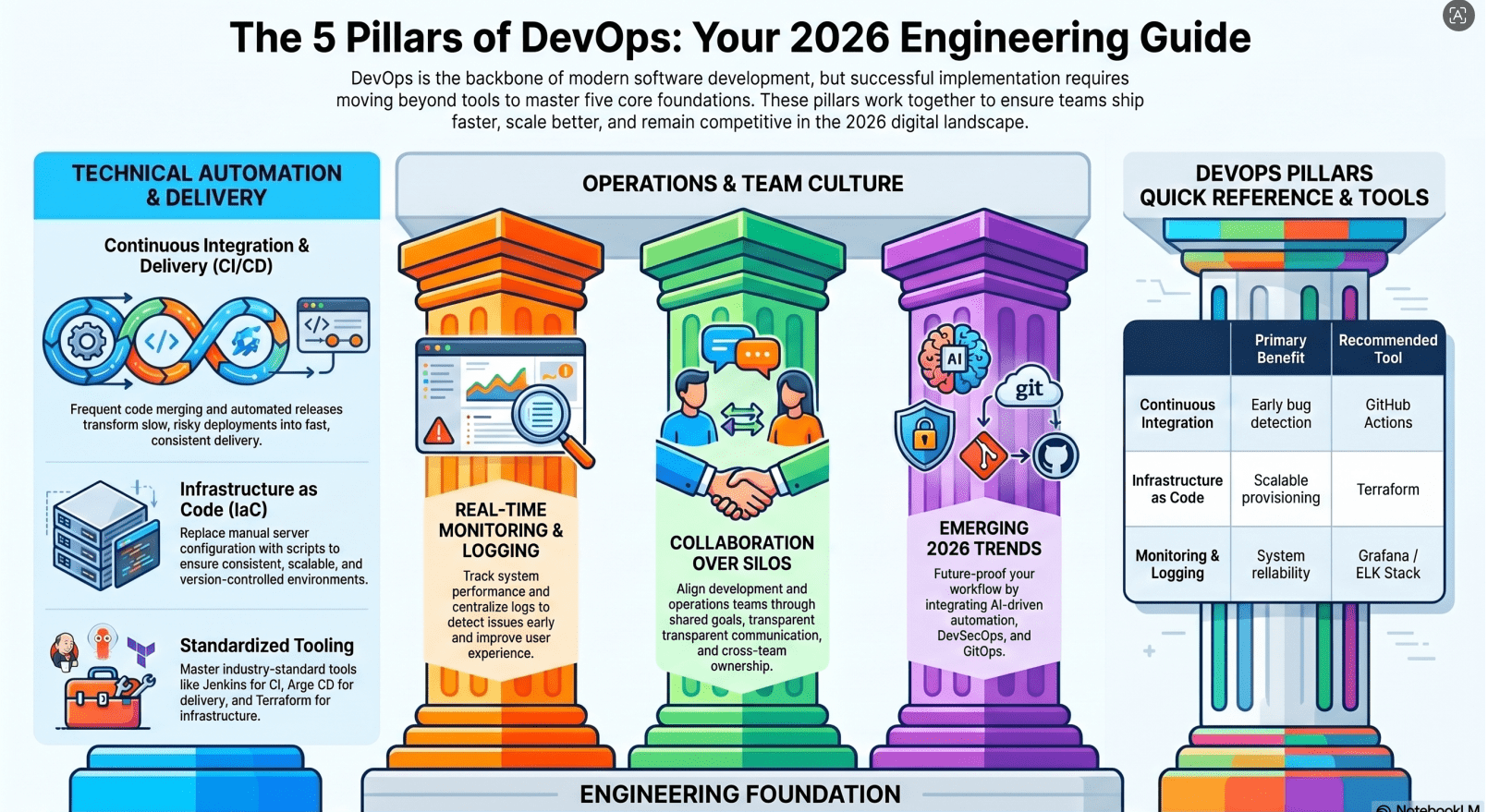
What Are the 5 Pillars of DevOps?
The five pillars of DevOps are:
- Continuous Integration (CI)
- Continuous Delivery/Deployment (CD)
- Infrastructure as Code (IaC)
- Monitoring & Logging
- Collaboration & Culture
These pillars work together to create a high-performing, automated, and scalable development lifecycle.
Continuous Integration (CI)
What It Means
Continuous Integration is the practice of frequently merging code changes into a shared repository, followed by automated builds and tests.
Instead of waiting weeks to integrate code, developers commit changes daily or even multiple times a day.
Why It Matters
Without CI:
- Integration becomes painful
- Bugs pile up
- Releases get delayed
With CI:
- Bugs are caught early
- Code quality improves
- Development speed increases
Tools You Can Use
- Jenkins
- GitHub Actions
- GitLab CI
Real-World Example
A team working on an e-commerce app pushes code multiple times daily. Each commit triggers automated tests. If something breaks, it’s fixed immediately preventing last-minute chaos before release.
Best Practices
- Commit small, frequent changes
- Automate unit tests
- Fail fast and fix quickly
Continuous Delivery & Deployment (CD)
What It Means
Continuous Delivery ensures your code is always ready for release, while Continuous Deployment goes a step further automatically releasing every change that passes tests.
Why It Matters
Traditional releases are slow and risky. CD transforms releases into:
- Faster deployments
- Lower risk
- Consistent delivery
Tools You Can Use
- Argo CD
- CircleCI
- Spinnaker
Real-World Example
A SaaS company deploys updates several times a day without downtime. New features reach users quickly, and bugs are fixed instantly.
Best Practices
- Automate deployment pipelines
- Use staging environments
- Implement rollback strategies
Infrastructure as Code (IaC)
What It Means
Infrastructure as Code is the practice of managing infrastructure using code instead of manual processes.
Instead of manually configuring servers, you define them using scripts.
Why It Matters
Manual infrastructure leads to:
- Configuration errors
- Inconsistent environments
- Slow setup
IaC solves this by:
- Automating provisioning
- Ensuring consistency
- Enabling scalability
Tools You Can Use
Real-World Example
A startup scales from 1 server to 100 servers automatically using IaC scripts without manual intervention.
Best Practices
- Version control your infrastructure
- Use reusable templates
- Test infrastructure changes
Monitoring & Logging
What It Means
Monitoring and logging involve tracking system performance and collecting logs to detect issues in real time.
Why It Matters
Without monitoring:
- Failures go unnoticed
- Debugging becomes difficult
- Downtime increases
With monitoring:
- Issues are detected early
- Systems stay reliable
- User experience improves
Tools You Can Use
Real-World Example
An application detects a sudden spike in errors. Alerts are triggered instantly, and engineers fix the issue before users are affected.
Best Practices
- Set up real-time alerts
- Monitor key metrics (CPU, memory, latency)
- Centralize logs
Collaboration & Culture
What It Means
DevOps is not just tools it’s a culture of collaboration between development, operations, and other teams.
Why It Matters
Without collaboration:
- Teams work in silos
- Miscommunication increases
- Delivery slows down
With a strong DevOps culture:
- Teams align on goals
- Communication improves
- Innovation accelerates
Real-World Example
Developers and operations teams work together from the start of a project, reducing friction and improving deployment speed.
Best Practices
- Encourage cross-team ownership
- Use shared tools and dashboards
- Promote transparency
How These Pillars Work Together
These pillars are not isolated they form a continuous loop:
- CI ensures code quality
- CD ensures fast delivery
- IaC ensures scalable infrastructure
- Monitoring ensures reliability
- Culture ensures smooth collaboration
Together, they create a high-performance DevOps ecosystem.
Common Mistakes Engineers Make
Even experienced teams struggle with DevOps. Here are common pitfalls:
- Focusing only on tools, not culture
- Skipping automated testing
- Ignoring monitoring until problems arise
- Overcomplicating pipelines
- Lack of documentation
DevOps Trends in 2026
DevOps continues to evolve. Key trends include:
- AI-driven automation for smarter pipelines
- DevSecOps (security integrated into DevOps)
- Platform engineering for better developer experience
- GitOps workflows for managing infrastructure
Engineers who master the 5 pillars will be better prepared for these trends.
How to Get Started
If you’re new to DevOps, follow this roadmap:
- Learn Git and version control
- Set up a basic CI/CD pipeline
- Explore cloud platforms (AWS, Azure, GCP)
- Practice Infrastructure as Code
- Implement monitoring tools
Start small, then scale gradually.
Final Thoughts
DevOps is not about mastering every tool it’s about understanding the core principles that drive efficiency and collaboration.
The 5 pillars of DevOps CI, CD, IaC, Monitoring, and Culture are your foundation.
Master them, and you’ll be able to:
- Build faster
- Deploy smarter
- Scale confidently
In 2026 and beyond, engineers who truly understand these pillars won’t just survive they’ll lead.
What’s Next?
Ask yourself:
- Which pillar am I weakest in?
- What can I automate today?
- How can I improve team collaboration?
Start there and your DevOps journey will accelerate faster than you expect.