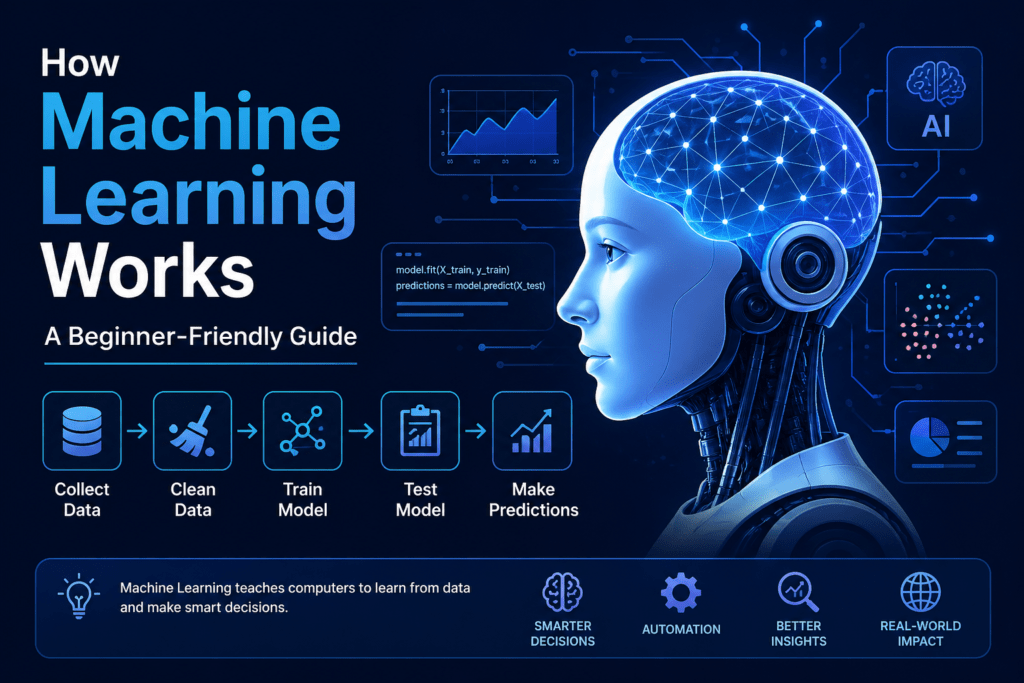
MACHINE LEARNING
Introduction
Machine Learning (ML) is one of the most powerful technologies shaping the modern world. It is a branch of Artificial Intelligence (AI) that enables computers to learn from data, identify patterns, and make decisions with minimal human intervention.
From Netflix recommendations and Google Maps traffic updates to fraud detection in banking and voice assistants like Siri, machine learning is already part of our daily lives.
But how does machine learning actually work?
In this beginner-friendly guide, you’ll learn the complete basics of machine learning in simple language.
What is Machine Learning?
Machine Learning is a process where computers learn from data instead of being manually programmed with strict rules.
Traditional programming works like this:
Input + Rules = Output
Machine Learning works like this:
Input + Output Data = Rules Learned Automatically
This means instead of telling a computer every rule, we allow it to study examples and discover the rules itself.
Example:
If we provide thousands of emails marked as:
- Spam
- Not Spam
The machine learning model studies patterns such as words, links, sender behavior, and formatting. Then it can predict whether a new email is spam or not.
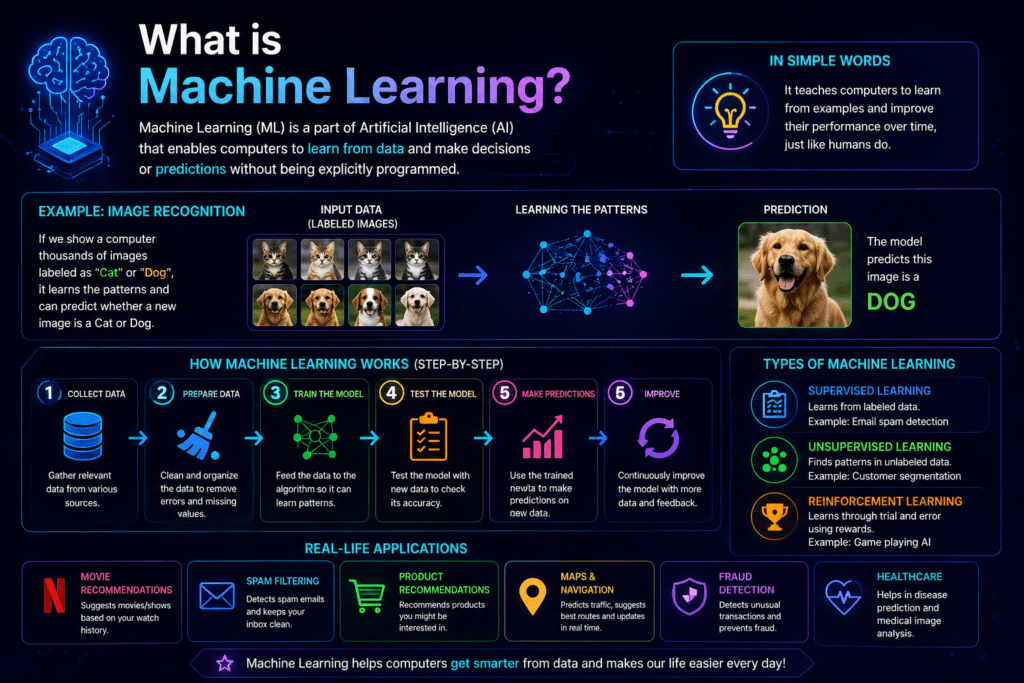
How Machine Learning Works (Step-by-Step)
1. Data Collection
Everything starts with data. Data is the fuel of machine learning.
Examples of data:
- Images
- Videos
- Customer records
- Text documents
- Website clicks
- Temperature readings
- Financial transactions
The quality of data directly affects the quality of results.
Good data = Better predictions
Data Cleaning and Preparation
Real-world data is often messy. It may contain:
- Missing values
- Duplicate records
- Wrong entries
- Irrelevant information
- Different formats
Before training begins, data must be cleaned and organized.
This stage may take 70% to 80% of the total project time.
3. Feature Selection
Features are the important pieces of information the model uses to learn.
Example: Predicting house prices
Features may include:
- Area size
- Number of bedrooms
- Location
- Age of house
- Nearby facilities
Choosing the right features improves model performance.
Choosing a Machine Learning Algorithm
An algorithm is the method used for learning patterns.
Popular algorithms:
- Linear Regression
- Logistic Regression
- Decision Tree
- Random Forest
- Support Vector Machine
- K-Nearest Neighbors
- Neural Networks
Different problems require different algorithms.
5. Training the Model
Training means feeding historical data into the algorithm.
The model studies relationships between inputs and outputs.
Example:
If larger houses usually cost more, the model learns that relationship.
It adjusts internal parameters repeatedly until prediction errors become smaller.
6. Testing the Model
After training, the model is tested using new unseen data.
This helps measure:
- Accuracy
- Precision
- Recall
- Error rate
Testing ensures the model performs well in real-world situations.
7. Prediction and Deployment
Once the model performs well, it is deployed for actual use.
Now it can make predictions such as:
- Will customer buy product?
- Is transaction fraud?
- What is tomorrow’s weather?
- Which movie should be recommended?
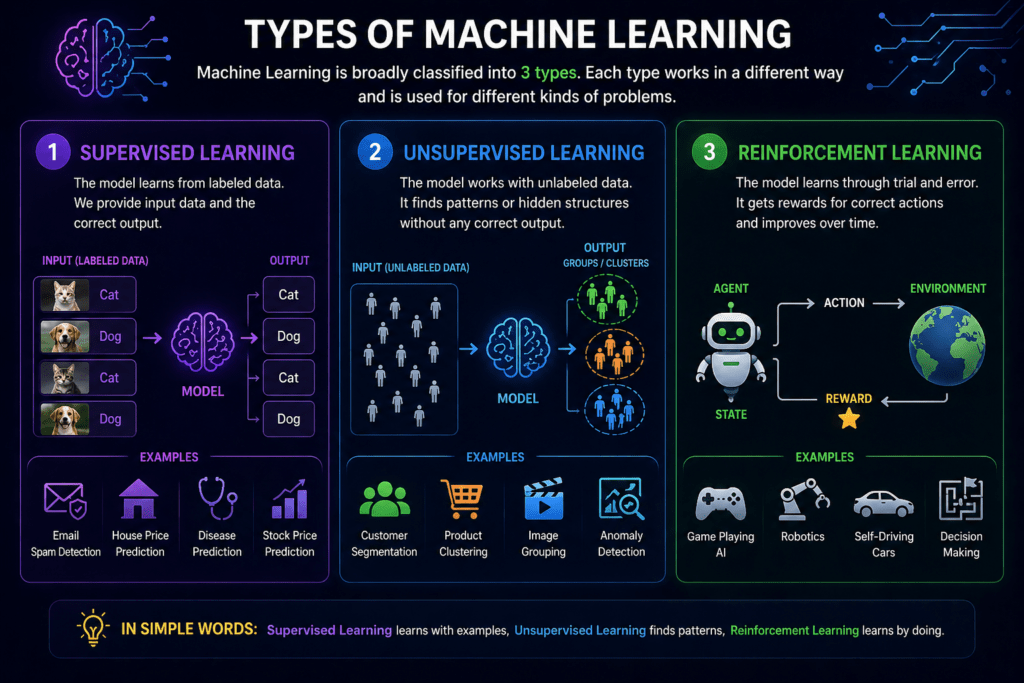
Types of Machine Learning
Supervised Learning
The model learns from labeled examples.
Example:
- Spam / Not Spam
- Cat / Dog
- House Price Prediction
Used when correct answers are already known.
2. Unsupervised Learning
The model works with unlabeled data and finds hidden patterns.
Example:
- Customer grouping
- Market segmentation
- Similar product clustering
Used for discovering unknown insights.
3. Reinforcement Learning
The model learns through trial and error using rewards and penalties.
Example:
- Self-driving cars
- Chess AI
- Robotics
The system improves by maximizing rewards.
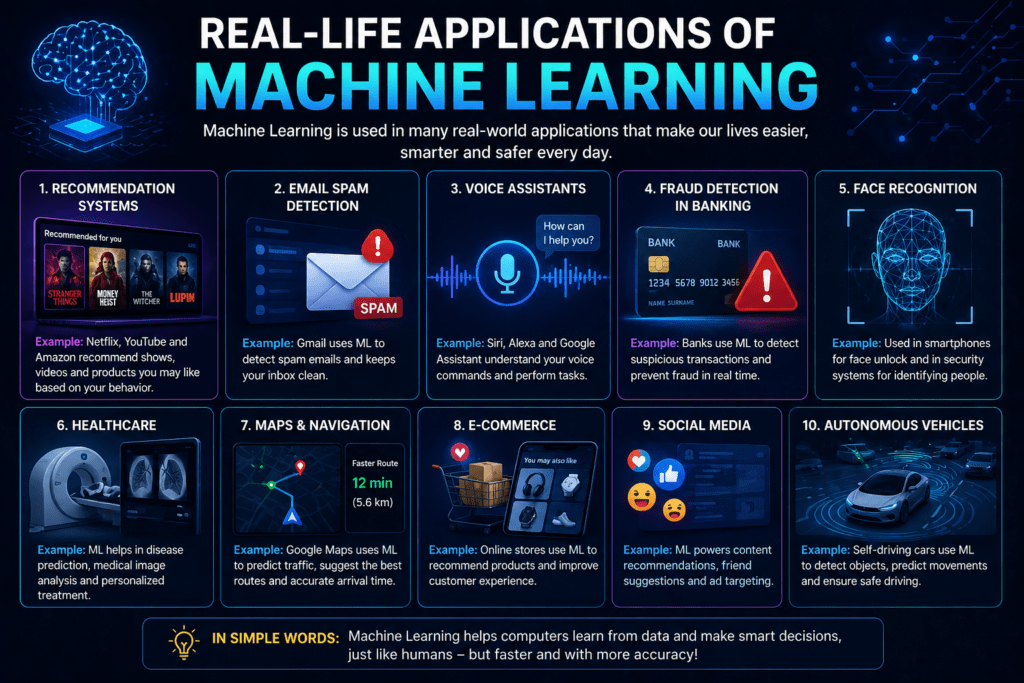
Real-Life Applications of Machine Learning
Healthcare
- Disease prediction
- Medical image analysis
- drug discovery
Banking
- Fraud detection
- Credit scoring
- Risk analysis
E-commerce
- Product recommendations
- Personalized ads
- Demand forecasting
Social Media
- Content recommendations
- Face recognition
- Spam filtering
Transportation
- Traffic prediction
- Route optimization
- Autonomous vehicles
Why Machine Learning is Important
Machine learning helps organizations:
- Automate repetitive tasks
- Make faster decisions
- Improve customer experience
- Reduce human errors
- Discover hidden trends
- Increase profits
It turns raw data into valuable intelligence.
Challenges of Machine Learning
Despite its power, ML has challenges:
1. Poor Data Quality
Bad data creates bad predictions.
2. Bias
If training data is unfair, results may also be unfair.
3. Overfitting
The model memorizes training data but fails on new data.
4. High Cost
Some models need powerful computers and GPUs.
5. Explainability
Complex models like deep learning can be difficult to understand.
Future of Machine Learning
Machine learning is rapidly growing in:
- Smart cities
- Cybersecurity
- Agriculture
- Space research
- Personalized education
- Finance automation
As data increases, machine learning will become even more important.
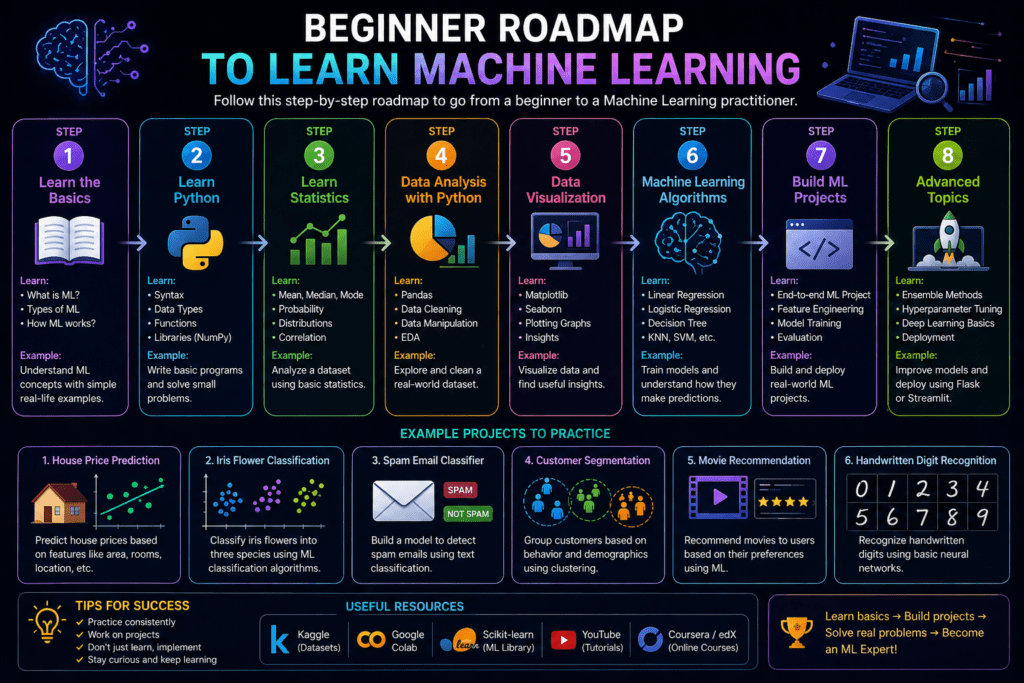
Beginner Roadmap to Learn Machine Learning
If you are starting today:
Step 1:
Learn Python
Step 2:
Learn Statistics Basics
Step 3:
Learn Data Analysis (Pandas, NumPy)
Step 4:
Learn Visualization
Step 5:
Build Small Projects
Examples:
- Price predictor
- Spam classifier
- Face mask detector
- Movie recommender
Final Conclusion
Machine Learning works by teaching computers to learn patterns from data and make decisions intelligently.
The process includes:
Collect Data → Clean Data → Train Model → Test Model → Predict Results
It is one of the most valuable skills in the digital future.
If you understand machine learning today, you are preparing for tomorrow.