
Choosing the right database is one of the most important decisions you’ll make when building an application. If you’ve been exploring backend development or cloud technologies, you’ve likely come across two major categories: SQL and NoSQL databases.
At first glance, the difference might seem technical or overwhelming. But in reality, the choice often comes down to how your data is structured, how it grows, and how your application needs to use it.
This guide breaks everything down in simple terms no jargon, no assumptions so you can confidently decide when to use SQL and when NoSQL makes more sense.
What Is a SQL Database?
SQL (Structured Query Language) databases are also known as relational databases. They store data in a structured format using tables, much like spreadsheets.
Each table has:
- Rows (records)
- Columns (fields with specific data types)
For example, a simple “Users” table might look like:
| ID | Name | |
|---|---|---|
| 1 | Arun | [email protected] |
| 2 | Priya | [email protected] |
Key Characteristics of SQL Databases
- Structured schema (you define the structure beforehand)
- Strong consistency (data is always accurate and reliable)
- Uses SQL language for querying
- Supports relationships between tables (joins)
Popular SQL Databases
- MySQL
- PostgreSQL
- Microsoft SQL Server
- Oracle Database
What Is a NoSQL Database?
NoSQL databases are non-relational. They don’t rely on tables and fixed schemas. Instead, they store data in more flexible formats like:
- Key-value pairs
- Documents (JSON-like)
- Graphs
- Wide-column stores
For example, in a document database, a user record might look like:
{ “id”: 1, “name”: “Arun”, “email”: “[email protected]”, “preferences”: { “theme”: “dark”, “notifications”: true } }Notice how flexible this is you can store nested data without needing multiple tables.
Key Characteristics of NoSQL Databases
- Flexible or schema-less structure
- High scalability (great for large datasets)
- Faster for certain types of queries
- Designed for distributed systems
Popular NoSQL Databases
- MongoDB (document-based)
- Redis (key-value store)
- Cassandra (wide-column)
- Neo4j (graph database)
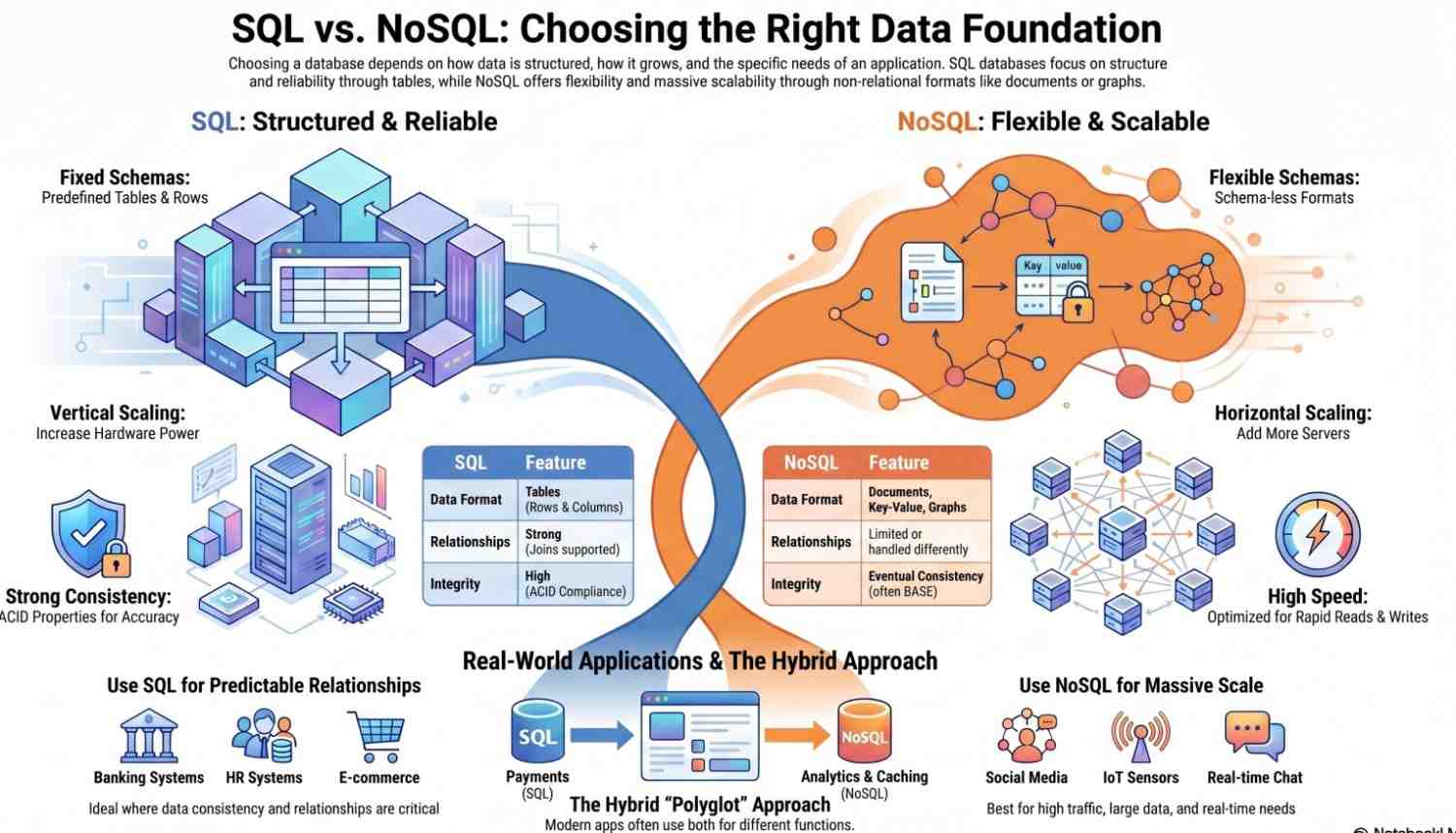
SQL vs NoSQL: Core Differences
Let’s simplify the comparison:
| Feature | SQL | NoSQL |
|---|---|---|
| Structure | Fixed schema (tables) | Flexible schema |
| Data Format | Rows & columns | JSON, key-value, graph |
| Scalability | Vertical (scale up) | Horizontal (scale out) |
| Consistency | Strong (ACID) | Eventual (BASE, often) |
| Relationships | Strong (joins supported) | Limited or handled differently |
| Best For | Structured data | Unstructured / evolving data |
When to Use SQL Databases
SQL databases shine when your data is structured and predictable.
1. When Data Has Clear Relationships
If your application involves multiple related entities (like users, orders, products), SQL is ideal.
Example: E-commerce app
- Users table
- Orders table
- Products table
All connected through relationships.
SQL makes it easy to:
- Join tables
- Query across relationships
- Maintain consistency
2. When You Need Strong Consistency
SQL databases follow ACID properties:
- Atomicity
- Consistency
- Isolation
- Durability
This means transactions are reliable and safe.
Example: Banking system
- Money transfers must be accurate
- No room for partial updates
SQL ensures:
Either the whole transaction happens, or none of it does.
3. When Your Schema Doesn’t Change Often
If your data structure is stable and predictable, SQL is a great fit.
Example: HR system
- Employees
- Departments
- Salaries
These don’t change frequently, so a fixed schema works well.
4. When Complex Queries Are Required
SQL is powerful for:
- Aggregations (SUM, COUNT)
- Filtering
- Joins across multiple tables
Example: Analytics dashboard
- Monthly revenue
- Top-performing products
SQL handles these queries efficiently.
When to Use NoSQL Databases
NoSQL databases are ideal when flexibility and scalability matter more than strict structure.
1. When Data Structure Is Flexible or Unknown
If your data evolves over time, NoSQL saves you from constant schema updates.
Example: User profiles
- Some users may have extra fields
- Others may not
NoSQL lets you store different structures easily.
2. When You Need High Scalability
NoSQL databases are built for horizontal scaling you can add more servers instead of upgrading one.
Example: Social media app
- Millions of users
- Massive amounts of data
NoSQL handles:
- High traffic
- Distributed systems
3. When You Need Fast Reads/Writes
NoSQL databases are optimized for performance, especially at scale.
Example: Real-time applications
- Chat apps
- Gaming leaderboards
They can handle:
- Rapid updates
- High throughput
4. When Working with Unstructured or Semi-Structured Data
If your data doesn’t fit neatly into tables, NoSQL is a better choice.
Example: Content management systems
- Articles
- Comments
- Media
Each entry may have different fields.
Real-World Scenarios
Let’s look at how you might choose between SQL and NoSQL in practical situations.
Scenario 1: Building a Blogging Platform
- Users, posts, comments
- Relationships matter
Best choice: SQL
Because you need structured relationships and queries.
Scenario 2: Building a Chat Application
- Messages sent in real time
- Massive data flow
Best choice: NoSQL
Because of speed and scalability.
Scenario 3: E-commerce Platform
- Orders, payments, inventory
Best choice: SQL (core system)
But you might combine with NoSQL for:
- Product recommendations
- Session storage
Scenario 4: IoT Data Collection
- Sensors sending continuous data
Best choice: NoSQL
Because:
- Data volume is huge
- Structure may vary
Can You Use Both? (Hybrid Approach)
Yes and many modern applications do exactly this.
This is called polyglot persistence.
Example Architecture
- SQL → core transactional data (users, payments)
- NoSQL → logs, caching, analytics
This way, you get:
- Reliability from SQL
- Flexibility and scale from NoSQL
Common Mistakes Beginners Make
1. Choosing NoSQL Just Because It’s Trendy
NoSQL isn’t always better. If your data is structured, SQL is often simpler and more reliable.
2. Ignoring Data Relationships
If your app relies heavily on relationships, forcing NoSQL can make things messy.
3. Overengineering Early
For small projects, SQL is usually enough. You don’t need a complex distributed NoSQL system right away.
4. Not Thinking About Future Growth
Start simple, but keep scalability in mind.
Quick Decision Guide
Ask yourself these questions:
Choose SQL if:
- Your data is structured
- Relationships are important
- You need strong consistency
- Queries are complex
Choose NoSQL if:
- Data structure is flexible
- You need high scalability
- Performance at scale matters
- You’re handling large or real-time data
Final Thoughts
There’s no “one-size-fits-all” answer when it comes to databases.
SQL databases offer:
- Reliability
- Structure
- Strong data integrity
NoSQL databases offer:
- Flexibility
- Scalability
- Performance at scale
Instead of asking “Which is better?”, ask:
“Which one fits my problem best?”
If you’re just starting out, a good rule of thumb is:
- Begin with SQL for structured applications
- Explore NoSQL when scaling or flexibility becomes a challenge
Over time, you’ll develop an instinct for choosing the right tool based on the problem in front of you and that’s what really matters.