Introduction:
Artificial Intelligence is rapidly transforming the way we live and work. From
voice assistants to recommendation systems, AI is already embedded in
our daily experiences. But the next major evolution in this space is the rise
of AI agents — intelligent systems designed not just to respond, but to act.
An AI agent is a software system that can perceive information, make
decisions, and take actions to achieve specific goals. Unlike traditional
programs that follow fixed instructions, AI agents adapt to new data, learn
from interactions, and operate with a degree of autonomy. This shift marks
a move from simple automation to intelligent, goal-driven execution.
What Are AI Agents?
An AI agent is a software system that can:
- Perceive its environment
- Make decisions
- Take actions Learn from outcomes
- Work toward a defined goal — often autonomously
Unlike traditional software that follows fixed rules, AI agents can adapt and
improve over time.
For example:
- A customer support AI that resolves tickets without human help
- A trading bot that analyzes markets and executes trades
- A smart home system that optimizes energy usage
These systems don’t just respond — they act strategically.
How AI Agents Work:
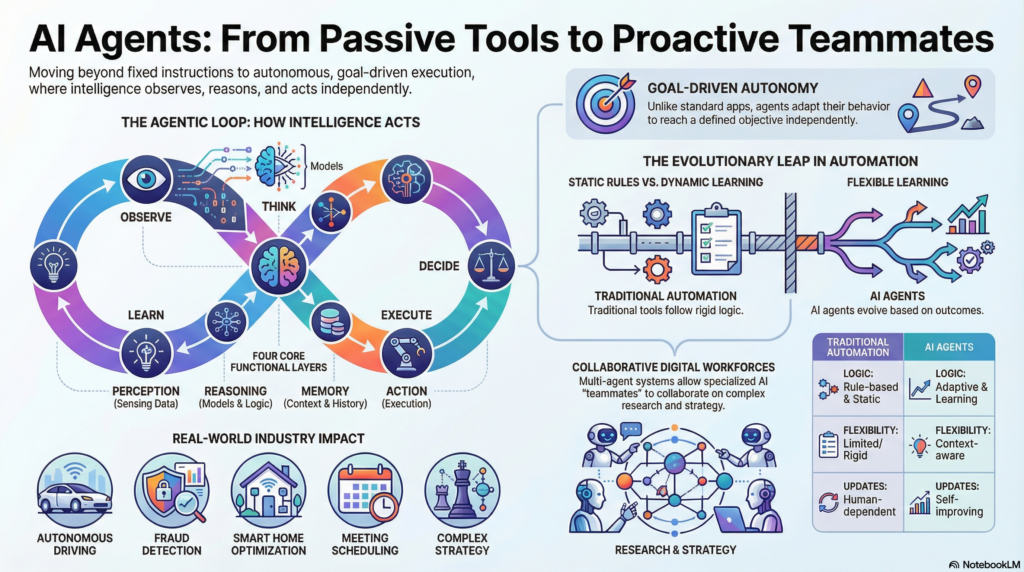
AI agents typically follow a loop:
- Observe – Collect data (user input, sensors, databases)
- Think – Analyze using AI models
- Decide – Choose the best action
- Act – Execute the task
- Learn – Improve based on feedback
Modern AI agents often use technologies like:
- Machine Learning
- Natural Language Processing
- Reinforcement Learning
- Large Language Models (LLMs)
Popular AI systems such as ChatGPT and AutoGPT demonstrate how AI
can reason, plan, and execute multi-step tasks.
Types of AI Agents
1.Simple Reflex Agents:
- React to current input
- No memory of past events
- Example: Basic spam filters
2.Model-Based Agents:
- Maintain internal state
- Understand context
- Example: Navigation systems
3.Goal-Based Agents:
- Work toward specific objectives
- Evaluate different possible actions
4.Learning Agents:
- Improve performance over time
- Adapt based on new data
Real-World Applications:
AI agents are already transforming industries:
Healthcare:
- Patient monitoring
- Drug discovery
- Virtual health assistants
E-Commerce:
- Personalized recommendations
- Automated customer service
- Inventory management
Finance:
- Fraud detection
- Algorithmic trading
- Risk assessment
Business Operations:
- Workflow automation
- Meeting scheduling
- Data analysis
Companies like Tesla use AI agents in autonomous driving systems, while
Amazon deploys AI agents in logistics and recommendation engines.
Why AI Agents Matter:
AI agents are important because they:
- Reduce operational costs
- Increase efficiency
- Work 24/7 without fatigue
- Handle complex decision-making
- Scale instantly
They’re not just tools — they’re becoming digital coworkers.
Challenges & Risks:
Despite their potential, AI agents also raise concerns:
- Data privacy risks
- Bias in decision-making
- Over-automation
- Security vulnerabilities
- Ethical considerations
Responsible AI development is crucial.
The Future of AI Agents:
We are entering an era of multi-agent systems, where multiple AI agents
collaborate to complete complex tasks — similar to a digital workforce.
In the near future, you may have:
- A personal AI financial advisor
- A health-monitoring AI companion
- A fully autonomous business AI manager
The shift from “AI tools” to AI teammates is already happening.
Deep Dive: Core Components of an AI Agent:
1. Perception Layer:
This is how the agent gathers information. It may collect:
- Text input (emails, chat messages)
- Sensor data (IoT devices)
- API responses (databases, web services)
- User behavior analytics
2. Reasoning Engine:
This is the brain of the agent. It can include:
- Rule-based logic
- Machine learning models
- Large Language Models
- Planning algorithms
For example, platforms like ChatGPT use advanced language models to
reason through multi-step tasks.
3.Memory System:
Modern AI agents use:
- Short-term memory (context of a conversation)
- Long-term memory (stored knowledge base)
- Vector databases for semantic search
Memory enables personalization and continuous improvement.
4. Action Module:
This allows the agent to:
- Send emails
- Update databases
- Trigger workflows
- Execute code
- Call APIs
This is what transforms an AI model into a true agent.
AI Agents in Enterprise Environments:
Large organizations are integrating AI agents into daily operations.
Companies like Microsoft and Google are building AI copilots that assist
with productivity, coding, document creation, and decision support.
Enterprise AI agents can:
- Automate internal ticketing systems
- Monitor cybersecurity threats
- Optimize supply chain logistics
- Provide real-time business intelligence
This reduces human workload and increases response speed.
Multi-Agent Systems: Digital Teams:
The future lies in collaborative AI agents.
Instead of one AI performing all tasks, multiple agents specialize in different
roles:
- A Research Agent (collects information)
- An Analysis Agent (interprets data)
- A Planning Agent (creates strategy)
- An Execution Agent (implements actions)
Together, they function like a coordinated digital workforce.
Open-source projects such as AutoGPT and BabyAGI explore this concept.
Business Benefits of AI Agents:
Here’s what makes AI agents a competitive advantage:
✅Scalability:
One AI agent can handle thousands of interactions simultaneously.
✅Cost Reduction
Reduced need for manual labor in repetitive tasks.
✅Speed
Instant analysis and execution.
✅Consistency
No fatigue or emotional bias.
✅Data-Driven Decisions
Agents rely on measurable inputs rather than intuition.
AI Agents vs. Traditional Automation:
| Feature | Traditional Automation | AI Agents |
|---|---|---|
| Definition | Rule-based systems (scripts, RPA) | Intelligent systems that can decide & act |
| Working Style | Predefined instructions | Context-based decision making |
| Flexibility | Very low | High |
| Learning Ability | ❌ No learning | ✅ Learns from data & experience |
| Data Handling | Structured data only | Structured + Unstructured (text, image, audio) |
| Adaptability | Breaks when conditions change | Adapts to new situations |
| Task Complexity | Simple, repetitive tasks | Complex, multi-step tasks |
| Decision Making | Fixed logic | Dynamic reasoning |
| Maintenance | Frequent manual updates needed | Improves over time |
| Error Handling | Stops or fails | Can self-correct |
| Speed | Fast for simple tasks | Efficient for complex workflows |
| Examples | Auto email, data entry bots | Chatbots, virtual assistants, autonomous systems |
Emerging Trends in AI Agents (2026 and Beyond):
1..Autonomous AI Businesses:
AI agents managing marketing, sales, and operations with minimal
human intervention.
2.Personal AI Ecosystems:
Individuals managing life, finance, and health through coordinated AI
assistants.
3.Agent Marketplaces:
Businesses buying and selling specialized AI agents.
4.Human-AI Collaboration Models:
AI agents augmenting professionals rather than replacing them.
Key Characteristics of an AI Agent :
- ✅Works automatically
- ✅Makes decisions
- ✅Learns from data
- ✅Focused on achieving goals
Skills Needed in the AI Agent Era:
To stay competitive, professionals should develop:
- AI literacy
- Prompt engineering
- Automation strategy
- Data analysis skills
- AI ethics awareness
Those who learn to orchestrate AI agents will lead the next wave of digital
transformation.
Conclusions:
AI agents are intelligent systems designed to observe, decide, and act
toward specific goals. They go beyond traditional automation by adding
adaptability and learning capabilities, allowing them to handle more
complex and dynamic tasks.
Their value lies in improving efficiency, reducing manual effort, and
enabling faster decision-making across industries. However, they are most
effective when supported by clear objectives, reliable data, and proper
human oversight.