In the world of cloud computing, one question keeps coming up:
Should you focus on AWS certification or real-world experience?
If you’re trying to break into cloud, DevOps, or backend engineering, this decision can shape your career path.
The truth? It’s not as simple as choosing one over the other.
In this in-depth guide, we’ll break down:
- The real value of AWS certifications
- Why hands-on experience matters more than you think
- What employers actually look for
- And the best strategy to maximize your career growth
Understanding AWS Certification
AWS certifications are official credentials that validate your understanding of cloud concepts and services.
Popular certifications include:
- Cloud Practitioner (beginner)
- Solutions Architect Associate
- Developer Associate
- DevOps Engineer Professional
Benefits of AWS Certification
1. Structured Learning Path
Certifications give you a clear roadmap:
This is extremely helpful for beginners who don’t know where to start.
2. Resume Visibility
Recruiters often filter resumes based on certifications.
Having AWS certification:
- Helps you pass HR screening
- Makes your profile stand out
- Signals commitment to learning
3. Industry Recognition
AWS certifications are globally recognized and trusted.
They show:
- You understand cloud fundamentals
- You’re serious about your career
4. Faster Entry into Cloud Roles
For beginners, certification can:
- Open doors to interviews
- Help transition from non-tech roles
- Provide initial credibility
Limitations of AWS Certification
1. Not Proof of Real Skills
Passing an exam doesn’t mean you can:
- Debug production issues
- Design scalable systems
- Handle outages
2. Easy to “Memorize and Forget”
Many candidates:
- Cram exam dumps
- Pass the test
- Forget everything later
This creates a false sense of expertise.
3. Limited Real-World Context
Exams don’t fully simulate:
- Production environments
- Team collaboration
- Business constraints
Understanding Real Experience
Real experience means:
- Building projects
- Deploying applications
- Solving actual problems
Benefits of Real Experience
1. Practical Problem Solving
You learn how to:
- Fix broken deployments
- Optimize performance
- Troubleshoot issues
This is what companies truly value.
2. Deep Understanding
Instead of memorizing:
- You understand why things work
- You can adapt to new situations
3. Job Readiness
Hands-on experience prepares you for:
- Real job tasks
- Production environments
- Team workflows
4. Strong Interview Performance
Interviewers often ask:
- “Tell me about a project you built”
- “How did you solve this issue?”
Experience gives you real answers.
Limitations of Real Experience
1. No Formal Validation
Without certification:
- Recruiters may overlook your resume
- HR filters might reject you
2. Unstructured Learning
You might:
- Miss key concepts
- Learn randomly
- Have knowledge gaps
3. Harder for Beginners
If you’re new:
- You may not know what to build
- You may feel lost without guidance
AWS Certification vs Real Experience (Direct Comparison)
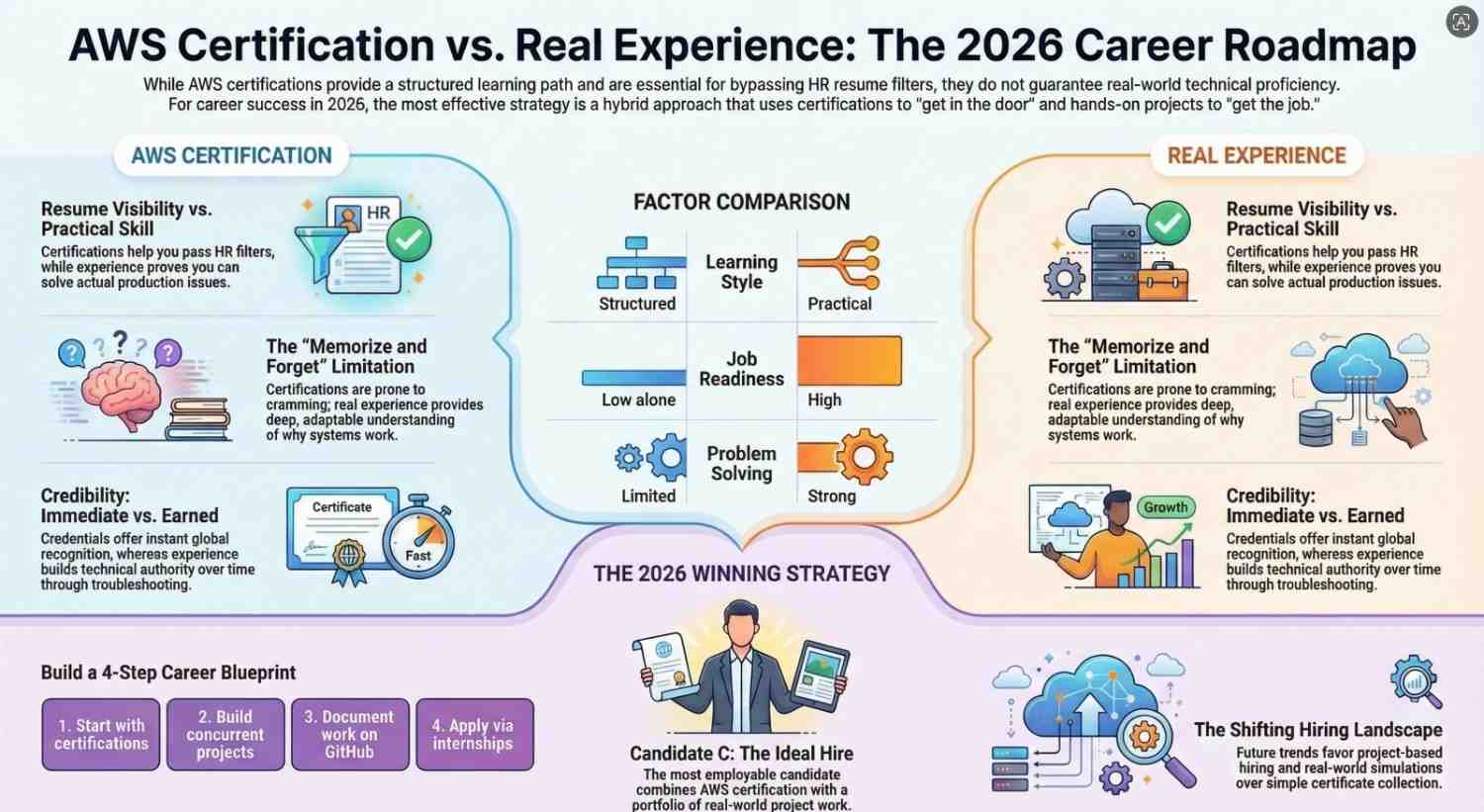
| Factor | AWS Certification | Real Experience |
|---|---|---|
| Learning Style | Structured | Practical |
| Resume Impact | High (HR filters) | Medium (unless showcased well) |
| Skill Depth | Basic to Intermediate | Deep |
| Job Readiness | Low alone | High |
| Credibility | Immediate | Earned over time |
| Problem Solving | Limited | Strong |
What Do Employers Actually Want?
Here’s the reality:
Employers prefer experience over certification
But…
Certification helps you get the interview
Hiring Reality
- HR → filters by certification
- Technical interviewer → tests real skills
So:
Certification gets you in the door
Experience gets you the job
Best Strategy: Combine Both
The smartest approach is not choosing one but combining both.
Step-by-Step Plan
Step 1: Start with Certification
- Learn fundamentals
- Build structured knowledge
Step 2: Build Projects Alongside
Examples:
- Deploy a web app on AWS
- Set up CI/CD pipeline
- Use Docker + EC2
- Configure load balancer
Step 3: Document Your Work
Create:
- GitHub repositories
- Blog posts
- Portfolio
Step 4: Apply Knowledge in Real Scenarios
- Freelance
- Internships
- Open-source contributions
Real Examples
Candidate A
- AWS certified
- No projects
Struggles in technical interviews
Candidate B
- No certification
- Strong hands-on projects
Better technically, but may miss HR screening
Candidate C (Ideal)
- AWS certified
- Real-world projects
Gets interviews + clears them
When to Focus on Certification
Choose certification if:
- You’re a beginner
- You need direction
- You want to switch careers
- You want to pass HR filters
When to Focus on Experience
Choose experience if:
- You already know basics
- You’re preparing for interviews
- You want to become job-ready
Common Mistakes to Avoid
1. Chasing Certifications Only
Collecting certificates without skills is useless.
2. Ignoring Fundamentals
Jumping into tools without understanding basics.
3. Not Building Projects
Projects = proof of skill.
4. Memorizing Instead of Learning
Short-term success, long-term failure.
Career Impact in 2026
Cloud demand continues to grow:
- DevOps engineers
- Cloud architects
- SRE roles
But hiring is shifting toward:
Skills > certificates
Future Trend
Certifications will remain important, but:
- Hands-on labs
- Real-world simulations
- Project-based hiring
will dominate hiring decisions.
Final Verdict
So, what matters more?
Real experience wins in the long run
Certification helps you get started
Final Advice
If you’re serious about cloud:
Bottom Line
AWS certification opens doors
Real experience builds your career
- If you want to explore Cloud Computing, start your training here.