Introduction.
AWS Lambda has changed how modern applications are built. It allows developers to run code without managing servers. For beginners, this idea can feel both exciting and confusing. Serverless promises speed, scalability, and lower operational overhead. Yet many tutorials stop at simple “hello world” examples. Real confidence comes from seeing Lambda used in production. This guide focuses on practical, real-world learning. It introduces AWS Lambda through ten proven projects. Each project has been used in live production systems. These are not toy demos or academic exercises.
They solve real business and technical problems. The projects span different industries and use cases. You will see Lambda powering APIs and backend services. You will explore event-driven data processing pipelines. You will learn how Lambdas react to AWS services. Examples include S3, DynamoDB, SQS, and API Gateway. Each project highlights a common architectural pattern. You will understand why Lambda was chosen. You will also see its limitations in practice. Cost efficiency is discussed with real traffic in mind.
Performance considerations are explained clearly. Cold starts are addressed with practical solutions. Security best practices are built into every example. IAM roles and permissions are explained step by step. Monitoring and logging are treated as first-class concerns. You will learn how teams observe Lambdas in production.
Error handling is shown beyond simple try-catch blocks. Retries, dead-letter queues, and alerts are covered.
Deployment strategies are explained for beginners. Infrastructure as code is introduced gently. Tools like SAM or Serverless Framework are referenced.
The focus remains on concepts, not just tools. Each project starts with a real problem statement. The Lambda-based solution is designed incrementally. Architectural diagrams are described in simple terms. Code examples are concise and readable. Language choices reflect common industry usage. You do not need deep AWS experience to start. Basic cloud knowledge is enough to follow along. By the end, Lambda will feel less abstract. You will understand when serverless makes sense. You will also know when it does not. These lessons come directly from production systems.
Trade-offs are explained honestly and clearly. Scaling behavior is demonstrated with real workloads. Failure scenarios are discussed, not hidden. This builds trust in the learning process. Beginners gain skills that transfer to real jobs. Intermediate developers gain production insight. Each project can inspire your own applications. You can adapt them to startups or enterprises. The goal is practical, job-ready understanding. AWS Lambda becomes a tool, not a mystery. You learn how teams actually use it daily. The projects reflect modern cloud-native thinking. Event-driven design becomes easier to grasp. Stateless services start to make sense. Costs, scale, and reliability connect together.
This introduction sets the tone for hands-on learning. It prepares you for deeper technical exploration. You will build confidence through realistic examples. You will stop guessing and start designing. Each project adds a new layer of understanding.
Together, they form a complete beginner journey. From first function to production-ready system. AWS Lambda becomes approachable and practical. Learning is grounded in real-world usage. Theory is supported by experience. Practice is guided by proven patterns. Welcome to AWS Lambda through real production projects.
Why AWS Lambda Is Popular in Production
Companies choose AWS Lambda because it:
- Eliminates server management
- Scales automatically
- Reduces operational costs
- Fits perfectly with event-driven architectures
Let’s dive into real projects.
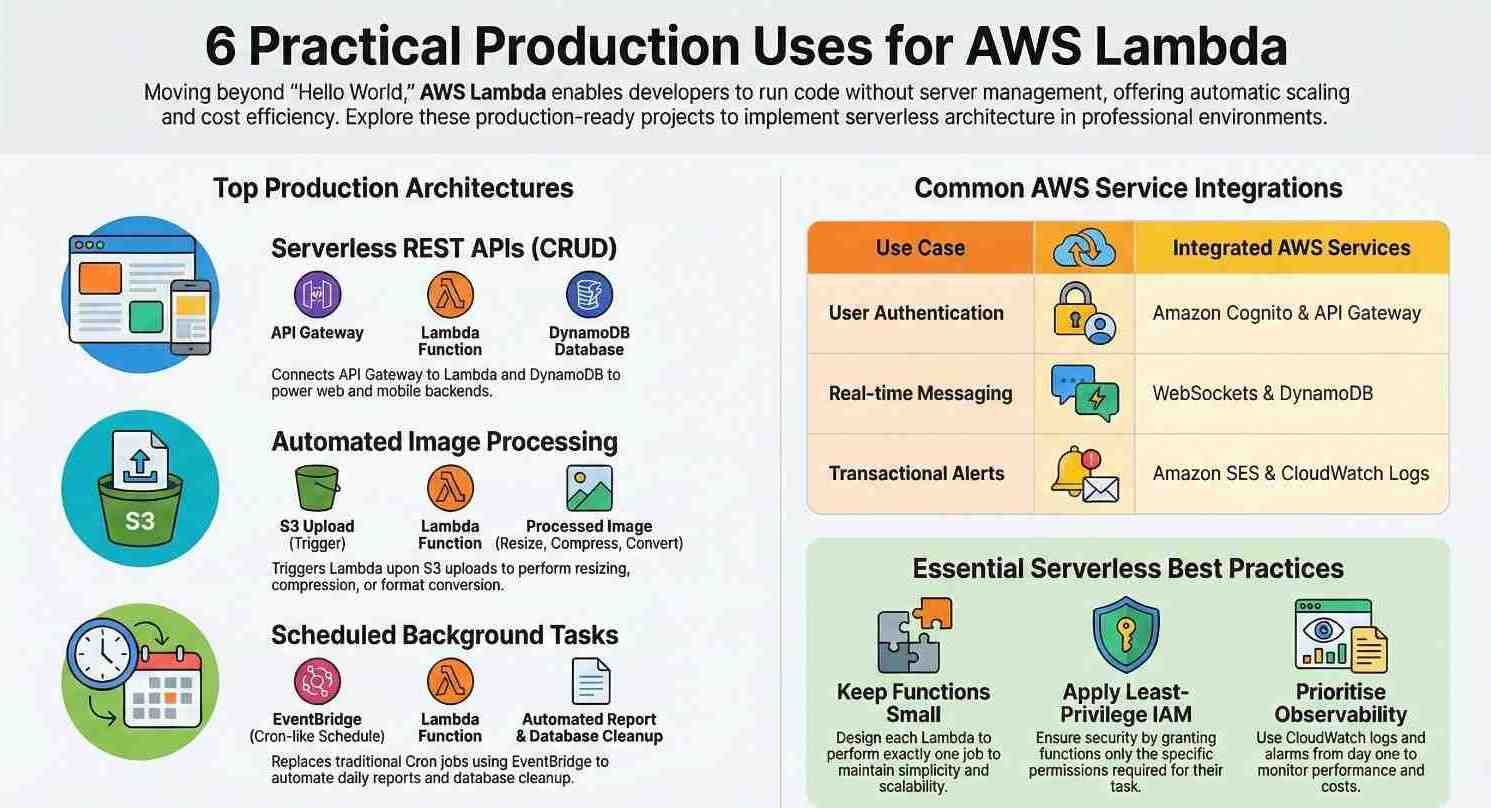
1. Serverless REST API (CRUD Application)
Real Use Case: Backend for web & mobile apps
Architecture:
Client → API Gateway → Lambda → DynamoDB
Production Usage:
- User management
- Product catalogs
- Admin dashboards
Beginner Skills Learned:
- API Gateway integration
- Lambda handlers
- DynamoDB operations
2. Image Upload & Processing System
Real Use Case: Profile pictures, product images
Architecture:
S3 Upload → Lambda Trigger → Image Processing → S3
Production Usage:
- Image resizing
- Compression
- Format conversion
Beginner Skills Learned:
- S3 events
- Binary file handling
- Lambda memory optimization
3. Scheduled Jobs (Cron Replacement)
Real Use Case: Background automation
Architecture:
EventBridge Schedule → Lambda
Production Usage:
- Daily reports
- Database cleanup
- Reminder emails
Beginner Skills Learned:
- EventBridge rules
- Stateless jobs
- CloudWatch logs
4. Payment Webhook Handler (Stripe / PayPal)
Real Use Case: Payment processing
Architecture:
Payment Provider → API Gateway → Lambda → Database
Production Usage:
- Order confirmation
- Subscription updates
- Invoice generation
Beginner Skills Learned:
- Webhook security
- Idempotency
- Error handling
5. Email Notification Service
Real Use Case: Transactional emails
Architecture:
Event / API → Lambda → Amazon SES
Production Usage:
- Order confirmations
- Password resets
- Alerts
Beginner Skills Learned:
- Email services
- Environment variables
- Secrets handling
6. File Processing System (CSV / Excel Uploads)
Real Use Case: Bulk data imports
Architecture:
S3 Upload → Lambda → DynamoDB / RDS
Production Usage:
- User data imports
- Sales data processing
- Reports generation
Beginner Skills Learned:
- Handling large files
- Chunk processing
- Lambda limits
7. Authentication & Authorization Backend
Real Use Case: Secure user access
Architecture:
Client → Cognito → Lambda → API
Production Usage:
- Signup & login
- Token validation
- Custom auth logic
Beginner Skills Learned:
- Cognito integration
- JWT handling
- Securing APIs
8. Log Monitoring & Alert System
Real Use Case: Production monitoring
Architecture:
CloudWatch Logs → Lambda → SNS / Slack
Production Usage:
- Error detection
- Incident alerts
- Log analysis
Beginner Skills Learned:
- Log parsing
- Event-driven alerts
- Observability basics
9. Serverless Chat or Notification Backend
Real Use Case: Real-time messaging
Architecture:
Client → API Gateway (WebSocket) → Lambda → DynamoDB
Production Usage:
- Chat apps
- Live notifications
- Collaboration tools
Beginner Skills Learned:
- WebSockets
- Real-time data flow
- Scalable design
10. DevOps & Infrastructure Automation
Real Use Case: Operational efficiency
Architecture:
GitHub / AWS Event → Lambda → AWS Services
Production Usage:
- Deployment notifications
- Resource cleanup
- Auto-tagging resources
Beginner Skills Learned:
- AWS automation
- IAM roles
- CI/CD concepts
Common Production Best Practices for Beginners
1. Keep Functions Small
Each Lambda should do one job only.
2. Use Least-Privilege IAM
Grant only required permissions.
3. Handle Errors Gracefully
Always log errors and return meaningful responses.
4. Monitor Everything
Use CloudWatch logs and alarms from day one.
5. Understand Costs
Lambda is cheap, but inefficient code still costs money.
Conclusion.
AWS Lambda can feel overwhelming at first, especially for beginners. Through these ten real production projects, that uncertainty fades. You have seen Lambda not as a concept, but as a working solution. Each project demonstrated how serverless fits real business needs. From APIs to background processing, Lambda proved its flexibility. You learned how event-driven systems behave in production. You saw how AWS services work together around Lambda. Cost, scalability, and performance were not theoretical topics. They were practical considerations in every example. You learned why simplicity is a major advantage of Lambda. You also learned where complexity can quietly appear. Cold starts, permissions, and observability became clear. Security was treated as part of design, not an afterthought. Monitoring and logging showed how teams maintain confidence in production.
Failures were handled deliberately, not ignored. Retries, alerts, and backups turned risk into resilience. You gained insight into real architectural decisions. You saw when Lambda was the right choice. You also learned when other approaches might work better. These lessons help you design responsibly. The projects showed patterns you can reuse and adapt. They reflect how modern cloud-native systems are built today. You now have a practical foundation in serverless thinking. AWS Lambda is no longer a black box.
It is a tool you can confidently evaluate and apply. With these examples, you can build your own production-ready solutions. You can experiment, iterate, and improve with confidence. The best way forward is hands-on practice. Start small, deploy often, and observe carefully. Let real problems guide your designs. As your experience grows, your architectures will mature. AWS Lambda will continue to evolve with your skills. This journey does not end here it begins.
- For more information about AWS Lambda, you can refer to Jeevi’s page.