
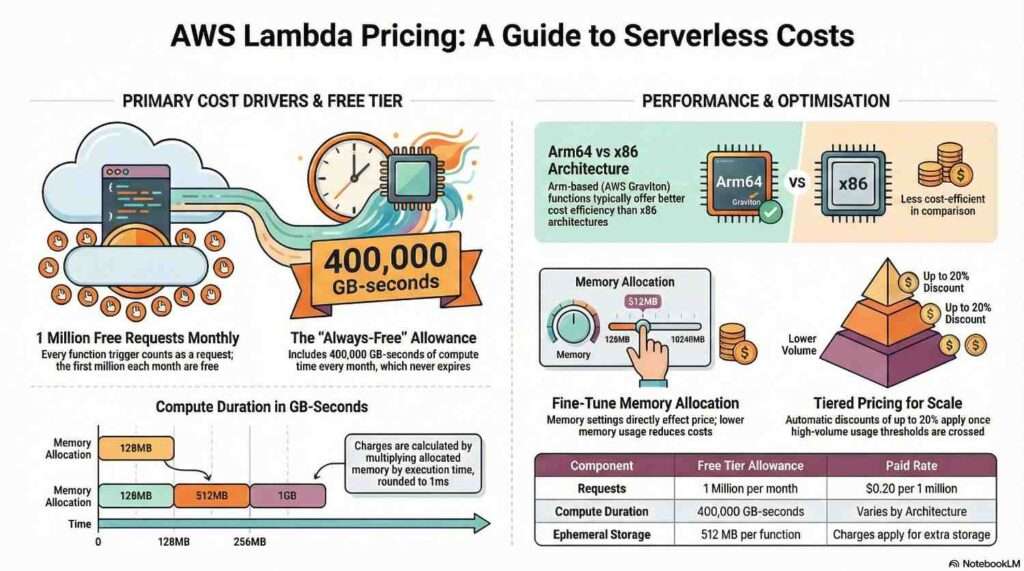
AWS Lambda pricing is a pay-as-you-go model that allows users to run code without provisioning or managing servers, charging only for the resources actually consumed during execution. The cost is primarily based on the number of requests made to a Lambda function and the amount of compute time used to process those requests. Each time a function is invoked, it counts as one request, and AWS provides a generous free tier that includes one million free requests per month.
Compute usage is measured in gigabyte-seconds, which is calculated by multiplying the memory allocated to the function by the time it takes to execute, measured from the start of execution until completion and rounded to the nearest millisecond. Users can choose different memory sizes, and higher memory allocations generally increase cost but may improve performance and reduce execution duration. AWS Lambda pricing also varies depending on the processor architecture, with Arm-based functions typically offering better cost efficiency compared to x86 architectures.
Additional costs may apply for optional features such as provisioned concurrency, increased ephemeral storage, and data transfer between AWS services or regions. Overall, AWS Lambda pricing is designed to be flexible, scalable, and cost-effective, making it suitable for applications ranging from small prototypes to large-scale enterprise workloads.
Main Pricing Components
1. Requests
Every time your function is triggered, AWS counts a request.
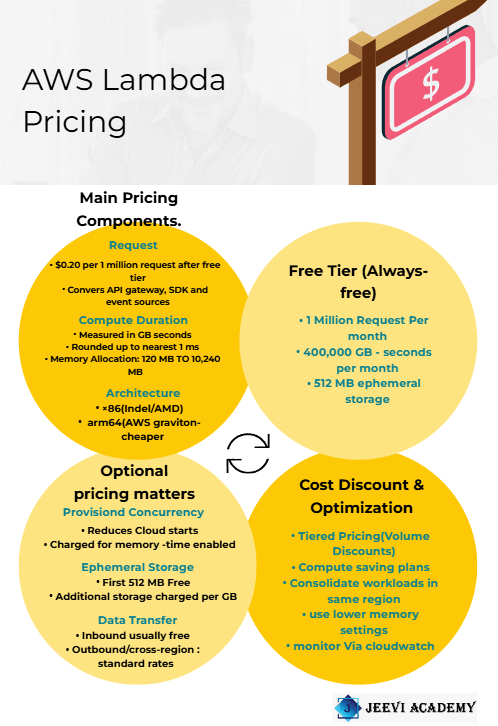
- $0.20 per 1 million requests after free tier.
- 1 million free requests per month in the Lambda free tier.
Requests include calls from API Gateway, SDK invokes, or event sources (SNS, S3, EventBridge, etc.).
2. Compute Duration
You pay for the time your function runs:
- Time is measured from start of execution to return/terminate, rounded up to 1 ms.
- You choose memory allocation (128 MB–10 240 MB) for the function.
- AWS calculates GB-seconds:
duration × memory (GB) - Charges vary with memory and architecture.
Free tier includes 400 000 GB-seconds per month.
Example: A 256 MB function running 100 ms:
- Duration: 100 ms = 0.1 s
- Memory: 0.256 GB
- GB-seconds: 0.0256 GB-sec
- Multiply by length of usage to estimate cost.
3. Architecture Discounts
Lambda supports two processor types:
- x86 (Intel/AMD)
- arm64 (AWS Graviton)
The arm64 functions are cheaper per GB-second than x86 often offering better performance per dollar.
Tiered Pricing (Lower Costs at Scale)
AWS now applies tiered pricing on compute duration:
- Discounts start once you cross large aggregate monthly usage thresholds.
- The higher the usage (GB-seconds per month), the larger the discount you get automatically.
This helps large workloads save up to ~20% on duration costs.
Optional Pricing Factors
🔹 Provisioned Concurrency
Keeps functions pre-initialized to reduce cold starts.
- You’re charged for the provisioned memory × time enabled and extra duration while executing.
- Free tier doesn’t apply to it.
🔹 Ephemeral Storage
- Lambda gives 512 MB storage free per function.
- Extra storage you configure is charged.
🔹 Data Transfer
- Inbound data to the region in which the function runs is usually free.
- Outbound and cross-region traffic are priced per standard AWS data transfer rates.
🔹 Durable Functions / New Features
New capabilities like durable functions (for stateful workflows) have additional costs (operations, storage) beyond basic invocation and duration charges.
Free Tier & Always-Free
AWS Lambda provides a Free Tier and an Always-Free offering that allows developers to use serverless computing with minimal or no cost for many workloads. The Free Tier includes one million free requests per month, making it possible to run applications, APIs, and background tasks without immediate charges. In addition to free requests, AWS also offers 400,000 gigabyte-seconds of compute time each month, which is often sufficient for small applications and development environments.
This allocation is part of the Always-Free tier, meaning it does not expire after the first 12 months and remains available as long as the AWS account is active. The Free Tier is especially useful for learning AWS Lambda, testing new ideas, building prototypes, and running low-traffic production applications. By taking advantage of the Free Tier and Always-Free benefits, developers can better manage costs while gaining hands-on experience with serverless architecture.
Cost Optimization Tips
Here are some practical ways teams reduce Lambda costs:
✅ Use lower memory where possible memory setting directly affects price.
✅ Choose arm64 (Graviton) where compatible (better cost/performance).
✅ Take advantage of tiered pricing by consolidating workloads in the same region.
✅ Use Compute Savings Plans for predictable usage to lower rates.
✅ Monitor function duration & cold starts with CloudWatch hidden init costs can add up.
Quick Summary
| Pricing Component | Charged? | Free Tier |
|---|---|---|
| Requests | Yes | 1 million invokes/month |
| Compute Duration | Yes | 400 000 GB-seconds/month |
| Provisioned Concurrency | Yes | No |
| Extra Storage | Yes (if >512 MB) | 512 MB free |
| Data Transfer | Depends | Inbound usually free |
Conclusion.
AWS Lambda pricing is built around a simple, usage-based model that helps organizations pay only for what they actually use, without the overhead of managing servers. By charging for requests and execution time, Lambda offers flexibility and scalability for workloads of all sizes, from small applications to large, high-traffic systems. Features such as the free tier, tiered pricing, and support for different processor architectures make it easier to control and optimize costs.
While additional options like provisioned concurrency and extra storage can increase expenses, they also provide performance benefits when used strategically. Overall, understanding how AWS Lambda pricing works enables teams to design efficient serverless architectures, make informed cost decisions, and maximize the value of cloud resources.
- For more information about AWS Lambda pricing, you can refer to Jeevi’s page.