As organizations double down on cloud-first and AI-first strategies, Amazon Web Services continues to define how modern infrastructure, intelligence, and security are built at scale. Understanding the AWS roadmap for the coming years is no longer just a technical concern it’s a strategic necessity.
By 2026, AWS is expected to push deeper into AI-native infrastructure, serverless compute, automated security, and simplified cloud operations. This article explores what the Amazon AWS roadmap may look like across Compute, AI, and Security, and how businesses, architects, and learners can align their cloud AWS roadmap and learning AWS roadmap accordingly.
Why the AWS Roadmap Matters in 2026
AWS is no longer just a cloud provider it’s an operating platform for digital business. Decisions AWS makes today ripple through startups, enterprises, governments, and the global developer ecosystem.
By 2026, most organizations will face:
- Increased pressure to optimize cloud costs
- Growing demand for AI-powered applications
- Stricter security and compliance requirements
- A shortage of skilled cloud professionals
A clear understanding of the AWS roadmap helps organizations:
- Invest in the right services early
- Avoid building on soon-to-be legacy patterns
- Design architectures that scale with minimal rework
- Build a future-proof learning AWS roadmap for teams
Compute in the AWS Roadmap 2026
1. The Continued Shift Toward Serverless-First Architectures
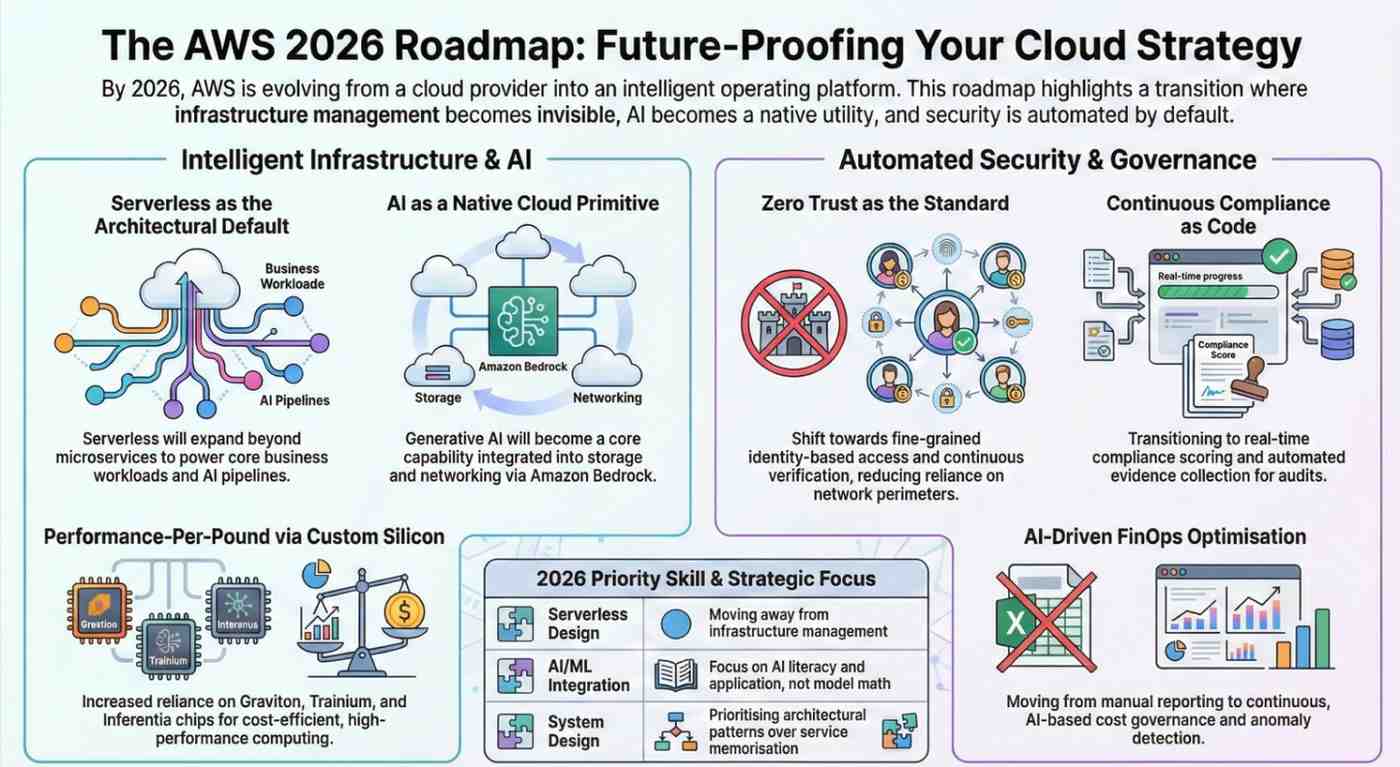
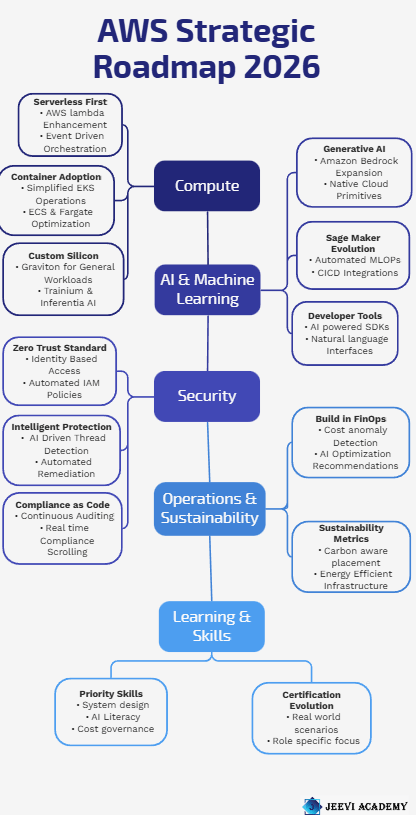
Compute has always been at the heart of AWS innovation. By 2026, the Amazon AWS roadmap strongly favors serverless abstractions over infrastructure management.
Expected trends:
- Expanded AWS Lambda runtime support
- Longer execution durations and higher memory limits
- Deeper integration with Step Functions and EventBridge
- Reduced cold-start latency through smarter orchestration
What this means:
By 2026, serverless will no longer be “just for microservices.” It will power core business workloads, data processing, and even AI pipelines.
2. Containers Become the Default, Not the Transition
While EC2 remains foundational, AWS continues nudging customers toward containers.
On the cloud AWS roadmap, expect:
- Further simplification of Amazon EKS operations
- More managed add-ons and automated upgrades
- Deeper ECS + Fargate optimization
- Better multi-region container orchestration
AWS is clearly reducing the operational overhead of Kubernetes without removing flexibility making containers accessible even to smaller teams.
3. Purpose-Built Compute Accelerates
AWS has been investing heavily in custom silicon, and this trend will accelerate through 2026.
Likely roadmap focus:
- New generations of Graviton for general workloads
- Trainium and Inferentia chips optimized for AI
- Cost-efficient compute for bursty and event-driven workloads
Impact on customers:
Organizations that align early with AWS’s compute roadmap will see major gains in performance-per-dollar, especially for AI and data-heavy workloads.
AI and Machine Learning: The Core of the Amazon AWS Roadmap
AI is no longer a feature it’s the platform. By 2026, AI will sit at the center of the AWS roadmap.
4. Generative AI Becomes a Native Cloud Capability
With Amazon Bedrock, AWS has made it clear: customers want choice, security, and control in generative AI.
By 2026, expect:
- More foundation models available via Bedrock
- Tighter integration with data sources (S3, RDS, OpenSearch)
- Stronger governance and model customization
- Reduced inference costs via custom chips
Generative AI will feel less like an add-on and more like a native cloud primitive similar to storage or networking.
5. SageMaker Evolves into a Full AI Platform
SageMaker is evolving beyond model training.
On the AWS roadmap, SageMaker is expected to:
- Fully automate MLOps pipelines
- Integrate deeply with CI/CD workflows
- Support real-time and batch inference seamlessly
- Improve explainability and compliance features
For enterprises, this means faster AI adoption with fewer specialized skills required.
6. AI for Builders, Not Just Data Scientists
AWS is clearly targeting developers, not just ML experts.
By 2026:
- More AI-powered SDKs and APIs
- Natural language interfaces for cloud operations
- AI-assisted debugging, optimization, and monitoring
- Deeper AI integration into developer tools
This shift directly impacts the learning AWS roadmap, making AI skills essential not optional.
Security: A Foundational Pillar of the Cloud AWS Roadmap
Security is no longer something teams “add later.” AWS’s roadmap reflects a move toward security by default.
7. Zero Trust Becomes the Standard
By 2026, Zero Trust will be embedded across AWS services.
Expected developments:
- Fine-grained identity-based access everywhere
- Reduced reliance on network perimeters
- Smarter IAM policy recommendations
- Continuous identity verification
IAM complexity will still exist but AWS will increasingly automate and abstract it.
8. Security Automation and AI-Driven Threat Detection
AWS is investing heavily in intelligent security services.
On the Amazon AWS roadmap:
- Expanded GuardDuty capabilities
- AI-powered anomaly detection
- Automated remediation workflows
- Unified security dashboards across accounts
Security teams will spend less time reacting and more time governing.
9. Compliance as Code
By 2026, compliance will be continuous, automated, and auditable by default.
Expect:
- More compliance frameworks built into AWS
- Policy-as-code becoming standard
- Native evidence collection for audits
- Real-time compliance scoring
This is a major shift for regulated industries and global enterprises.
Cost Optimization and Sustainability in the AWS Roadmap
AWS understands that cloud cost management is now a board-level concern.
10. FinOps Becomes Built-In
The cloud AWS roadmap increasingly integrates cost visibility and optimization.
By 2026:
- Smarter cost anomaly detection
- AI-based optimization recommendations
- Easier Savings Plan management
- Better cost allocation across teams
FinOps will shift from manual reporting to continuous optimization.
11. Sustainability as a First-Class Metric
AWS has committed to aggressive sustainability goals.
Roadmap indicators include:
- Carbon-aware workload placement
- Energy-efficient data centers
- Sustainability metrics in AWS dashboards
By 2026, sustainability will influence architectural decisions not just reporting.
The Learning AWS Roadmap for 2026
The technical AWS roadmap directly shapes how individuals should learn.
12. Skills That Will Matter Most
By 2026, the most valuable AWS skills will include:
- Serverless architecture design
- Container orchestration fundamentals
- AI/ML integration (not model math)
- Cloud security and IAM
- Cost optimization and governance
The learning AWS roadmap will shift away from “service memorization” toward system design and decision-making.
13. Certifications Will Evolve
AWS certifications are expected to:
- Focus more on real-world scenarios
- Emphasize AI, security, and cost awareness
- Become more role-specific
Hands-on experience will matter more than ever.
What This Means for Your AWS Strategy
Aligning with the AWS roadmap 2026 requires intentional planning.
For Organizations
- Design for serverless and managed services first
- Build AI readiness into every architecture
- Automate security and compliance early
- Invest in cloud cost governance
For Architects and Engineers
- Focus on patterns, not just services
- Learn how AWS services fit together
- Develop AI literacy, not just ML depth
For Learners
- Follow a structured learning AWS roadmap
- Combine certifications with real projects
- Understand why AWS builds services not just how
Final Thoughts: AWS in 2026 and Beyond
The Amazon AWS roadmap for 2026 points toward a cloud that is:
- More intelligent
- More automated
- More secure
- More cost-aware
Compute will fade into the background, AI will become ubiquitous, and security will be continuous and invisible.
Those who understand and align with the AWS roadmap, cloud AWS roadmap, and learning AWS roadmap today will be best positioned to thrive in the next generation of cloud computing.
For more information about AWS, you can refer to Jeevi’s page.
This tutorial is just the beginning learn AWS hands-on in our complete course. Upgrade your skills with AWS.