Introduction to Networking.
A computer network is a group of interconnected computers that communicate with each other to share resources, data, and applications. Each device in a network is assigned an IP address, which serves as its unique identifier.
Types of Networks.
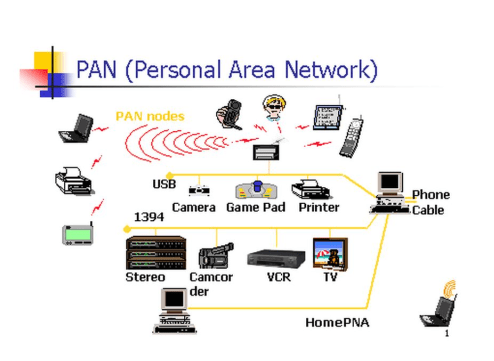
1. Personal Area Network (PAN) – Small network for personal use (e.g., Bluetooth).
A Personal Area Network (PAN) is a small, short-range network designed to connect devices that are used by a single individual within a limited area, typically within a radius of a few meters, such as a room, a workspace, or even around a person’s body. It primarily supports communication among personal devices like smartphones, laptops, tablets, smartwatches, earbuds, fitness bands, and other wearable technology. The goal of a PAN is to make data sharing, synchronization, and device control seamless and convenient without requiring complex infrastructure or cabling. Technologies such as Bluetooth, Infrared (IR), Zigbee, and Near-Field Communication (NFC) are commonly used to establish these networks because they consume low power and offer sufficient speed for personal tasks.
Bluetooth is the most widely used PAN technology, enabling wireless headsets, wireless keyboards, wireless speakers, and file transfer between devices. A PAN can also be wired, such as when USB cables are used to connect a computer and a smartphone for data transfer or tethering. In modern life, PANs play a crucial role in enabling smart, portable, and wearable ecosystems where devices share information effortlessly. They also enhance mobility, as users can move freely while staying connected to their personal devices without physical restrictions.
Security is an essential consideration in PANs because these networks often transmit private or sensitive information, such as health data from wearable devices or personal files between smartphones and laptops. Encryption, device pairing, authentication, and secure communication protocols are used to protect these connections from unauthorized access or interference. As technology advances, PANs are becoming more intelligent and energy-efficient, allowing more devices to connect simultaneously while maintaining stable communication.
PANs are also increasingly integrated with larger networks such as Local Area Networks (LANs) and Internet of Things (IoT) systems, allowing personal devices to interact with home automation systems, cloud services, and the internet. This integration enables features like smart notifications, wireless streaming, automation tracking, and real-time monitoring of health or activity levels. Overall, a Personal Area Network provides convenience, mobility, and seamless connectivity for an individual’s personal digital ecosystem, making it an essential part of modern wireless communication and everyday technological interaction.

2. Local Area Network (LAN) – Covers a small geographic area like a home, office, or school.
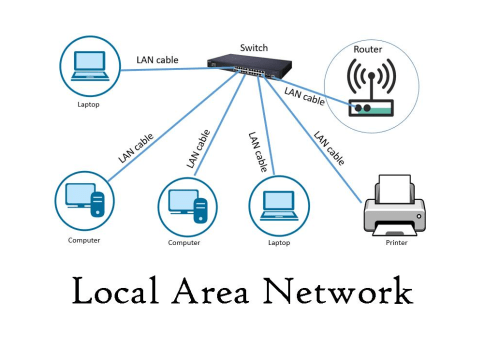
A Local Area Network (LAN) is a computer network that covers a relatively small geographic area, such as a home, office, school, laboratory, or small group of buildings, and is used to connect multiple devices so they can share information and resources efficiently. LANs are essential in modern computing environments because they enable users to communicate, collaborate, and access shared services such as printers, servers, file storage systems, and internet connections with high speed and low latency.
LANs typically use wired connections like Ethernet cables or wireless technologies such as Wi-Fi, both of which provide fast data transfer rates that support real-time communication, multimedia streaming, and data-intensive applications. The structure of a LAN can vary depending on its size and purpose, ranging from a few interconnected devices in a home to hundreds of computers in a corporate or educational network.
Devices on a LAN are usually connected through networking hardware like switches, routers, access points, and network interface cards, which manage data transmission and maintain smooth communication among connected clients. Wired LANs often provide more reliability, stability, and security, while wireless LANs offer greater convenience and mobility, allowing users to connect anywhere within the coverage area. LANs are typically managed by administrators who configure network settings, assign IP addresses, enforce security rules, and ensure that all devices can communicate safely and efficiently.
Security is a major aspect of LAN management, as these networks must be protected from unauthorized access, malware, and data breaches using firewalls, encryption, and secure authentication methods. LANs also support resource sharing, enabling multiple users to print documents, share files, run centralized applications, and access common databases without needing separate equipment for each workstation. Another key advantage of LANs is that they significantly reduce operational costs by centralizing data and making communication faster and more reliable. In educational environments, LANs enable digital learning, computer lab connectivity, and access to shared educational resources.
In offices, LANs support collaboration platforms, enterprise software, video conferencing, and cloud services that improve teamwork and productivity. As technology has evolved, LANs have become faster and more efficient, now supporting gigabit and multi-gigabit speeds that allow seamless transfer of large files and smooth operation of modern applications. LANs also serve as the foundation for connecting to wider networks like Metropolitan Area Networks (MANs), Wide Area Networks (WANs), and the global Internet. Overall, a Local Area Network is a critical component of modern digital infrastructure, providing fast, secure, and reliable communication within a limited geographic area and enabling efficient resource sharing, enhanced collaboration, and seamless technological interaction among users.
3. Metropolitan Area Network (MAN) – Covers a city or town.
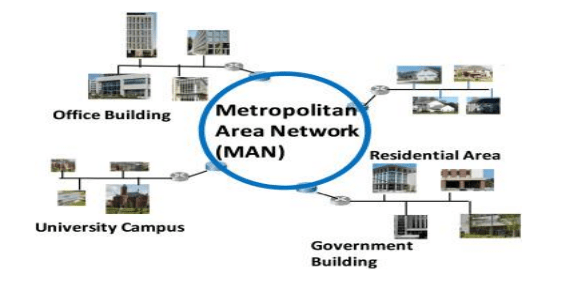
A Metropolitan Area Network (MAN) is a large computer network that spans a city, town, or metropolitan region and is designed to connect multiple Local Area Networks (LANs) within that area so that they can share resources and communicate efficiently. It bridges the gap between smaller LANs and much larger Wide Area Networks (WANs), offering high-speed connectivity across institutions, government offices, businesses, schools, hospitals, and other organizations located within the same urban environment.
MANs often rely on high-capacity fiber-optic cables, microwave links, or other advanced transmission media to provide fast and reliable data transfer across the city, making them suitable for supporting large-scale communication, real-time services, and data-intensive applications. Because MANs cover a wider geographical area than LANs, they are usually managed by telecommunications companies, internet service providers, or municipal authorities who maintain the infrastructure and ensure stable network performance. MANs play a crucial role in connecting public services such as transportation systems, surveillance networks, emergency response teams, and city-wide Wi-Fi, enabling more efficient and coordinated urban operations. They also support businesses by linking branch offices, data centers, and corporate buildings within the city, allowing employees to collaborate seamlessly and access centralized information systems.
In educational environments, MANs connect multiple campuses of a university or different schools within a district, enabling shared access to learning resources, virtual classrooms, and centralized administrative services. One of the significant advantages of MANs is their ability to provide high bandwidth and low latency over relatively long distances, ensuring smooth data flow even when handling heavy traffic. Security in MANs is essential because they support critical city-level communication, so advanced encryption, firewalls, and monitoring systems are used to protect against cyber threats and unauthorized access. MANs can also act as the backbone for internet distribution within a city, connecting users to national or global networks through high-speed gateways. With the growth of smart cities, MANs have become even more important, enabling technologies such as smart traffic control, public safety systems, environmental monitoring sensors, and digital public services.
They contribute to improving the quality of life in urban areas by supporting efficient communication, better service delivery, and enhanced technological innovation. MANs are scalable, meaning they can grow as the city expands or as new institutions require connectivity, and their robust infrastructure ensures continuity even during high-demand periods. They also help reduce communication costs for organizations by allowing shared access to high-speed communication channels instead of relying on separate connections for each site. Overall, a Metropolitan Area Network is a vital communication system for modern cities, providing high-speed, reliable, and secure connectivity across an entire urban region and enabling efficient operation of public services, businesses, and digital technologies that improve both productivity and urban living.
4. Wide Area Network (WAN) – Spans large areas like countries or continents (e.g., the Internet).
A Wide Area Network (WAN) is a large communication network that spans vast geographical areas such as countries, continents, or even the entire globe, enabling devices and smaller networks located far apart to connect and share information. WANs link together multiple Local Area Networks (LANs) and Metropolitan Area Networks (MANs), allowing organizations, governments, and individuals to communicate across long distances using a variety of communication technologies.
The most well-known example of a WAN is the Internet, which connects millions of computers and networks worldwide, enabling instant access to information, online communication, cloud services, and digital resources. WANs often rely on high-capacity communication technologies such as fiber-optic cables, satellite links, undersea cables, microwave transmission, and leased telecommunication lines to ensure efficient and reliable data transfer over long distances. Because WANs cover such large areas, they are usually maintained and managed by telecommunications companies, internet service providers, and global network operators with the resources to build, monitor, and protect such extensive infrastructure.
WANs are crucial for global connectivity because they allow businesses to operate across multiple regions, enabling remote offices, data centers, and international branches to communicate as if they were located in the same building. Governments also depend on WANs for national security systems, military communication, public service networks, and large-scale data management. WANs support various services such as email, video conferencing, cloud computing, VoIP calling, remote access to corporate networks, and worldwide data sharing. Security is a major concern in WANs due to the vast number of interconnected devices and networks, so strong encryption, firewalls, virtual private networks (VPNs), and intrusion detection systems are needed to protect data from cyber threats. WANs must also handle high levels of traffic, requiring routing protocols, network management software, and load balancing techniques to ensure smooth, uninterrupted communication.
The performance of a WAN depends on bandwidth availability, latency levels, and the quality of the underlying physical infrastructure, which can be affected by distance, weather, and network congestion. WANs have enabled globalization by allowing businesses to collaborate internationally, enabling online commerce, digital banking, and global supply chain management. They also make modern online services such as streaming platforms, social media, cloud storage, and online gaming possible by connecting users around the world. Innovations such as 5G, satellite internet, software-defined WAN (SD-WAN), and edge computing continue to improve WAN efficiency, speed, and reliability.
WANs are essential for disaster recovery, as organizations can store data in remote locations to protect it from local outages or natural disasters. They also support education by enabling online classes, global research collaboration, and access to digital libraries. Overall, a Wide Area Network is one of the most important components of modern communication infrastructure, enabling worldwide connectivity, supporting global business operations, and providing the foundation for nearly all digital services that people rely on today.

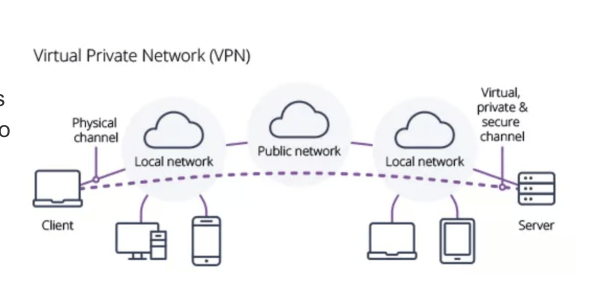
5. Virtual Private Network (VPN) – Secures private communications over public networks.
A Virtual Private Network (VPN) is a secure technology that allows users to create a protected and encrypted connection over a public network, such as the Internet, making it appear as though they are communicating through a private and dedicated network. VPNs are used to protect sensitive data from hackers, unauthorized access, and cyber threats by encrypting all information that travels between a user’s device and the VPN server, ensuring that even if the data is intercepted, it cannot be read or misused. When a user connects to a VPN, their real IP address is hidden, and the VPN server assigns a new virtual IP address, enhancing privacy and making online activity more difficult to trace.
This feature is especially important for users accessing public Wi-Fi networks, which are often insecure and vulnerable to attacks like eavesdropping or data theft. VPNs are widely used by businesses to allow employees to securely access corporate networks from remote locations, enabling efficient remote work while maintaining the safety of company data. They also help users access region-restricted or geo-blocked content by allowing them to connect to servers in different countries, making it appear as if they are browsing from that region. VPNs operate through secure protocols such as OpenVPN, IPSec, L2TP, and WireGuard, each offering different levels of encryption, speed, and security. These protocols help ensure that data is transmitted safely across long distances without compromising performance.
VPN services often include additional features such as kill switches, which automatically disconnect the internet if the VPN connection drops, preventing accidental exposure of data. Many VPNs also block malicious websites, prevent tracking, and stop advertisers from collecting user information. In corporate environments, VPNs play a key role in enabling secure file sharing, access to internal databases, remote server management, and communication between branch offices located in different regions. Governments, journalists, and activists also use VPNs to bypass censorship, protect freedom of expression, and safeguard communication from surveillance. However, not all VPNs offer the same level of protection, so choosing a trusted provider with strong encryption, a no-log policy, and reliable servers is essential.
VPNs must also be regularly updated to stay secure against evolving cyber threats. While VPNs enhance privacy, they can sometimes reduce internet speed due to encryption overhead and the distance to the VPN server. Modern VPN technologies aim to minimize this slowdown by optimizing server performance and improving protocol efficiency. VPNs are integral to modern cybersecurity because they offer both privacy and secure access, which are crucial in a world where digital threats are constantly increasing. They support online safety in everyday activities such as browsing, banking, streaming, and teleworking by ensuring that data remains protected at all times. Overall, a Virtual Private Network provides a powerful and reliable way to secure communications, maintain privacy, and enable safe access to digital services over public networks, making it an essential tool for individuals, businesses, and organizations in today’s interconnected world.