Introduction
Cloud DevOps has become one of the most in-demand career paths in tech. Companies are rapidly adopting cloud platforms and automation practices to deliver software faster, more reliably, and at scale. If you’re starting from scratch, the journey can feel overwhelming but with the right roadmap, you can navigate it step by step.
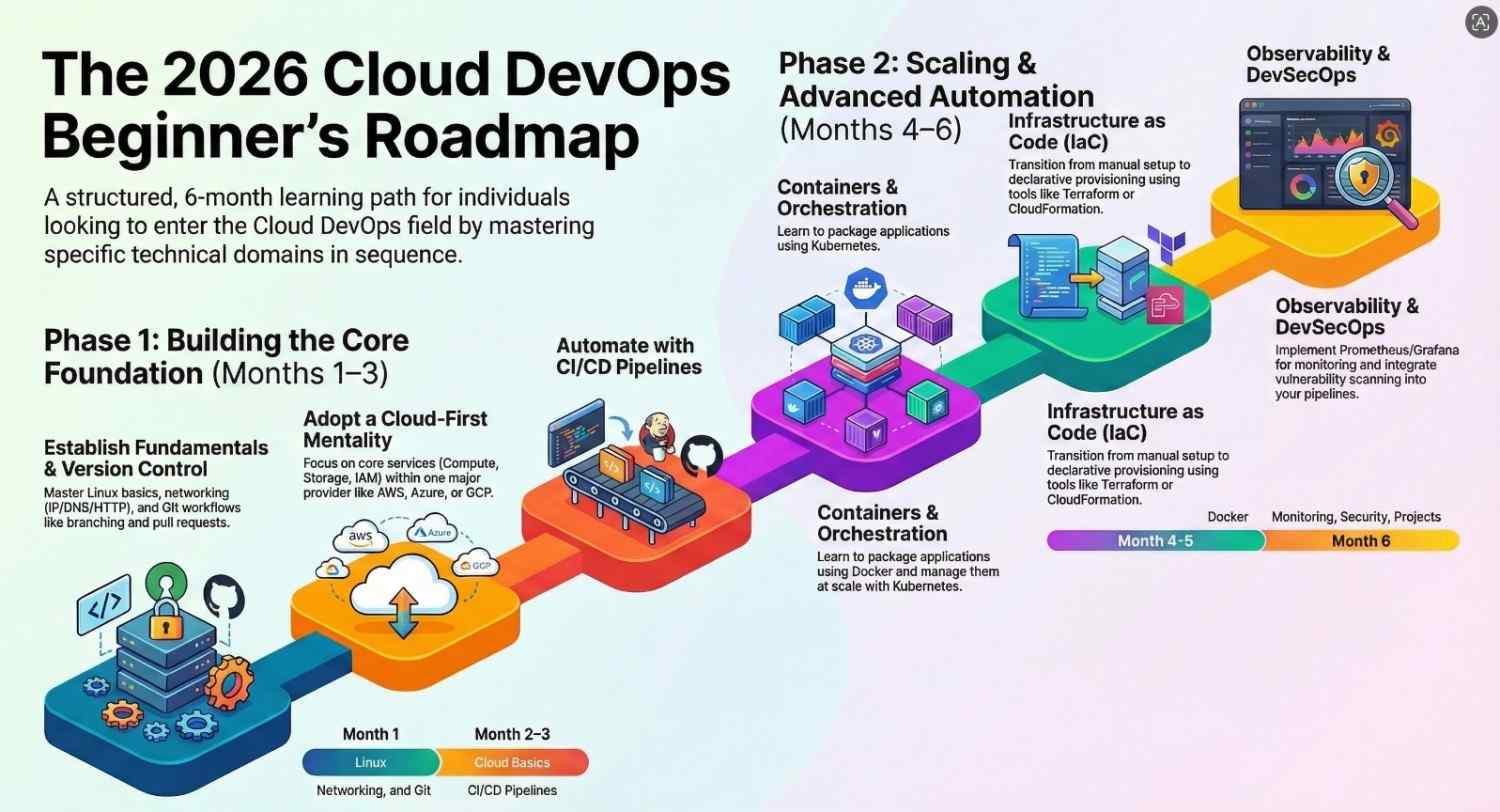
This Cloud DevOps Roadmap for Beginners (2026 Edition) is a structured guide to help you understand what to learn, in what order, and how to build real-world skills.
What is Cloud DevOps?
Cloud DevOps combines:
- Cloud Computing (infrastructure, scalability, services)
- DevOps Practices (automation, CI/CD, monitoring, collaboration)
The goal:
Deliver applications faster, safer, and more efficiently
Step-by-Step Cloud DevOps Roadmap
Learn the Fundamentals (Weeks 1–4)
Before jumping into tools, build a strong foundation.
🔹 Key Topics:
- Operating Systems (Linux basics)
- Networking fundamentals (IP, DNS, HTTP/HTTPS)
- Basic scripting (Bash or Python)
- Version control concepts
Master Version Control (Weeks 3–5)
Version control is the backbone of DevOps.
🔹 Learn:
- Repositories, commits, branches
- Pull requests & merge conflicts
- Collaboration workflows
Practice:
- Create your own repositories
- Contribute to open source
Understand Cloud Platforms (Weeks 5–8)
Cloud is essential for modern DevOps.
🔹 Learn Core Services:
- Compute (virtual machines)
- Storage (object/block storage)
- Networking (VPC, load balancers)
- IAM (identity & access management)
Tip:
Start with one cloud provider, then expand.
- cloud computing basics
- AWS for beginners DevOps
- Azure DevOps learning path
- GCP beginner guide
Learn CI/CD (Weeks 8–10)
CI/CD automates building, testing, and deployment.
🔹 Concepts:
- Continuous Integration
- Continuous Delivery vs Deployment
- Pipelines and workflows
Hands-On:
- Build a CI/CD pipeline for a simple app
Containers & Orchestration (Weeks 10–14)
This is a core DevOps skill in 2026.
🔹 Learn:
- Containerization concepts
- Images, containers, registries
- Orchestration basics
Practice:
- Containerize an application
- Deploy using orchestration tools
Infrastructure as Code (Weeks 14–16)
Manage infrastructure using code instead of manual setup.
🔹 Learn:
- Declarative vs imperative approach
- Infrastructure provisioning
- State management
Practice:
- Create infrastructure using code templates
Configuration Management (Weeks 16–18)
Automate system setup and configuration.
Learn:
- Configuration automation
- Idempotency
- Playbooks & roles
Monitoring & Logging (Weeks 18–20)
You can’t improve what you don’t measure.
Learn:
- Metrics, logs, traces
- Alerting systems
- Observability
Practice:
- Set up dashboards and alerts
DevSecOps Basics (Weeks 20–22)
Security is now part of DevOps.
🔹 Learn:
- Secure pipelines
- Vulnerability scanning
- Secrets management
Real-World Projects (Weeks 22–26)
Projects are what make you job-ready.
Project Ideas:
- Build a CI/CD pipeline for a web app
- Deploy a containerized app to the cloud
- Automate infrastructure setup
- Set up monitoring and alerts
Essential DevOps Tools List (2026)
Here’s what you should aim to learn:
Version Control
Cloud Platforms
- AWS / Azure / GCP
CI/CD
- Jenkins / GitHub Actions / GitLab CI
Containers
- Docker / Kubernetes
Infrastructure as Code
- Terraform / CloudFormation
Monitoring
- Prometheus / Grafana
Security
- Vault / SonarQube
Suggested 6-Month Learning Plan
| Month | Focus Area |
|---|---|
| 1 | Linux + Networking + Git |
| 2 | Cloud Basics |
| 3 | CI/CD |
| 4 | Docker + Kubernetes |
| 5 | Terraform + Config Mgmt |
| 6 | Monitoring + Projects |
Common Mistakes to Avoid
- Learning too many tools at once
- Skipping fundamentals
- Not doing hands-on practice
- Ignoring networking concepts
- Avoiding real-world projects
Career Opportunities
After completing this roadmap, you can apply for:
- Junior DevOps Engineer
- Cloud Engineer
- Site Reliability Engineer (SRE)
- Platform Engineer
Pro Tips for Success
- Build projects and upload to GitHub
- Write technical blogs to showcase learning
- Practice daily (consistency beats intensity)
- Join DevOps communities
- Learn debugging and troubleshooting
Final Thoughts
Cloud DevOps is not just about tools it’s about mindset, automation, and continuous improvement.
If you follow this roadmap consistently:
- You’ll build strong fundamentals
- Gain hands-on experience
- Become job-ready within 6 months
Your Next Step
Start today:
- Install Linux or use a virtual machine
- Learn Git basics
- Create your first repository
- Build something small and deploy it
Small steps → Big results.