
Introduction.
DevOps has become one of the most in-demand career paths in the IT industry. As companies move faster toward cloud and automation, DevOps skills are no longer optional. This growing demand has led to a surge in DevOps training programs worldwide. However, choosing the right DevOps course can be confusing for beginners. Many learners struggle to understand what a DevOps course actually covers. Others are unsure whether the syllabus matches real industry requirements. Another common concern is whether the DevOps course price justifies the skills offered.
This is where a clear explanation of the DevOps course syllabus becomes essential. A well-structured syllabus shows the learning journey from fundamentals to advanced concepts. It helps students understand what they will learn at each stage of the course. For those exploring devops courses for beginners, syllabus clarity is especially important. Beginners need a strong foundation before moving to complex tools and practices. Without a proper learning sequence, DevOps can feel overwhelming.
A complete DevOps syllabus typically starts with core IT and Linux fundamentals. It then gradually introduces automation, CI/CD pipelines, and containerization. Advanced modules focus on cloud platforms, Kubernetes, and infrastructure as code. Security, monitoring, and real-world DevOps practices are also key components. Each module builds on the previous one to create job-ready skills.
Understanding the DevOps syllabus also helps learners compare different courses. It allows students to identify missing or outdated topics. This comparison becomes crucial when evaluating the DevOps course price. Not all expensive courses offer better content. Likewise, low-cost courses may lack hands-on projects.
For working professionals, time investment matters as much as cost. For freshers, beginner-friendly explanations are critical. That is why devops courses for beginners should focus on clarity and practical learning. Hands-on labs and real-world projects make a big difference.
In this blog, we explain the DevOps course syllabus from beginner to advanced level. Each stage is broken down in a simple and structured way. You will understand what topics are covered and why they matter. This guide will help you decide if a course fits your career goals. It will also help you judge whether the DevOps course price is worth paying. Whether you are new to DevOps or planning to upskill, this syllabus breakdown will help.
Let’s explore the complete DevOps learning path step by step.
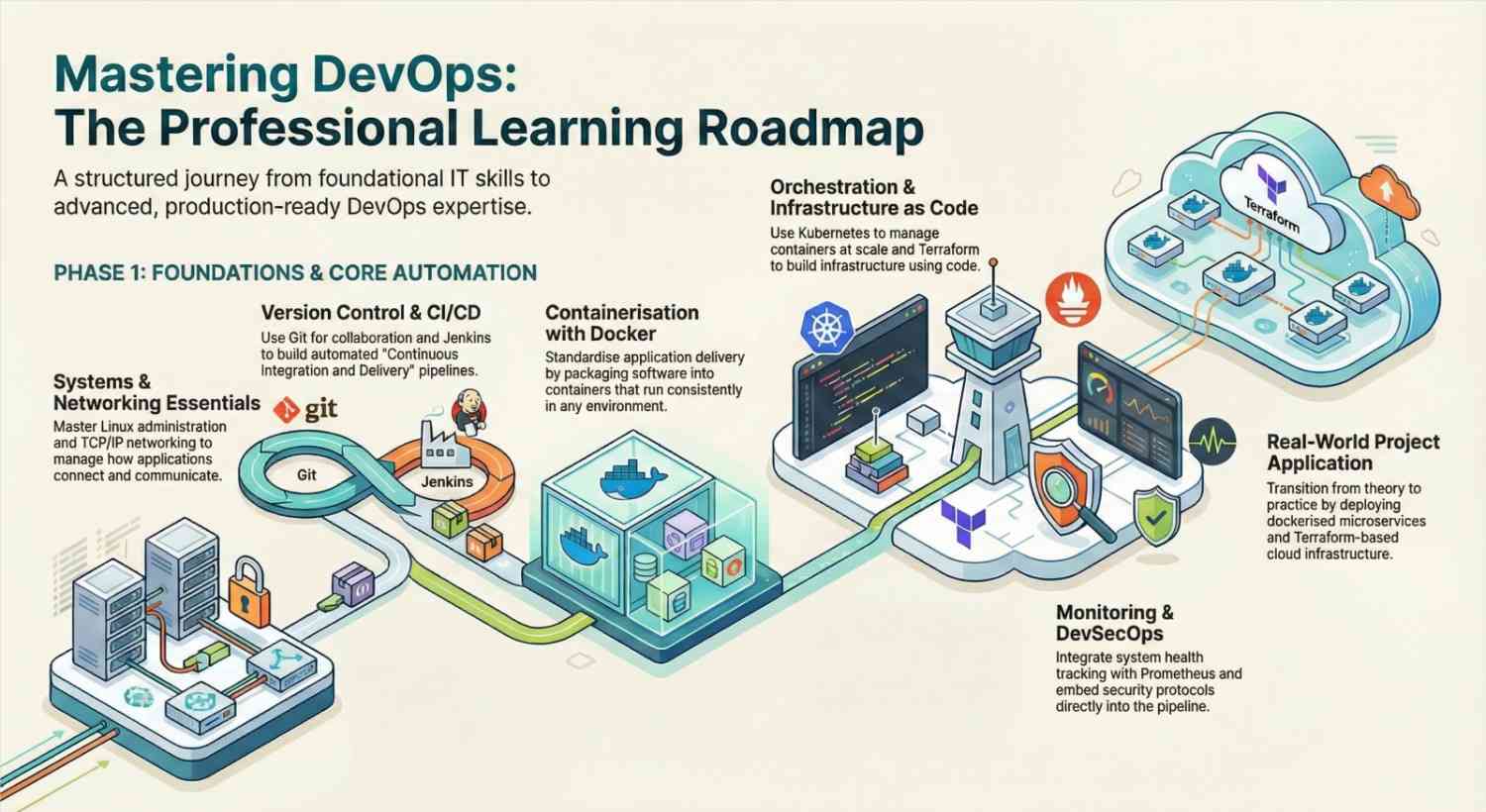
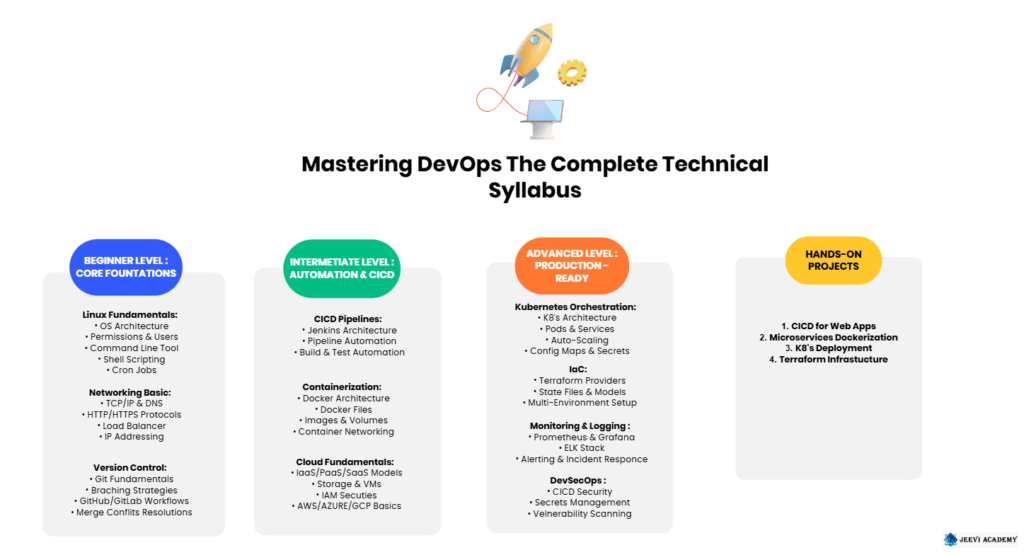
Beginner Level: Core Foundations
At this stage, the goal is to build strong system and development fundamentals.
Linux Fundamentals
Linux is the backbone of DevOps.
Topics covered:
- Linux OS basics & architecture
- File system, permissions, users & groups
- Essential commands (
ls,grep,awk,sed,ps,top) - Package management
- Basic shell scripting
- Cron jobs & automation basics
Outcome: You can confidently work on Linux servers.
For additional details on Linux Commands.
Networking Basics for DevOps
Understanding how systems communicate is critical.
Topics covered:
- TCP/IP, DNS, HTTP/HTTPS
- Ports & protocols
- Load balancers & firewalls
- IP addressing & subnetting
- Networking troubleshooting basics
Outcome: You understand how applications connect and fail.
Version Control with Git
Collaboration starts with version control.
Topics covered:
- Git fundamentals (clone, commit, push, pull)
- Branching & merging strategies
- GitHub/GitLab workflows
- Resolving merge conflicts
- Git best practices
Outcome: You can manage and collaborate on code efficiently.
For additional details on Git.
Intermediate Level: Automation & CI/CD
This phase focuses on automation, pipelines, and containers.
CI/CD (Continuous Integration & Delivery)
The heart of DevOps.
Topics covered:
- CI/CD concepts & benefits
- Jenkins architecture
- Jenkins pipelines (Declarative & Scripted)
- Build, test & deploy automation
- Integrating Git with CI/CD tools
Outcome: You can build end-to-end automated pipelines.
For additional details on Jenkins.
Containerization with Docker
Containers standardize application delivery.
Topics covered:
- Docker architecture
- Images & containers
- Writing Dockerfiles
- Docker networking & volumes
- Container best practices
Outcome: You can containerize and run applications anywhere.
For additional details on Docker.
Cloud Fundamentals (AWS / Azure / GCP)
Modern DevOps runs on the cloud.
Topics covered:
- Cloud service models (IaaS, PaaS, SaaS)
- Virtual machines & storage
- IAM & security basics
- Networking in cloud
- Cloud deployment basics
Outcome: You can deploy applications on cloud platforms.
For additional details on AWS.
Advanced Level: Production-Ready DevOps
This stage focuses on scalability, security, and real-world DevOps practices.
Kubernetes (Container Orchestration)
Managing containers at scale.
Topics covered:
- Kubernetes architecture
- Pods, deployments, services
- ConfigMaps & secrets
- Auto-scaling & rolling updates
- Kubernetes networking
Outcome: You can deploy and manage scalable applications.
Infrastructure as Code (Terraform)
Automate infrastructure creation.
Topics covered:
- IaC concepts
- Terraform providers & resources
- State files & modules
- Terraform best practices
- Managing multi-environment setups
Outcome: You can create infrastructure using code.
Monitoring & Logging
Visibility into systems is critical.
Topics covered:
- Monitoring vs logging
- Prometheus fundamentals
- Grafana dashboards
- ELK stack basics
- Alerting & incident response
Outcome: You can monitor system health and performance.
DevSecOps & Security
Security integrated into DevOps.
Topics covered:
- DevSecOps principles
- Secrets management
- CI/CD security best practices
- Container & Kubernetes security
- Vulnerability scanning basics
Outcome: You can build secure DevOps pipelines.
Projects & Hands-On Labs
A good DevOps course always includes real-world projects, such as:
- CI/CD pipeline for a web application
- Dockerized microservices app
- Kubernetes deployment project
- Terraform-based cloud infrastructure
- Monitoring setup with alerts
Outcome: Resume-ready, job-relevant experience.
Final Outcome of the Course
After completing the DevOps syllabus, you will be able to:
- Automate software delivery pipelines
- Manage cloud infrastructure
- Deploy scalable applications
- Monitor and secure production systems
- Prepare for DevOps certifications & interviews
Who Is This Course For?
- Freshers entering IT
- System administrators
- Developers transitioning to DevOps
- Cloud & automation engineers
Final Thoughts
A beginner-to-advanced DevOps syllabus ensures you don’t just learn tools, but also how DevOps works in real companies. Always choose a course that balances theory, hands-on labs, and real projects.
To explore DevOps in more detail, visit Jeevi’s dedicated page. This tutorial is just the first step master DevOps with hands-on learning in our complete course.