Launching a startup is a race against time. You’re shipping fast, validating ideas, and trying to scale all while keeping costs low and reliability high. This is where DevOps becomes a superpower.
But here’s the catch: most startups either over-engineer too early or ignore DevOps completely until things break.
This guide walks you through exactly what to set up in your first 30 days, using practical steps, modern tools, and startup-friendly DevOps practices.
Why DevOps Matters for Startups
DevOps is not just about tools it’s about speed, reliability, and automation.
For startups, it helps you:
- Ship features faster
- Reduce downtime
- Scale without chaos
- Control cloud costs
- Build a strong engineering foundation early
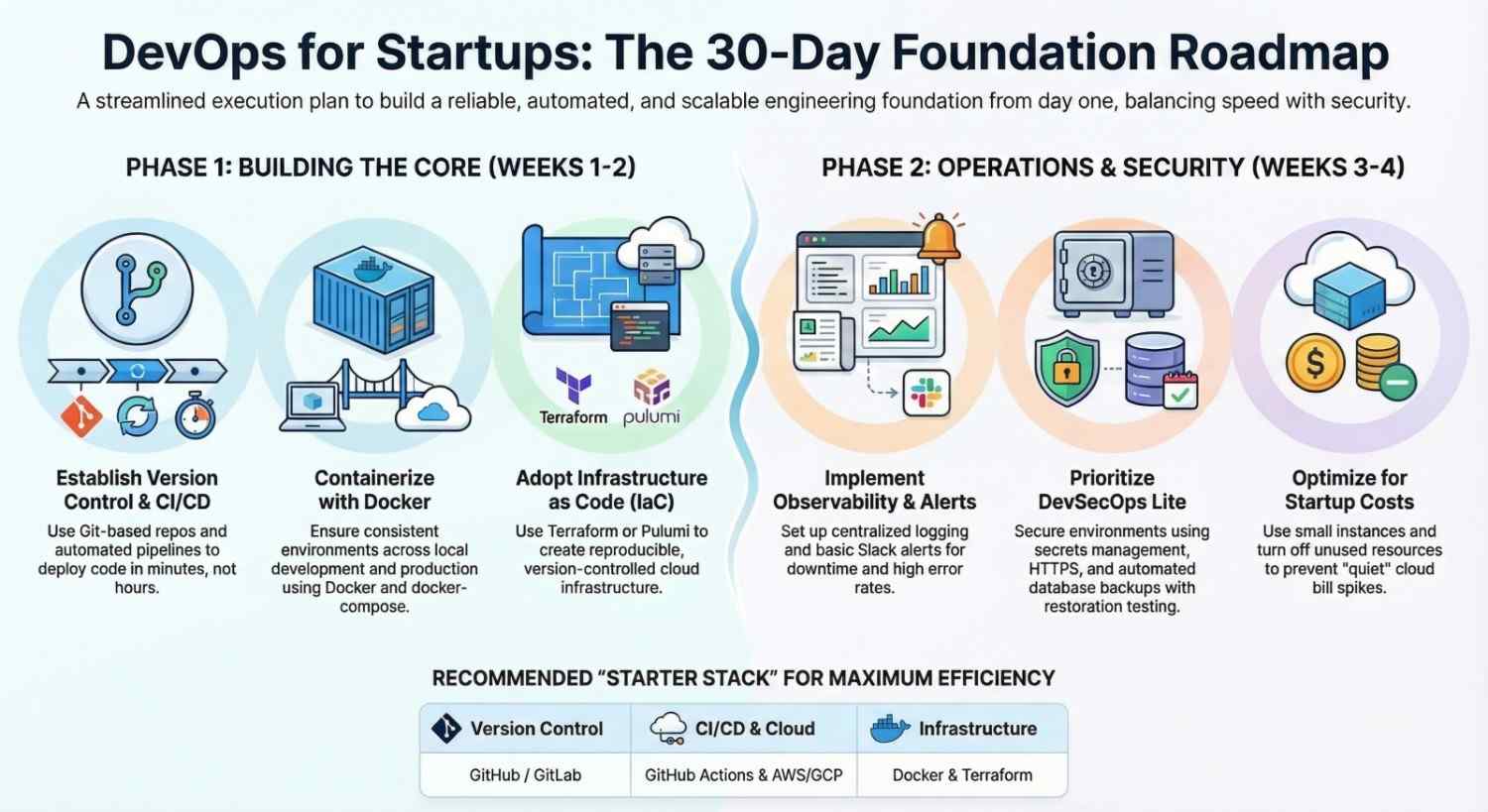
Week 1: Build the Foundation
1. Version Control (Non-Negotiable)
Start with:
- Git-based repository (GitHub, GitLab, Bitbucket)
- Clear branching strategy:
main→ productiondev→ staging- feature branches
Best practices:
- Enforce pull requests
- Add code reviews
- Use commit message conventions
2. Basic CI/CD Pipeline
Set up a simple CI/CD pipeline:
- Run tests on every commit
- Auto-deploy on merge to main
Start simple:
- Build → Test → Deploy
Goal: Deploy code in minutes, not hours.
3. Containerization with Docker
Why Docker?
- Consistent environments
- Easy deployment
- Faster onboarding
What to do:
- Create a Dockerfile
- Containerize your app
- Use docker-compose for local dev
Week 2: Cloud & Infrastructure Setup
4. Choose a Cloud Provider
Pick one (don’t overthink multi-cloud early):
Focus on:
- Simplicity
- Free credits
- Managed services
5. Infrastructure as Code (IaC)
Avoid manual setups.
Use:
- Terraform or Pulumi
Benefits:
- Reproducible infrastructure
- Easy scaling
- Version-controlled infra
6. Environment Setup
At minimum:
- Development
- Staging
- Production
Why this matters:
- Prevents breaking production
- Enables safe testing
Week 3: Monitoring, Logging & Alerts
7. Monitoring & Observability
Track:
- CPU, memory usage
- API response times
- Error rates
Goal: Know when things break before users complain.
8. Logging System
Set up:
- Centralized logs (not scattered logs)
Benefits:
- Faster debugging
- Better visibility
9. Alerts & Incident Response
Set alerts for:
- Downtime
- High latency
- Errors
Keep it simple:
- Email or Slack alerts are enough early on
Week 4: Security, Scaling & Cost Control
10. Basic Security (DevSecOps Lite)
Must-haves:
- Environment variables for secrets
- HTTPS everywhere
- Role-based access control
Avoid:
- Hardcoding secrets
- Publicly exposed keys
11. Backup & Recovery
Ask yourself:
- Can you recover your database in minutes?
Set up:
- Automated backups
- Restore testing
12. Cost Optimization (Critical for Startups)
Tips:
- Use small instances
- Turn off unused resources
- Monitor usage regularly
Golden rule: Don’t pay for what you don’t use.
13. Basic Scaling Strategy
Start with:
- Vertical scaling (upgrade server size)
Then move to:
- Horizontal scaling (multiple instances)
Recommended DevOps Stack for Startups
Here’s a simple, proven stack:
- Version Control → GitHub
- CI/CD → GitHub Actions
- Containers → Docker
- Cloud → AWS / GCP
- IaC → Terraform
- Monitoring → Prometheus + Grafana
- Logging → ELK stack or managed logging
- Alerts → Slack + email
Common DevOps Mistakes Startups Make
1. Overengineering Too Early
You don’t need Kubernetes on Day 1.
2. Ignoring Monitoring
If you can’t see it, you can’t fix it.
3. Manual Deployments
Manual = slow + error-prone.
4. No Backup Strategy
One mistake = total data loss.
5. Poor Cost Management
Cloud bills can quietly kill startups.
Pro Tips for the First 30 Days
- Automate everything you repeat twice
- Keep infrastructure simple
- Focus on speed over perfection
- Document your setup
- Prioritize reliability early
What Success Looks Like After 30 Days
By the end of your first month, you should have:
- Automated deployments
- Containerized application
- Cloud infrastructure running
- Monitoring + logging setup
- Basic security in place
- Controlled cloud costs
What to Do After 30 Days
Once your foundation is ready, move to:
- Advanced CI/CD pipelines
- Kubernetes (only if needed)
- DevSecOps automation
- Performance optimization
- Platform engineering
Final Thoughts
DevOps for startups isn’t about using the most advanced tools it’s about building a system that helps you move fast without breaking things.
In your first 30 days:
- Keep it simple
- Automate the essentials
- Focus on reliability
Because the real goal isn’t just launching it’s scaling smoothly when success hits.
- If you want to explore DevOps, start your training here.