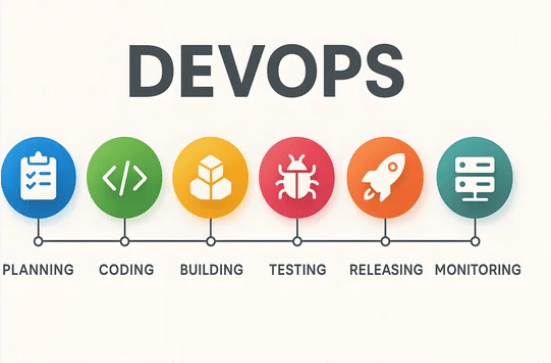
DevOps is no longer just a buzzword it’s the backbone of modern software delivery. As we move into 2026, companies expect DevOps engineers to do far more than manage CI/CD pipelines. Cloud optimization, security, automation, and platform engineering are now part of the role.
If you’re confused by endless tool lists and unrealistic expectations, this guide is for you. This DevOps roadmap 2026 is designed to take you from beginner to expert using a dynamic roadmap approach focused on skills, not just tools.
Table of Contents
ToggleWhy a Dynamic DevOps Roadmap Matters in 2026
Traditional roadmaps fail because DevOps evolves rapidly. Tools change, but fundamentals don’t.
A dynamic roadmap means:
- Learning concepts first, tools second
- Adapting skills based on job market demand
- Building real-world projects, not just certifications
Instead of chasing every new tool, you’ll learn how systems work, so switching tools becomes easy.
Phase 1: Foundations (Beginner Level)
1. Linux & Operating Systems
Linux remains the heart of DevOps.
Focus on:
- File systems, permissions, users, processes
- Systemd, logs, package managers
- Bash scripting
Goal: Be comfortable managing servers without a GUI.
2. Networking Basics
You don’t need to be a network engineer, but you must understand:
- TCP/IP, DNS, HTTP/HTTPS
- Load balancers, proxies
- Firewalls and ports
Why it matters: Most production issues are networking-related.
3. Version Control (Git)
Git is non-negotiable.
Learn:
- Git workflows (GitFlow, trunk-based)
- Pull requests and code reviews
- Resolving merge conflicts
Outcome: You can collaborate confidently with developers.
Phase 2: Core DevOps Skills (Junior → Mid-Level)
4. CI/CD Pipelines
This is where DevOps truly begins.
Learn concepts first:
- Continuous Integration vs Continuous Delivery vs Deployment
- Build, test, release pipelines
Popular tools:
- Jenkins
- GitHub Actions
- GitLab CI
Project idea: Build a pipeline that tests and deploys an app automatically.
5. Cloud Fundamentals (AWS Focus)
Cloud skills are mandatory in 2026.
This is where the AWS DevOps road map fits in.
Core AWS services:
- EC2, S3, IAM
- VPC, Load Balancers
- RDS, DynamoDB
Understand:
- Shared responsibility model
- Cost optimization basics
Tip: Don’t memorize services understand use cases.
6. Containers (Docker)
Containers standardized software delivery.
Key topics:
- Dockerfiles & images
- Container networking
- Multi-stage builds
Outcome: You can containerize any application.
Phase 3: Kubernetes & Infrastructure (Mid-Level)
7. Kubernetes (K8s)
Kubernetes is the operating system of the cloud.
Learn:
- Pods, Deployments, Services
- ConfigMaps, Secrets
- Ingress controllers
- Helm basics
Reality check: You don’t need to master everything focus on operating workloads.
8. Infrastructure as Code (IaC)
Manual infrastructure is dead.
Tools:
- Terraform (industry standard)
- CloudFormation (AWS-native)
Concepts:
- Idempotency
- State management
- Modular infrastructure
Project idea: Provision an AWS environment using Terraform.
Phase 4: Observability & Security (Senior-Level)
9. Monitoring & Observability
If you can’t observe it, you can’t fix it.
Learn:
- Metrics, logs, traces
- SLIs, SLOs, SLAs
Popular tools:
- Prometheus
- Grafana
- OpenTelemetry
Skill that stands out: Troubleshooting production issues calmly.
10. DevSecOps
Security is now everyone’s responsibility.
Key areas:
- Secrets management
- Vulnerability scanning
- CI/CD security
- IAM best practices
Tools:
- Trivy
- Snyk
- Vault
Mindset shift: Security by default, not as an afterthought.
Phase 5: Advanced & Expert Level (2026 Expectations)
11. AWS DevOps at Scale
At senior levels, the AWS DevOps road map goes beyond basics.
Focus on:
- Auto Scaling & high availability
- Disaster recovery strategies
- Blue/Green & Canary deployments
- Multi-account AWS architecture
Outcome: You design systems, not just manage them.
12. SRE & Platform Engineering Concepts
Modern DevOps overlaps with:
- Site Reliability Engineering (SRE)
- Platform Engineering
Key concepts:
- Error budgets
- Internal developer platforms
- Self-service infrastructure
This is where DevOps careers are heading in 2026.
Projects-Based Learning (Most Important Part)
Certifications help, but projects get you hired.
Build:
- CI/CD pipeline with AWS + Docker
- Kubernetes cluster with monitoring
- Terraform-managed AWS infrastructure
- Secure deployment with DevSecOps tools
Document everything in GitHub and blogs.
DevOps Roadmap Timeline (Realistic)
- 0–3 months: Foundations + Git + Linux
- 3–6 months: CI/CD + Docker + AWS basics
- 6–12 months: Kubernetes + Terraform + Monitoring
- 12+ months: Advanced AWS, SRE, Platform Engineering
Everyone’s journey is different this is a dynamic roadmap, not a rigid checklist.
Common DevOps Roadmap Mistakes
Avoid these in 2026:
- Learning tools without understanding concepts
- Skipping Linux and networking
- Chasing certifications without projects
- Trying to learn everything at once
Final Thoughts
The DevOps roadmap 2026 is not about mastering every tool it’s about mastering systems, automation, and reliability.
Whether you’re following an AWS DevOps road map or a multi-cloud path, success comes from:
- Strong fundamentals
- Hands-on practice
- Continuous learning
Treat this guide as a dynamic roadmap adapt it, revisit it, and evolve with the industry.