
In modern IT, DevOps and Cloud Computing are often mentioned together sometimes even confused as the same thing. Job listings blend the terms, tools overlap, and career paths seem to intersect. This leads to common questions like: DevOps vs Cloud Computing: which is better? or Cloud Computing vs DevOps engineer what’s the real difference?
This article breaks it all down clearly. We’ll explore what DevOps and Cloud Computing are, how they differ, how they work together, and how to choose between them as a career path, including a look at DevOps vs Cloud Computing salary trends.
1. What Is Cloud Computing?
Cloud Computing is the delivery of computing resources such as servers, storage, databases, networking, and software over the internet instead of on physical hardware.
Instead of buying and maintaining servers, organizations rent infrastructure from cloud providers like:
Key Characteristics of Cloud Computing
- On-demand resource provisioning
- Pay-as-you-go pricing
- Global scalability
- High availability and redundancy
Cloud computing focuses on infrastructure and services, not how software is built or deployed.
2. What Is DevOps?
DevOps is a culture, practice, and set of tools that brings software development (Dev) and IT operations (Ops) together. The goal is to deliver software faster, more reliably, and with fewer failures.
DevOps emphasizes:
- Automation
- Continuous Integration and Continuous Deployment (CI/CD)
- Collaboration between teams
- Monitoring and feedback loops
DevOps is not a technology it’s a way of working.
3. DevOps vs Cloud Computing: Core Difference
The simplest way to understand the difference:
- Cloud Computing answers: Where does your application run?
- DevOps answers: How do you build, deploy, and maintain it?
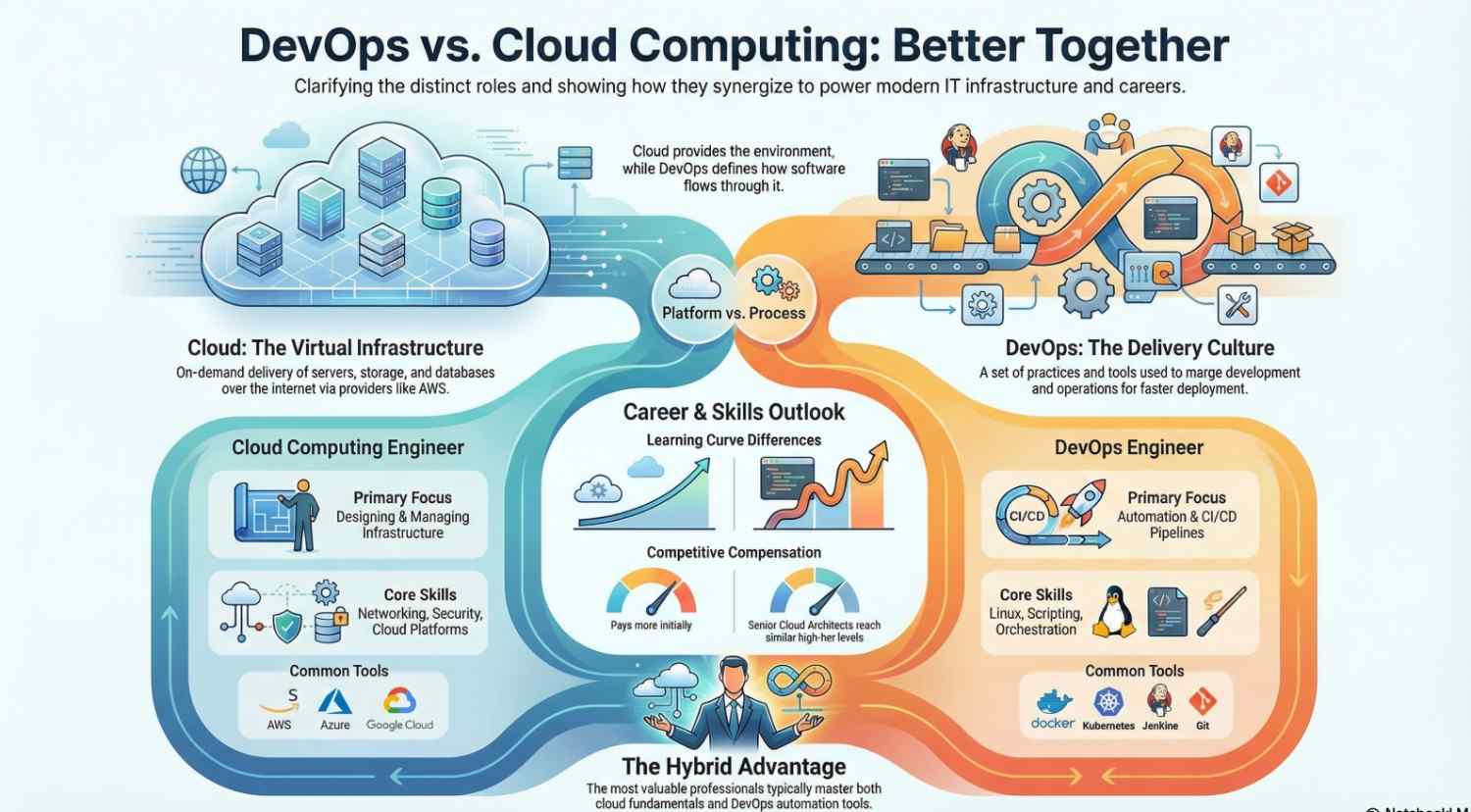
Cloud computing provides the platform, while DevOps defines the process.
4. How DevOps and Cloud Computing Work Together
DevOps and Cloud Computing are highly complementary. In fact, modern DevOps practices are much harder to implement without cloud platforms.
Cloud Enables DevOps by Providing:
- Instant infrastructure provisioning
- Elastic scaling for CI/CD pipelines
- Managed services for databases, monitoring, and logging
- Infrastructure as Code (IaC) support
DevOps Enhances Cloud by:
- Automating deployments
- Reducing cloud costs through efficiency
- Improving reliability and uptime
- Enabling faster experimentation
In practice, most DevOps teams work on top of cloud platforms.
5. DevOps vs Cloud Computing: Tools Comparison
Cloud Computing Tools
DevOps Tools
- Git, GitHub, GitLab
- Jenkins, GitHub Actions, GitLab CI
- Docker, Kubernetes
- Terraform, Ansible
- Prometheus, Grafana
Many DevOps tools are used inside cloud environments, which is why the roles often overlap.
6. Cloud Computing vs DevOps Engineer: Role Comparison
Cloud Computing Engineer
Focuses on:
- Designing cloud infrastructure
- Managing cloud services
- Optimizing performance and cost
- Ensuring security and compliance
Skills required:
- Cloud platforms (AWS/Azure/GCP)
- Networking and security
- Storage and compute optimization
DevOps Engineer
Focuses on:
- CI/CD pipelines
- Automation
- Deployment strategies
- Monitoring and reliability
Skills required:
- Linux and scripting
- CI/CD tools
- Containers and orchestration
- Infrastructure as Code
This Cloud Computing vs DevOps engineer comparison shows that cloud engineers build and manage the environment, while DevOps engineers optimize how software flows through it.
7. DevOps vs Cloud Computing: Which Is Better?
This is one of the most searched questions:
DevOps vs Cloud Computing which is better?
The honest answer: neither is better universally.
Choose Cloud Computing If:
- You enjoy infrastructure and architecture
- You like working with cloud services
- You prefer system design over pipelines
- You want a strong foundation in IT infrastructure
Choose DevOps If:
- You enjoy automation and scripting
- You like improving development workflows
- You enjoy problem-solving production issues
- You want to work closely with developers
In real-world companies, DevOps and cloud skills are often combined.
8. DevOps vs Cloud Computing Salary Comparison
Another major factor is compensation. Let’s look at DevOps vs Cloud Computing salary trends globally.
DevOps Engineer Salary (Approximate)
- Entry-level: High compared to traditional IT roles
- Mid-level: Competitive due to demand
- Senior-level: Among the highest in tech roles
Cloud Computing Engineer Salary
- Entry-level: Strong but slightly lower than DevOps in some regions
- Mid-level: Very competitive
- Senior-level: Similar to DevOps, especially for cloud architects
Salary Insight
DevOps engineers often earn slightly more early in their careers due to automation expertise.
Cloud architects can earn more at senior levels, especially in large enterprises.
Ultimately, skills matter more than titles.
9. Career Growth: DevOps vs Cloud Computing
Cloud Computing Career Path
- Cloud Support Engineer
- Cloud Engineer
- Cloud Architect
- Cloud Solutions Architect
DevOps Career Path
- Junior DevOps Engineer
- DevOps Engineer
- Senior DevOps Engineer
- SRE / Platform Engineer
Many professionals move between these paths during their careers.
10. Learning Curve Comparison
Cloud Computing Learning Curve
- Easier to start
- Requires understanding of infrastructure basics
- Certification-driven learning path
DevOps Learning Curve
- Steeper
- Requires coding, Linux, automation
- Hands-on experience is critical
If you prefer structured learning, cloud may feel easier at first.
11. Certifications: DevOps vs Cloud
Popular Cloud Certifications
- AWS Solutions Architect
- Azure Administrator
- Google Cloud Associate Engineer
Popular DevOps Certifications
- AWS DevOps Engineer
- Kubernetes (CKA, CKAD)
- Terraform certifications
Certifications help in both paths, but real-world projects matter more in DevOps.
12. Can You Learn Both?
Absolutely and many professionals do.
A common path is:
- Learn Cloud Computing fundamentals
- Move into DevOps practices
- Specialize in automation and reliability
This combination is extremely valuable in the job market.
13. Real-World Example
A typical modern team might:
- Use AWS for infrastructure (Cloud Computing)
- Use Terraform to provision resources (DevOps + Cloud)
- Use GitHub Actions for CI/CD (DevOps)
- Deploy containers to Kubernetes in the cloud (Both)
This shows how DevOps and Cloud Computing coexist, not compete.
14. DevOps vs Cloud Computing: Job Market Demand
Both roles are in high demand, but:
- DevOps roles are fewer and more specialized
- Cloud roles are broader and more accessible
Companies often prefer candidates with both skill sets.
15. Final Thoughts
DevOps and Cloud Computing are not rivals they are partners in modern software delivery. Cloud computing provides the scalable foundation, while DevOps ensures speed, reliability, and automation.
If you’re choosing between them, don’t ask which is better ask which aligns with your interests. Long-term success comes from understanding how both work together.
Key Takeaways
- Cloud Computing = infrastructure and services
- DevOps = process, automation, and culture
- DevOps vs Cloud Computing salary differences are small at senior levels
- The best professionals often master both
For more information about Cloud Computing and DevOps, you can refer to Jeevi’s page.
This tutorial is just the beginning learn Cloud Computing and DevOps hands-on in our complete course. Upgrade your skills.