Cloud computing isn’t slowing down in fact, it’s becoming the backbone of nearly every modern business. Naturally, certifications from Amazon Web Services (AWS) remain some of the most popular credentials in tech. But a common question still pops up: Do AWS certifications expire? And are they still worth it in 2026?
Let’s break it down in a practical, no-hype way so you can decide whether investing your time and money into AWS certifications is the right move.
Do AWS Certifications Expire?
Yes AWS certifications are not permanent.
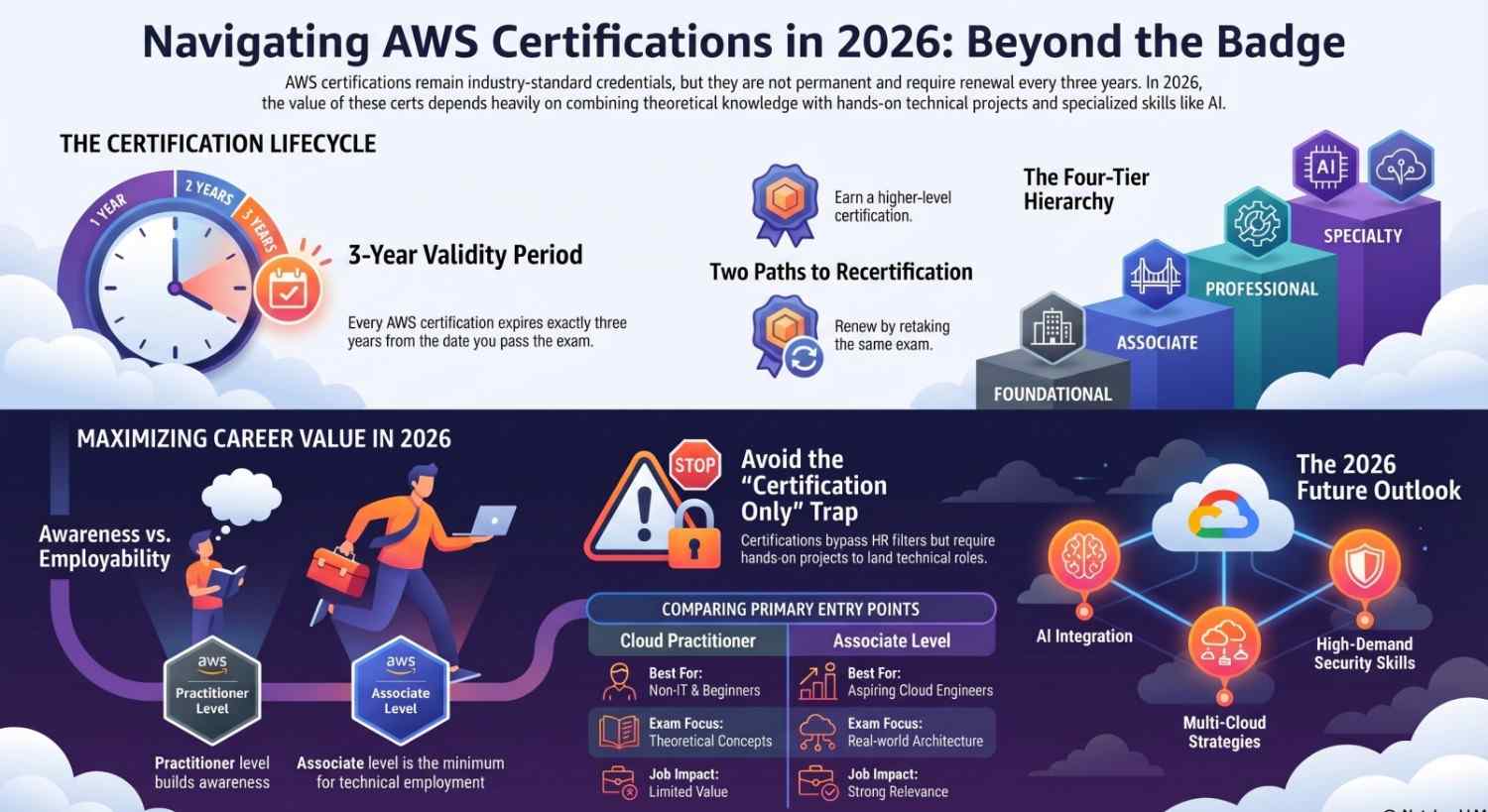
Every AWS certification is valid for 3 years from the date you pass the exam. After that, it expires unless you renew it.
Why do they expire?
Cloud technology evolves rapidly. New services, tools, and best practices are introduced constantly. AWS updates its certifications to ensure certified professionals stay relevant.
For example:
- New AI/ML services are added regularly
- Security standards evolve
- Architecture best practices change
A certification earned in 2021 may not reflect the realities of 2026.
How to Renew AWS Certifications
AWS gives you a few ways to stay certified:
1. Retake the Same Exam
- Pass the latest version of your certification exam
- Valid for another 3 years
2. Earn a Higher-Level Certification
If you pass a more advanced certification, it can automatically renew lower-level ones.
Example:
- Passing Solutions Architect Professional renews Associate-level certs
3. Recertification Discounts
AWS often provides discount vouchers for recertification exams, reducing the cost burden.
AWS Certification Levels (Quick Overview)
AWS certifications are structured into levels:
🟢 Foundational
🔵 Associate
- Solutions Architect Associate
- Developer Associate
- SysOps Administrator
🟣 Professional
- Solutions Architect Professional
- DevOps Engineer Professional
🟡 Specialty
- Security, Machine Learning, Data Analytics, etc.
Each level builds on the previous one but not all are required.
Are AWS Certifications Still Valuable in 2026?
Short answer: Yes but only if used correctly.
Let’s dig deeper.
1. Demand for Cloud Skills Is Still Growing
Cloud adoption continues to rise globally. Companies are:
- Migrating from on-premise to cloud
- Building cloud-native apps
- Scaling infrastructure with microservices
AWS still holds a dominant share in the cloud market, ahead of competitors like Microsoft Azure and Google Cloud Platform.
This means AWS-certified professionals are still in demand in 2026.
2. Certifications Help You Get Past HR Filters
Let’s be realistic certifications alone won’t get you hired.
But they do help you get noticed.
Many companies use certifications as:
- Resume filters
- Proof of basic cloud knowledge
- A way to shortlist candidates
Especially for beginners, certifications act as a foot in the door.
3. Salary Impact: Still Strong (With Experience)
AWS-certified professionals often earn higher salaries but only when combined with:
- Hands-on projects
- Real-world experience
- Problem-solving ability
Certification + skills = real value
Certification alone = limited impact
4. The “Certification Only” Trap
Here’s where many people go wrong:
They:
- Memorize answers
- Pass exams
- Skip hands-on practice
Result?
They struggle in real interviews and jobs.
In 2026, employers care more about:
- Deploying real applications
- Debugging systems
- Understanding architecture decisions
So certifications without practice are losing value.
Beginner vs Associate Certifications: Which One Matters More?
Let’s compare the two most common entry points.
AWS Cloud Practitioner (Beginner Level)
✅ Pros:
- Easy to start (no technical background required)
- Good introduction to cloud concepts
- Quick win (can be completed in weeks)
❌ Cons:
- Limited job value
- Mostly theoretical
- Not enough for technical roles
👉 Best for:
- Non-IT professionals
- Absolute beginners
- Managers or sales roles
🔵 AWS Associate Certifications
(Especially Solutions Architect Associate)
✅ Pros:
- Industry-recognized
- Covers real-world architecture
- Stronger job relevance
❌ Cons:
- Requires effort and understanding
- Slightly steeper learning curve
👉 Best for:
- Aspiring cloud engineers
- Developers
- IT professionals
Final Verdict
- Cloud Practitioner = Awareness
- Associate = Employability
If your goal is a job in cloud, skip or quickly move past Cloud Practitioner and focus on Associate-level certifications.
Are AWS Certifications Enough to Get a Job in 2026?
No and they never were.
To actually land a job, you need:
1. Hands-On Projects
Examples:
- Deploy a website on AWS
- Build a serverless app
- Set up CI/CD pipelines
2. Portfolio
Show your work:
- GitHub projects
- Architecture diagrams
- Case studies
3. Practical Skills
Learn tools like:
- Docker
- Kubernetes
- Terraform
4. Real Understanding
Not just:
- “What is EC2?”
But:
- When to use EC2 vs Lambda
- Cost optimization strategies
- Security best practices
When AWS Certifications Are NOT Worth It
Let’s be honest sometimes they’re not the best investment.
Avoid AWS certifications if:
- You hate cloud/infrastructure work
- You only want quick money without effort
- You’re not willing to practice hands-on
When AWS Certifications ARE Worth It
They are highly valuable if:
- You’re serious about a cloud career
- You combine them with projects
- You keep learning beyond the exam
Future Outlook: AWS Certifications Beyond 2026
Looking ahead:
Trends
- AI + Cloud integration is rising
- Multi-cloud strategies are increasing
- Security skills are in high demand
AWS is evolving fast, and certifications will continue to adapt.
Expect:
- More AI-focused certifications
- More practical exam formats
- Greater emphasis on real-world skills
Final Verdict
✔️ Do AWS certifications expire?
Yes every 3 years.
✔️ Are they still valuable in 2026?
Yes but only when paired with real skills.