AWS has spent a decade convincing us that serverless equals cheaper. And for many workloads, that’s true at least at first.
But in 2026, teams are asking a more uncomfortable question:
Is AWS Lambda actually cheaper than EC2 anymore?
The short answer: sometimes.
The honest answer: only for specific workloads.
This article is a deep, practical look at EC2 vs Lambda pricing in 2026, why the cost curves behave the way they do, where teams get surprised, and how to choose the cheaper option before your AWS bill explodes.
Why This Comparison Still Matters in 2026
Despite years of guidance, this decision still trips teams up because:
- Lambda pricing scales with usage
- EC2 pricing scales with time
- Most real systems don’t scale cleanly in either direction
Startups default to Lambda. Enterprises default to EC2.
Both groups often regret it later for different reasons.
Understanding where the cost crossover happens is the key.
How AWS Lambda Pricing Actually Works (2026 Reality)
Lambda pricing hasn’t changed conceptually, but usage patterns have.
You pay for:
- Number of requests
- Execution duration
- Memory allocated (GB-seconds)
You do not pay for:
- Idle time
- Provisioning
- Capacity planning
Why Lambda Is So Attractive Early On
Lambda shines when:
- Traffic is low or unpredictable
- Workloads are event-driven
- You want zero infrastructure overhead
- You don’t want to think about scaling
For many teams, Lambda costs pennies or even $0 for months.
This creates a dangerous illusion:
“Lambda is basically free.”
It isn’t it’s just delayed.
The Lambda Cost Curve (The Part AWS Doesn’t Emphasize)
Lambda pricing is linear per execution, but your workload rarely is.
Common cost accelerators:
- Slightly longer execution time
- Over-allocated memory
- More retries than expected
- Fan-out architectures
- High request concurrency
Each individual function still looks cheap but multiplied across millions of requests, the bill climbs fast.
Lambda is priced for convenience, not efficiency.
How EC2 Pricing Works in 2026
EC2 is simpler, but far less forgiving.
You pay for:
- Instance uptime (even when idle)
- Storage (EBS)
- Load balancers
- Data transfer
You do not pay per request.
Why EC2 Becomes Cheap at Scale
Once traffic is steady:
- Cost stops scaling linearly
- Reserved Instances and Savings Plans flatten the curve
- Spot Instances offer dramatic discounts
- High utilization = high efficiency
This is why large, stable workloads almost always end up on EC2 even if they started on Lambda.
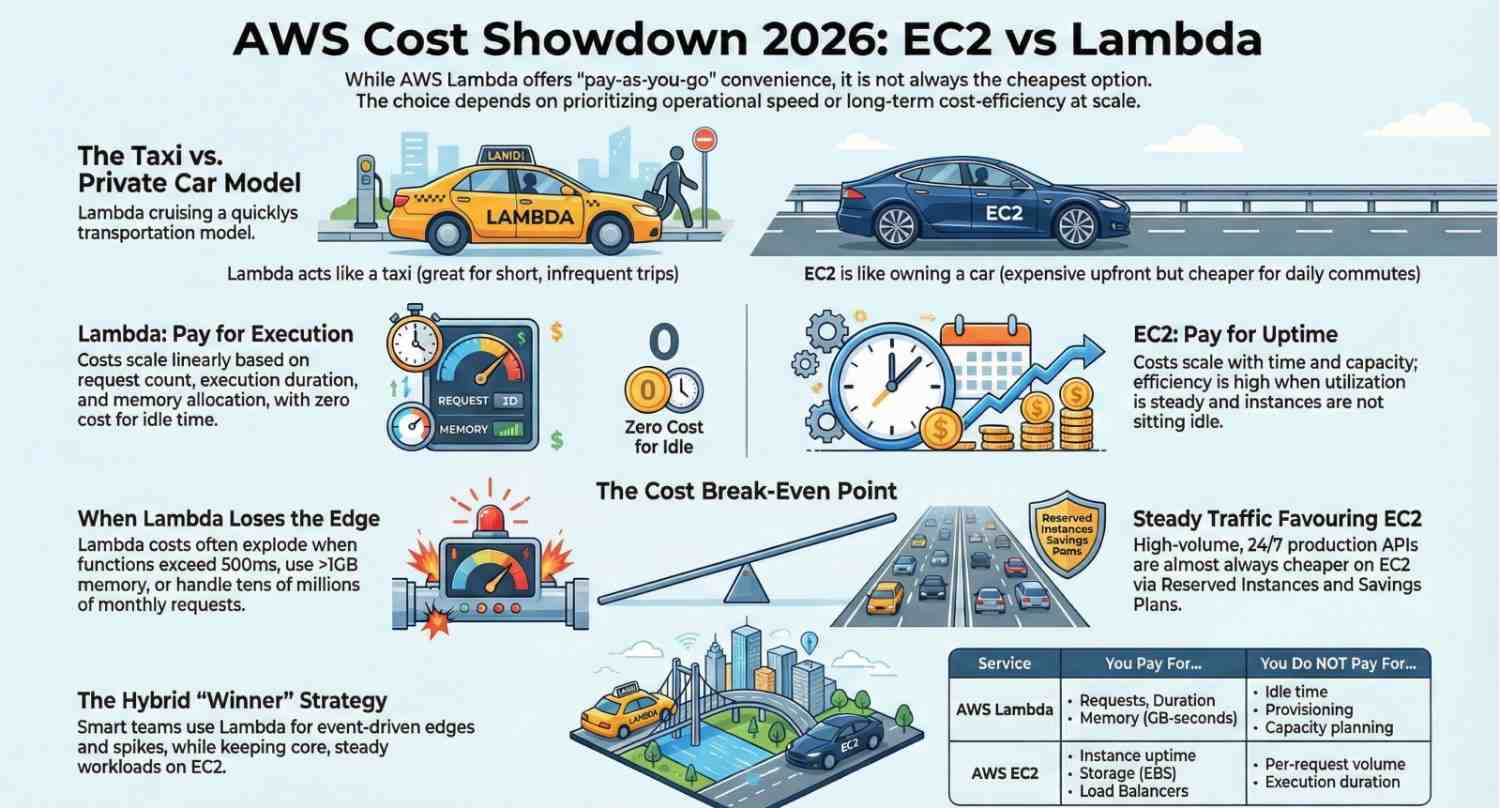
Lambda vs EC2: Cost Intuition (Taxi vs Car)
A useful mental model:
- Lambda = Taxi
- Great for short trips
- Terrible for commuting every day
- EC2 = Car ownership
- Expensive upfront
- Cheap if used constantly
Most teams unknowingly turn taxis into daily commutes.
Scenario-Based Cost Comparison
Let’s look at how this plays out in real systems.
Scenario 1: Low-Traffic API
Profile
- <500k requests/month
- Fast responses (<200ms)
- Occasional spikes
Cheapest option: Lambda
Why:
- Often covered by free tier
- No idle cost
- Zero operational burden
EC2 would sit idle most of the time and cost more simply by existing.
Scenario 2: Always-On Production API
Profile
- Millions of requests/month
- Steady traffic
- Predictable load
Cheapest option: EC2
Why:
- Lambda cost scales with every request
- EC2 cost remains flat
- Reserved Instances crush Lambda pricing at this scale
This is the most common break-even point teams hit and the most painful.
Scenario 3: Spiky, Unpredictable Traffic
Profile
- Idle most of the month
- Sudden bursts (campaigns, product launches)
Cheapest option: Lambda
Why:
- You only pay during spikes
- No pre-scaling or over-provisioning
- EC2 would require capacity for worst-case load
This is Lambda’s best use case still true in 2026.
Scenario 4: Background Jobs & Batch Processing
Profile
- CPU-heavy tasks
- Long-running jobs
- Predictable schedules
Cheapest option: EC2 (or Spot EC2)
Why:
- Lambda GB-second pricing explodes
- Execution time limits become blockers
- Spot instances can be 70–90% cheaper
Lambda is actively hostile to long-running compute.
The Break-Even Point: When EC2 Becomes Cheaper
There is no universal number but patterns are consistent.
Lambda usually loses when:
- Traffic is sustained
- Functions exceed ~300–500ms
- Memory allocation is >1GB
- Request volume is in the tens of millions/month
- The system runs 24/7
Many teams cross this line without realizing it, because Lambda costs grow quietly.
Hidden Costs That Distort the Comparison
Lambda Hidden Costs
- API Gateway pricing
- Step Functions
- CloudWatch logs
- X-Ray
- VPC cold starts
- Retries you didn’t account for
EC2 Hidden Costs
- Load balancers
- Over-provisioned instances
- Idle capacity
- Human ops time
The AWS bill is only part of the cost operational complexity matters too.
Why Teams Migrate Both Directions
In 2026, the most common pattern is:
- Start with Lambda (speed + simplicity)
- Traffic grows
- Costs spike unexpectedly
- Core services move to EC2
- Lambda remains at the edges
This isn’t failure it’s maturity.
So, Which Is Cheaper in 2026?
Lambda Is Cheaper When:
- Traffic is low or bursty
- Workloads are short-lived
- You want zero ops
- Cost predictability is less important
EC2 Is Cheaper When:
- Traffic is steady or high
- Workloads run continuously
- You can commit to capacity
- You want predictable monthly bills
The Real Answer: Hybrid Wins
The cheapest architectures in 2026 are rarely pure.
Smart teams use:
- Lambda for event-driven edges, spikes, automation
- EC2 for core APIs, background processing, steady workloads
The question isn’t “EC2 or Lambda?”
It’s “Where does each stop making sense?”
Final Verdict
Lambda optimizes for speed and convenience.
EC2 optimizes for cost at scale.
If you choose based on ideology, you’ll overpay.
If you choose based on workload behavior, you won’t.
And in 2026, that difference shows up clearly on your AWS bill.
For more information about AWS Lambda & EC2, you can refer to Jeevi’s page.
This tutorial is just the beginning learn AWS hands-on in our complete course. Upgrade your skills with AWS.