Introduction:
When humans learn, we often need only a few examples to understand a new task.
For example:
Show a child two pictures of a zebra, and they can recognize another zebra in
the wild.
AI models traditionally need thousands or millions of examples to perform well.
Few-Shot Learning (FSL) is a technique where AI models can learn a task with very
few examples — sometimes just 1, 2, or 5!
This makes AI more flexible, efficient, and closer to human-like learning.
Simple Definition:
Few-Shot Learning is a type of machine learning where a model can
perform a task after seeing only a few examples.
Other related terms:
- One-Shot Learning → model learns from 1 example
- Zero-Shot Learning → model can solve a task without any examples, only instructions
How Few-Shot Learning Works
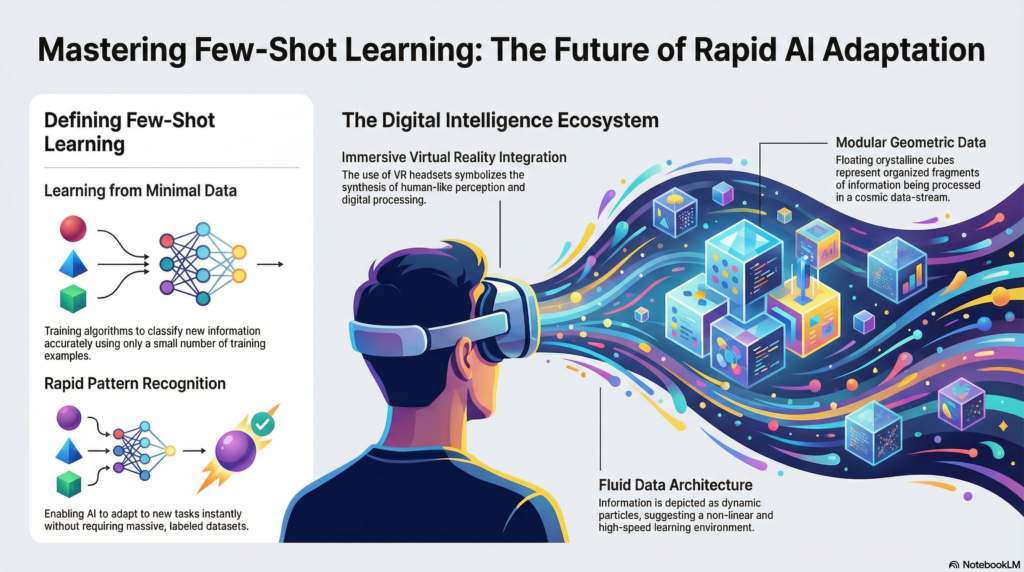
Few-shot learning relies on models that already have pretrained knowledge.
Steps:
1.Pretraining:
The model is trained on a large dataset to understand general patterns (like
grammar, logic, or vision).
2.Providing Examples:
A few task-specific examples (called shots) are given.
3.Task Execution:
The model uses its pretrained knowledge + few examples to perform the task.
Why Few-Shot Learning Matters
Few-Shot Learning is important because it solves several challenges:
1.Limited Data – Many real-world tasks don’t have huge datasets.
For example:
- Rare diseases in medical imaging
- Niche languages for translation
2.Time and Cost Efficiency – Annotating thousands of samples is expensive.
Few-shot reduces the need for massive labeling.
3.Rapid Adaptation – AI can quickly adjust to new tasks without retraining from
scratch.
Why Few-Shot Learning is Important
- Reduces data requirements → Less labeled data needed
- Saves time & cost → No need to retrain huge models
- Flexibility → Model can adapt to new tasks quickly
- Human-like learning → Learns from small examples
Few-Shot vs Zero-Shot vs Many-Shot
| Criteria | Zero-Shot Learning | Few-Shot Learning | Many-Shot Learning |
|---|---|---|---|
| Definition | Model performs a task without seeing labeled examples for that specific task | Model learns from a small number of labeled examples (1–5 per class) | Model learns from a large number of labeled examples |
| Training Data | No task-specific labeled data | Very limited labeled data | Large labeled dataset |
| Learning Approach | Relies on pre-trained knowledge and semantic understanding | Uses similarity, embeddings, or meta-learning | Traditional supervised learning |
| Data Requirement | 0 examples per class | K examples per class (K-shot) | Hundreds or thousands per class |
| Model Dependency | Strongly depends on large pre-trained models | Depends on embedding quality and distance metrics | Depends on dataset size and quality |
| Training Time | No additional task training | Very fast adaptation | Longer training time |
| Example | Classifying a new object using only text description | Recognizing a new animal with 3 images | Image classification with 10,000 labeled images |
| Use Case | NLP tasks, prompt-based models | Medical imaging, rare object detection | Large-scale image or speech recognition |
How Models Achieve Few-Shot Learning
Few-shot learning is often implemented with large pretrained models like GPT, BERT,
or CLIP.
Techniques include:
1.Prompting:
Give the model examples + instruction in natural language.
2.Meta-Learning:
Train the model to learn how to learn so it adapts quickly to new tasks.
For vision tasks, compare new inputs to examples in a high-dimensional space.
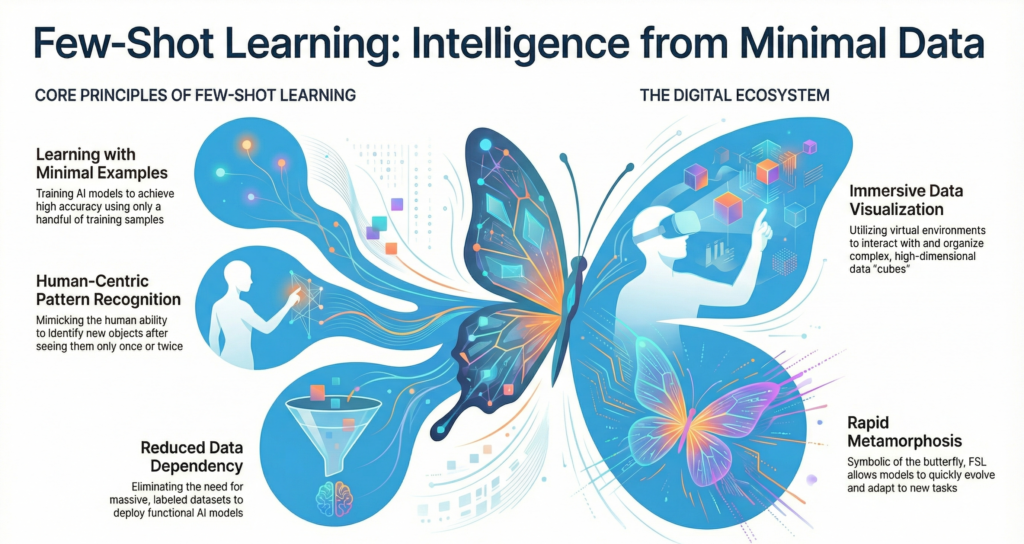
Few-Shot Learning: Intelligence from minimal data:
Real-World Applications
1.Chatbots:
Answer new types of questions with a few example dialogues.
2.Content Moderation:
Detect new types of harmful content with just a few labeled samples.
3.Medical Diagnosis:
Identify rare diseases with very few patient records.
4.Language Translation:
Translate rare languages using just a few example sentences.
5.Image Classification:
Recognize new products or objects without massive training datasets.
Types of Few-Shot Learning:
1.One-Shot Learning
2.Few-Shot Learning
3.Zero-Shot Learning
Advantages:
- Less labeled data required
- Faster adaptation to new tasks
- Reduces computational cost
- Makes AI more human-like
Limitations:
- Performance depends on pretrained knowledge
- Can struggle with very complex tasks
- Examples must be high quality
- May be sensitive to the way examples are presented
Simple Human Analogy
Imagine teaching someone to recognize a rare bird:
- Traditional ML: Show 10,000 pictures
- Few-shot: Show 5 good pictures, they learn
- Zero-shot: Tell them a detailed description, they try to identify it
Humans are naturally few-shot learners — AI is catching up!
Few-Shot Learning Techniques
1.Prompting (Mostly in NLP)
- Give the model a few input-output examples in the text prompt.
- The model generalizes from these examples.
Example: Sentiment Analysis
Review: “The movie was amazing.” → Positive
Review: “The film was boring.” → Negative
Review: “The storyline is interesting.” → ?
The model predicts Positive for the last review.
2.Meta-Learning (“Learning to Learn”)
- Model is trained to adapt quickly to new tasks with few examples.
- Idea: Learn how to learn instead of learning one task.
Example:
- Train on multiple tasks → model can perform unseen tasks using only a few examples.
3.Metric Learning / Embedding-Based
- Represent inputs in a vector space.
- Compare new examples to known examples using similarity.
Example in Vision:
- Image of a new animal is converted into a vector.
- Compare with vectors of known animals to classify it.
4.Fine-Tuning Pretrained Models
- Use pretrained models (like GPT) and fine-tune on a few examples.
- This allows leveraging general knowledge while adapting to a new task.
Conclusion
Few-Shot Learning is revolutionizing AI by enabling models to learn like humans
efficiently, quickly, and flexibly.
With pretrained models, clever prompting, and meta-learning techniques, AI can
now solve tasks with very few examples, opening doors to applications in healthcare,
NLP, vision, and more.