ANALYSIS OF GOOGLE ALGORITHYM -how its works.
1. How Google Algorithm Works.
Google’s algorithm uses hundreds of ranking factors to decide which page appears first when someone searches.
The process happens in 3 major stages:
1️⃣ Crawling
Google’s bots (“Googlebot”) go through the web and discover new or updated pages.
Optimization tips:
- Submit your site to Google Search Console.
- Keep your robots.txt and sitemap.xml files updated.
- Ensure internal links connect all key pages.
2️⃣ Indexing
Google analyzes the page content, structure, and keywords to understand what the page is about.
Optimization tips:
- Use relevant keywords in titles, headings, and content naturally.
- Use structured data (schema markup).
- Ensure content is original, clear, and readable.
3️⃣ Ranking
Once pages are indexed, Google uses algorithms to decide which pages best match the searcher’s intent.
2. Major Google Algorithm Components
RankBrain
AI system that understands search intent and ranks pages based on user behavior (like clicks and time on page).
→ Optimize for: User satisfaction, readability, and engagement.
BERT / MUM
Natural language processing updates to understand context and meaning of content.
→ Optimize for: Natural, conversational content write like you’re helping a person, not a machine.
Helpful Content Update
Google now prioritizes content written for people, not SEO manipulation.
→ Optimize for: Authentic expertise and useful information, not keyword stuffing.
The Foundation: Crawling, Indexing, and Ranking
Before any ranking can occur, Google needs to know your page exists and what it’s about.
1. Crawling:
- Googlebots (Spiders): These are automated programs that travel across the web, following links from one page to another.
- Discovery: They discover new pages and updates to existing ones. This can happen via sitemaps (XML files submitted to Google Search Console), internal links within your site, or external backlinks from other sites.
- Crawl Budget: Google allocates a “crawl budget” to each website, which is the number of pages Googlebot is willing to crawl on a site. Large, frequently updated sites get more budget. Efficient internal linking and a clean site structure can help Googlebots navigate and crawl your site effectively.
- robots.txt: This file tells crawlers which parts of your site they shouldn’t access. It’s essential for preventing indexing of private or irrelevant content, but it doesn’t prevent other sites from linking to it.
2. Indexing:
- Processing: Once crawled, Google processes the information on each page. This includes analyzing the text, images, videos, and other embedded content.
- Storing in the Index: This processed information is then stored in Google’s massive index – a colossal database of all the web pages it knows about. Think of it as an unbelievably detailed library catalog.
- Keywords and Concepts: Google doesn’t just store exact keyword matches; it understands the underlying concepts, entities, and relationships between them using advanced AI and machine learning.
- noindex Tag: The noindex meta tag (or X-Robots-Tag HTTP header) instructs Google not to add a page to its index. This is different from robots.txt, which just prevents crawling.
3. Ranking:
- Algorithm Application: When a user enters a query, Google’s algorithms instantly sift through its index to find the most relevant and highest-quality pages. This happens in milliseconds.
- Hundreds of Factors: There are hundreds of ranking signals, and their weight can vary depending on the query. Some are universal, while others are specific to certain types of searches (e.g., local search, image search).
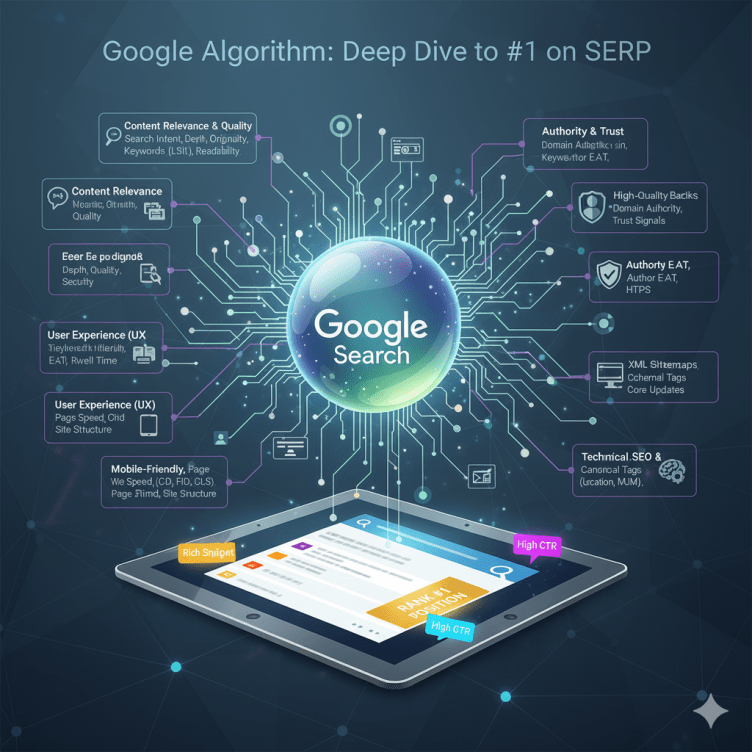
Key Ranking Factors for First Position.
Let’s break down the most impactful categories in more detail:
1. Content Relevance & Quality
This is arguably the most critical factor. Google’s primary goal is to provide the best possible answer to a user’s query.
- Understanding Search Intent:
- Informational: Users want to learn something (e.g., “how to bake bread”).
- Navigational: Users want to go to a specific website (e.g., “Facebook login”).
- Transactional: Users want to buy something or perform an action (e.g., “buy running shoes”).
- Commercial Investigation: Users are researching before a purchase (e.g., “best vacuum cleaners reviews”).
- Strategy: Your content must align perfectly with the user’s intent. If someone is looking for “how to,” a product page won’t rank well, even if it contains the keywords.
- Depth and Comprehensiveness:
- Long-form Content: Often performs well because it has the space to cover a topic exhaustively. However, length alone isn’t enough; it must be valuable.
- “All-in-one” Resource: Aim to be the definitive resource for a given query, anticipating follow-up questions and answering them within your content.
- Originality and Value:
- Unique Insights: Provide original research, unique perspectives, or innovative solutions. Don’t just regurgitate what others have said.
- Actionable Advice: For “how-to” content, provide clear, step-by-step instructions.
- Multimedia: Incorporate images, videos, infographics, and interactive elements to enhance understanding and engagement.
- Readability and User-Friendliness:
- Clear Language: Use plain language where appropriate, avoid jargon, or explain it clearly.
- Formatting: Use headings (H1, H2, H3), bullet points, and short paragraphs to break up text and make it scannable.
- Accuracy: Ensure all information is factual and up-to-date.
- Keyword Optimization (Natural Integration):
- Primary Keyword: Include your main keyword naturally in the title tag, meta description, H1 heading, and within the first paragraph.
- LSI Keywords (Latent Semantic Indexing): Use semantically related keywords and phrases. Google understands relationships between words. For example, if your topic is “cars,” LSI keywords might include “automobiles,” “vehicles,” “driving,” “transport,” etc. This signals deeper topical relevance.
- Avoid Keyword Stuffing: Over-saturating your content with keywords will harm your ranking and user experience.
2. Authority & Trust (E-A-T)
Google wants to show authoritative and trustworthy sources. This is heavily influenced by the E-A-T framework (Expertise, Authoritativeness, Trustworthiness), especially for “Your Money or Your Life” (YMYL) topics that could impact a user’s health, financial stability, or safety.
- Backlinks (The “Votes of Confidence”):
- Quality over Quantity: A few high-quality backlinks from reputable, relevant sites are far more valuable than many low-quality, spammy links.
- Relevance: A link from a related industry blog or academic institution carries more weight than a random forum link.
- Anchor Text: The text used to link to your page (anchor text) should be natural and descriptive, ideally including relevant keywords.
- Diversity: A natural backlink profile includes links from various sources (blogs, news sites, directories, forums).
- Link Building Strategies: This involves creating linkable assets (great content), outreach to other webmasters, guest posting, broken link building, and earning editorial mentions.
- Domain Authority/Page Authority:
- These are aggregate scores (often third-party metrics like Moz’s DA or Ahrefs’ DR) that predict how well a website or page will rank. While not Google’s internal metric, they correlate strongly with ranking ability.
- A website’s overall reputation and age contribute to its authority.
- Author Authority:
- For YMYL content, Google looks at the expertise of the author. Does the author have credentials, experience, or a recognized standing in their field?
- Author bios, links to professional profiles, and other publications can help establish this.
- Trust Signals:
- HTTPS: A secure website connection (SSL certificate) is a minor ranking factor and builds user trust.
- Privacy Policy & Terms of Service: Having these clearly visible pages indicates professionalism and transparency.
- Contact Information: Easily accessible contact details enhance trust.
- Positive Reviews & Mentions: While not direct ranking factors, positive brand mentions and reviews across the web can influence brand authority and trust.
3. User Experience (UX)
Google heavily emphasizes a positive user experience, as it directly reflects how satisfied users are with the search results.
- Mobile-Friendliness:
- Responsive Design: Your website should adapt seamlessly to any screen size (desktops, tablets, phones). Google uses mobile-first indexing, meaning it primarily uses the mobile version of your site for indexing and ranking.
- Page Speed (Core Web Vitals):
- Largest Contentful Paint (LCP): Measures loading performance. The main content should load quickly.
- First Input Delay (FID): Measures interactivity. How quickly the browser responds to user input (clicks, taps).
- Cumulative Layout Shift (CLS): Measures visual stability. Content shouldn’t jump around unexpectedly during loading.
- Optimization: This involves optimizing images, leveraging browser caching, minifying CSS/JavaScript, using a Content Delivery Network (CDN), and choosing a fast web host.
- User Engagement Signals (Indirect Factors):
- Click-Through Rate (CTR): If your page gets a high CTR from the SERP, it suggests your title and meta description are compelling and relevant to the query. Google sees this as a positive signal.
- Dwell Time (Time on Page): If users spend a significant amount of time on your page, it indicates they found the content engaging and valuable.
- Bounce Rate: A high bounce rate (users quickly leaving your site after viewing one page) can indicate that the content didn’t meet their expectations or the UX was poor.
- Pogo-sticking: This occurs when users click on a result, quickly return to the SERP, and then click on another result. This is a strong negative signal, indicating dissatisfaction with the initial result.
- Strategy: Create compelling titles and meta descriptions, deliver on the promise of your title, and ensure your content is engaging and easy to consume.
- Site Structure and Navigation:
- Logical Hierarchy: A clear, intuitive site structure (e.g., Homepage > Categories > Subcategories > Products/Posts) helps both users and crawlers.
- Internal Linking: Thoughtful internal links guide users through your site and distribute “link juice” (authority) to important pages.
- Breadcrumbs: These navigation aids help users understand their location within your site.
4. Technical SEO
The invisible backbone of your website’s performance.
- XML Sitemaps: Help Google discover all important pages on your site.
- Schema Markup (Structured Data): Provides context to search engines about the content on your page (e.g., telling Google that a page is a recipe, a review, an event). This can lead to rich snippets in the SERP, making your listing more prominent.
- Canonical Tags: Prevent duplicate content issues by telling Google which version of a page is the preferred one.
- Hreflang Tags: For multilingual or multi-regional sites, these tell Google which language/region version of a page to show.
- Broken Links and Redirects: Fix broken internal/external links. Use 301 redirects for permanently moved pages to preserve link equity.
5. Personalization and Context
Google strives to provide the most relevant results for each individual user.
- Location: For queries like “restaurants near me,” location is paramount.
- Search History: Previous searches can influence future results.
- User Settings: Language preferences, safe search settings.
- Device Type: Results might slightly vary between desktop and mobile.
6. Algorithmic Updates
Google constantly updates its algorithm to improve search quality and combat spam.
- Core Updates: Broad changes that can significantly impact rankings across the web. They often focus on overall content quality and E-A-T.
- Specific Updates: Targeted at particular issues (e.g., Penguin for link spam, Panda for low-quality content).
- AI/Machine Learning (RankBrain, BERT, MUM): Google uses advanced AI to better understand queries and content.
- RankBrain: Interprets ambiguous queries and connects them to relevant results.
- BERT (Bidirectional Encoder Representations from Transformers): Better understands the nuances and context of words in search queries, especially prepositions and connecting words.
- MUM (Multitask Unified Model): A more powerful AI that can understand information across multiple modalities (text, images, audio, video) and answer complex questions that require information from various sources.
The Holistic Approach to Ranking First.
Achieving the #1 position is rarely due to excelling in just one area. It’s a holistic effort:
- Audience-First Content: Start with deep user research to understand what your target audience genuinely wants and needs. Create content that provides unparalleled value.
- Technical Excellence: Ensure your site is technically sound, fast, and mobile-friendly, providing an optimal experience for both users and search engine crawlers.
- Strategic Link Building: Actively seek high-quality, relevant backlinks from authoritative sources. This is often the hardest part, but one of the most rewarding.
- Constant Monitoring & Improvement: Use tools like Google Analytics, Google Search Console, and third-party SEO tools (Ahrefs, Semrush) to monitor performance, identify areas for improvement, and adapt to algorithm changes.
- Brand Building: A strong brand naturally attracts links, mentions, and direct traffic, all of which indirectly signal authority and trust to Google
1. On-Page SEO Optimization (High Impact)
Jeevi Academy follows strong on-page SEO fundamentals:
- Optimized title tags, meta descriptions, and URLs
- Clear H1 and subheadings
- Exact-match keywords aligned with how users actually search
- CTR-focused titles that encourage clicks
✅ Result: Higher relevance score and better click-through rate (CTR).
2. Technical SEO Foundation (Clean & Healthy)
Jeevi maintains a technically sound website with:
- Healthy Domain Authority
- Low spam score
- Clean backlink profile
- Fast-loading, mobile-friendly pages
- Proper site structure and crawlability
✅ Small, optimized websites often outperform larger sites when technical SEO is done right.
3. Content Strategy (Semantic & Intent-Driven)
Jeevi focuses on clarity and completeness, not keyword stuffing:
- Clear explanation of courses
- Strong keyword placement
- FAQs addressing real learner questions
- Smart internal linking between related pages
✅ Google now rewards topical completeness over content length.
4. Backlink Strategy (Quality > Quantity)
Jeevi Academy has a focused backlink approach with around 100+ relevant referring domains, including:
- Educational directories (UrbanPro, Justdial, Sulekha)
- Guest posts on education and tech blogs
- Local business citations
- Mentions on platforms like Quora and social media
✅ Google values link relevance and trust more than backlink volume.
5. Local SEO Optimization (Major Advantage)
Jeevi Academy strongly targets Chennai-based searches, which gives it a local ranking edge:
- Optimized Google Business Profile (GBP)
- Correct and consistent NAP (Name, Address, Phone)
- Local schema markup
- Reviews and local citations
✅ For searches like “course in Chennai,” Google prefers hyperlocal relevance.
6. CTR & Engagement Metrics (RankBrain Signals)
User behavior plays a major role in rankings:
- Higher click-through rate
- Lower bounce rate
- Longer dwell time
When users stay longer and engage more, Google sees the page as highly relevant.
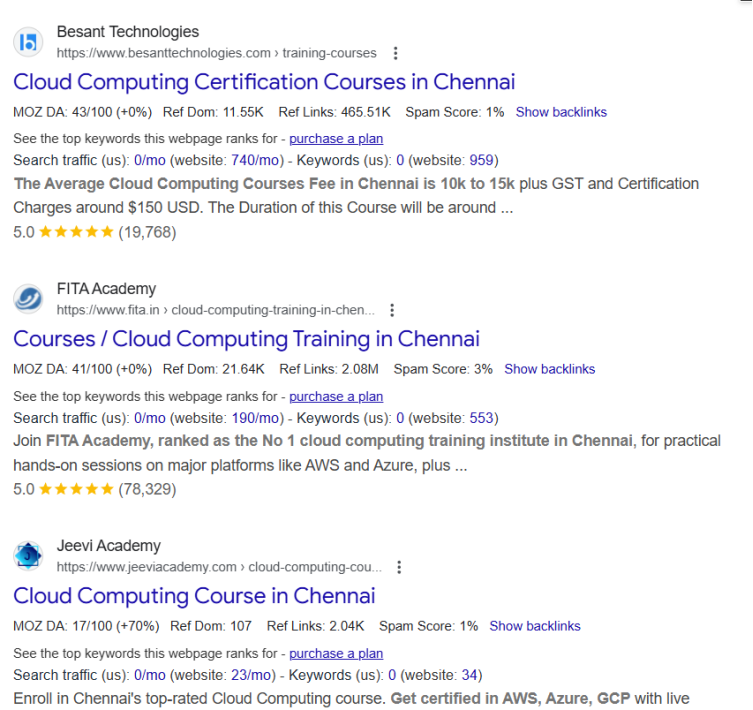
Why Jeevi Academy Ranks Well Even with Lower DA
1️⃣ Search Intent & Keyword Match (Highest Weight)
Jeevi’s pages:
- Perfectly match user intent
- Use exact keywords users type
- Focus on learners, careers, and outcomes
✅ Intent match beats raw authority.
2️⃣ Content Structure & Semantic SEO
- Clear H1s and subheadings
- Location-based modifiers
- Easy-to-read layout
This helps both users and search engines understand the content better.
3️⃣ Freshness & Regular Updates
Jeevi updates:
- Course syllabus
- Meta titles and descriptions
- FAQs and placement details
✅ Fresh content signals relevance to Google.
4️⃣ Page Experience & Core Web Vitals
Jeevi’s site:
- Loads faster
- Has fewer distractions
- Works smoothly on mobile devices
Google officially uses Core Web Vitals (LCP, CLS, INP) as ranking signals.
5️⃣ Topical Authority Over Domain Authority
Instead of covering hundreds of unrelated topics, Jeevi focuses deeply on:
- UI/UX
- DevOps
- Cloud Computing
- Data Analytics
✅ Strong niche focus builds topical authority, which Google trusts.
6️⃣ Clean Link Profile & Local Relevance
- Fewer but highly relevant backlinks
- Strong local context
- No spam or duplicate links
✅ Link quality + location relevance > link volume.
How Jeevi Academy Can Achieve High Position on SERP
Google’s Modern Ranking Priority:
Relevance > User Experience > Content Quality
To move higher in SERP, Jeevi should continue focusing on:
✅ Strengthening Topical Authority
- Expand content depth
- Create supporting blog clusters
✅ Improving CTR & Engagement
- Benefit-driven titles
- Emotional, career-focused meta descriptions
✅ Boosting EEAT Signals
- Trainer profiles
- Student reviews
- Placement proof
✅ Optimizing Core Web Vitals
- Faster load times
- Stable layouts
- Smooth interactions
✅ Building Brand Signals
- Encourage branded searches
- YouTube videos & testimonials
- Local PR mentions
Course-Wise SEO Strategy for Jeevi Academy
Cloud Computing Course in Chennai
Why Jeevi Performs Well:
- Exact-match keyword usage
- Career-focused intent
- Strong local SEO
- Clean, relevant backlinks
- High CTR titles
Next Steps to Reach #1:
- Add AWS & Azure subtopics
- Embed short explainer videos
- Add FAQ + Review + Course schema
- Earn backlinks from tech blogs
Digital Marketing Course in Chennai
Current Challenges:
- Low topical authority
- Thin content
- Weak local signals
SEO Fixes:
- Expand content to 1200–1500 words
- Add syllabus, tools, reviews, and FAQs
- Implement schema markup
- Improve Google Business Profile
- Optimize CTR-focused titles
Data Analytics Course in Chennai
Why Rankings Are Low:
- Weak on-page keyword optimization
- No topical cluster
- Limited backlinks
- Low engagement signals
Action Plan:
- Exact-match title & H1
- Add supporting blogs
- Improve internal linking
- Strengthen local SEO
- Add videos, syllabus PDFs, and CTAs
Data Science Course in Chennai
Why Jeevi Doesn’t Appear on SERP:
- Missing keyword optimization
- Low topical authority
- Weak backlinks
- Technical SEO gaps
Fixes:
- Optimize title, URL, and H1
- Add schema markup
- Build content clusters
- Strengthen Google Business Profile
- Improve CTR with benefit-driven meta text
DevOps Course in Chennai
Why Jeevi Performs Strongly:
- Emotional, benefit-driven titles
- Career-focused content intent
- Excellent page speed & UX
- Clean and relevant backlinks
- Strong local SEO focus
How to Reach #1:
- Add certification & demo keywords
- Include student review schema
- Publish DevOps-related guest blogs
- Add video content
- Strengthen brand searches
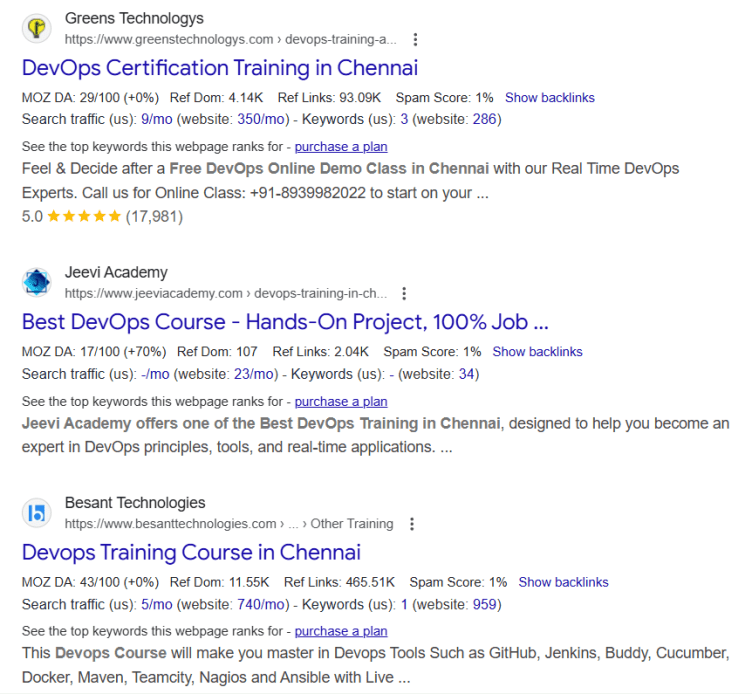
🚀 Final Takeaway
Jeevi Academy’s SEO success proves one thing clearly:
Google ranks relevance, intent match, and user experience higher than raw authority.
By continuing to focus on:
- Intent-driven content
- Local SEO
- Clean backlinks
- High engagement
- Technical performance
Conclusion.
Ranking on Google’s first page isn’t about shortcuts it’s about a smart, consistent strategy. The Jeevisoft SEO approach focuses on building a strong technical foundation, creating high-quality and user-focused content, optimizing keywords naturally, and earning trust through authority and performance. By combining data-driven decisions with ongoing optimization and ethical SEO practices, businesses can achieve sustainable visibility, attract the right audience, and turn traffic into real growth. With patience and the right strategy, first-page rankings are not just possible they’re achievable.
- For More Information about This Courses, You Can Refer to Jeevi’s Page.