Introduction:
Natural Language Programming Interfaces (NLPI) are transforming the way people interact with software and systems. Instead of writing complex code or commands, users can simply describe what they want in plain English (or any human language). The system then understands the request and performs the required action.
NLPI reduces the gap between humans and machines by making technology more accessible, faster to use, and easier to learn.
What is a Natural Language Programming Interface?
A Natural Language Programming Interface allows users to communicate with a computer using everyday language instead of traditional programming syntax.
Example:
Using NLPI:
“Print numbers from 0 to 9.”
The system understands the instruction and generates the required code automatically.
NLPI acts as a bridge between human language and machine instructions.
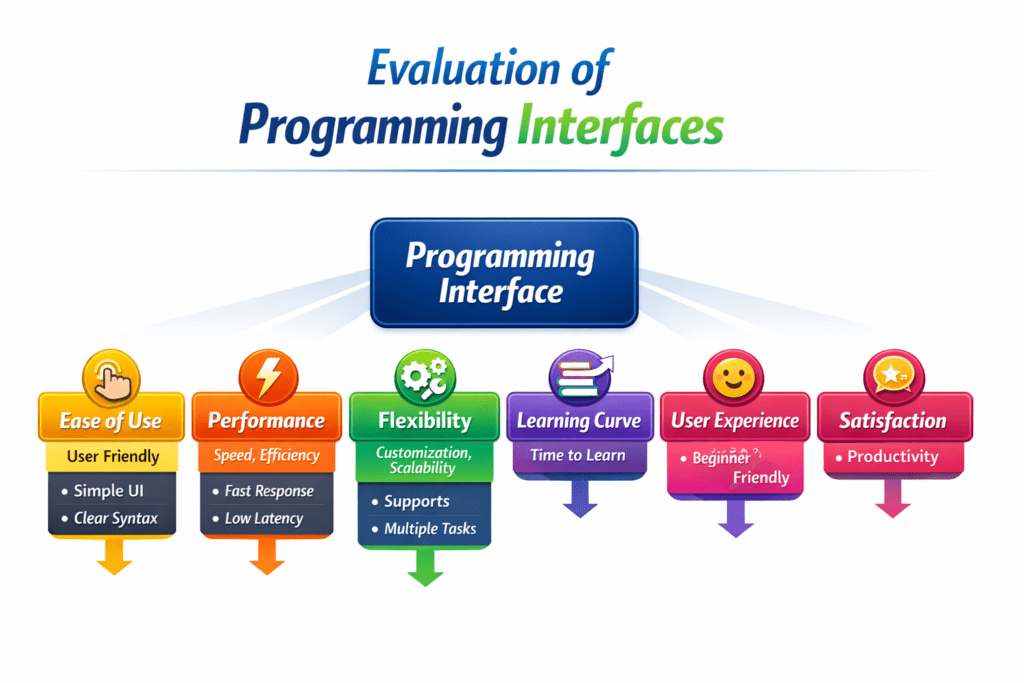
Evolution of Programming Interfaces:
1. Command-Line Interfaces (CLI)
Users typed specific commands.
Example: cd, ls, mkdir
2. Graphical User Interfaces (GUI)
Users interacted through buttons, menus, and icons.
3. Natural Language Interfaces (NLI)
Users interact through text or voice.
4. Natural Language Programming Interfaces (NLPI)
Users describe tasks, and the system generates:
- Code
- Queries
- Workflows
- Automations
NLPI represents the next step toward conversational computing.
How Natural Language Programming Interfaces Work:
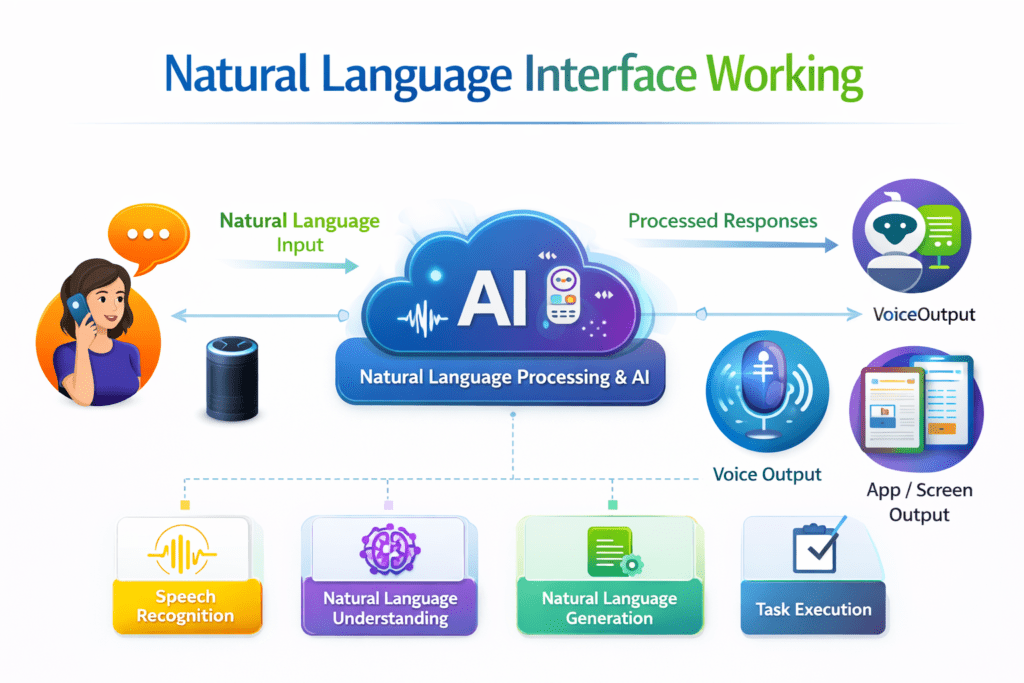
NLPI systems combine multiple AI technologies:
1. Input Processing
User enters text or voice instruction.
Example:
“Create a bar chart showing monthly sales.”
2. Natural Language Understanding (NLU)
The system analyzes:
- Intent (create chart)
- Entities (monthly sales)
- Context (data source)
3. Context & Knowledge Processing
The system:
- Checks available data
- Understands previous conversation
- Applies domain knowledge
4. Code or Action Generation
The instruction is converted into:
- Python / SQL / API calls
- Dashboard creation
- Workflow automation
5. Execution and Output
The system performs the task and returns:
- Results
- Visualizations
- Generated code
Key Components of NLPI Systems:
1. Natural Language Processing (NLP)
Processes and understands human language.
2. Large Language Models (LLMs)
Models like GPT interpret instructions and generate responses.
3. Prompt Engineering
Optimizes how instructions are interpreted.
4. Execution Engine
Runs generated code or commands.
5. Safety & Validation Layer
Prevents harmful or incorrect actions.
Features of Natural Language Programming Interfaces:
Conversational interaction
No coding knowledge required
Multi-language support
Context-aware responses
Automatic code generation
Integration with databases, APIs, and applications
Real-time feedback
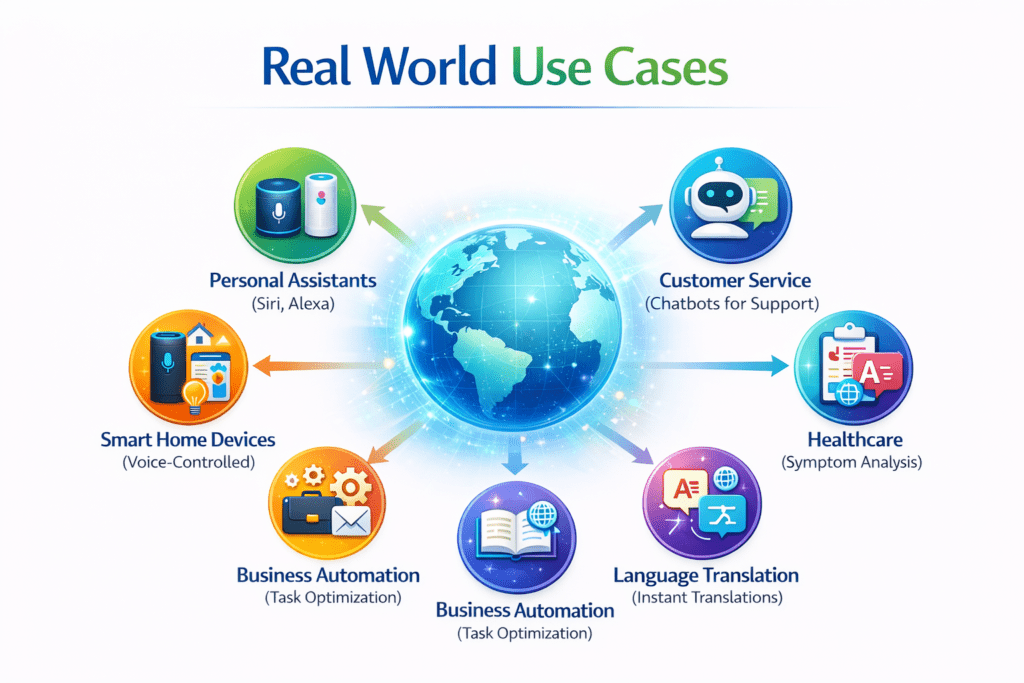
Real-World Use Cases:
1. AI Code Generation
Tools:
- ChatGPT
- GitHub Copilot
- Amazon CodeWhisperer
Example:
“Create a login system using Flask.”
2. Data Analysis
Example queries:
- “Show last year’s revenue growth.”
- “Find top 10 customers by purchase value.”
The system generates SQL or Python automatically.
3. Business Intelligence
Platforms:
- Power BI
- Tableau
- Looker
Users ask:
“Show sales performance by region.”
4. DevOps and Cloud Management
Example:
“Deploy a Kubernetes cluster with 3 nodes.”
5. Automation and Workflow Creation
Example:
“Send an email when a new customer registers.”
6. Voice-Based Programming
Voice assistants can trigger system operations through spoken commands.
Benefits of NLPI
1. Accessibility for Non-Technical Users
Anyone can interact with systems without coding knowledge.
2. Faster Development
Developers can generate boilerplate code quickly.
3. Improved Productivity
Tasks that took hours can be completed in minutes.
4. Reduced Errors
Less manual coding reduces syntax mistakes.
5. Faster Decision Making
Managers can query data directly without technical teams.
Challenges and Limitations:
1. Language Ambiguity
Human language can be unclear or interpreted in multiple ways.
2. Accuracy Issues
Generated code or results may need verification.
3. Security Risks
Sensitive operations require strict validation.
4. Context Understanding
Complex workflows may need multiple clarifications.
5. Dependency on Data Quality
Incorrect or incomplete data affects results.
Best Practices for Using NLPI:
- Be specific and clear in instructions
- Provide context when needed
- Break complex tasks into smaller steps
- Review generated output
- Use structured prompts
- Avoid vague language
Example:
Instead of:
“Analyze sales”
Use:
“Analyze monthly sales for 2025 and show a trend chart.”
NLPI vs Traditional Programming:
| Aspect | NLPI (Natural Language Programming Interfaces) | Traditional Programming |
|---|---|---|
| Interaction Method | Uses natural language (text or voice) | Requires writing code using programming languages |
| Technical Knowledge | Minimal or not required | Strong programming knowledge required |
| Learning Curve | Low and easy to learn | High learning curve |
| Syntax | No strict syntax rules | Strict syntax and structure required |
| Development Speed | Faster for simple and repetitive tasks | Slower, requires manual coding |
| Accessibility | Accessible to non-technical users and business teams | Mostly limited to developers |
| Flexibility | Limited by AI model capabilities | Highly flexible and customizable |
| Control Over Logic | Limited control over system behavior | Full control over logic and execution |
| Error Handling | AI-assisted suggestions and corrections | Manual debugging required |
| Accuracy | May produce incorrect or ambiguous results | More predictable and deterministic |
| Best Use Cases | Rapid prototyping, automation, data queries, code generation | Complex applications, enterprise systems, performance-critical software |
| Productivity | High for quick tasks | High for complex and large-scale development |
| Maintenance | Easier for simple workflows | Requires ongoing developer support |
Future of Natural Language Programming Interfaces:
The future of NLPI is closely linked to advancements in AI and LLMs.
Expected developments:
- No-code and low-code platforms powered by AI
- Fully conversational software development
- Voice-based programming environments
- Intelligent business automation
- Personalized AI assistants for developers and enterprises
NLPI will play a major role in democratizing technology and enabling anyone to build applications using natural language.
Conclusion:
Natural Language Programming Interfaces are changing how humans interact with technology. By allowing users to communicate with systems using everyday language, NLPI removes technical barriers and makes computing more intuitive and efficient.