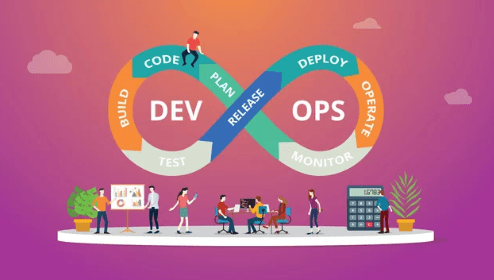
Over the past decade, DevOps has transformed how software is built and delivered. But as systems grew more complex especially with the rise of cloud-native technologies like Kubernetes a new discipline emerged: Platform Engineering.
So what’s actually changing? Is DevOps being replaced or evolved?
This 30-minute deep dive explains the differences, overlaps, and why platform engineering is becoming the backbone of modern software delivery.
The Evolution: From DevOps to Platform Engineering
What is DevOps?
DevOps is a culture and set of practices focused on:
- Breaking silos between development and operations
- Automating software delivery
- Improving deployment speed and reliability
Core DevOps goals:
- Continuous Integration (CI)
- Continuous Delivery (CD)
- Faster feedback loops
- Infrastructure as Code (IaC)
Popular DevOps tools:
What is Platform Engineering?
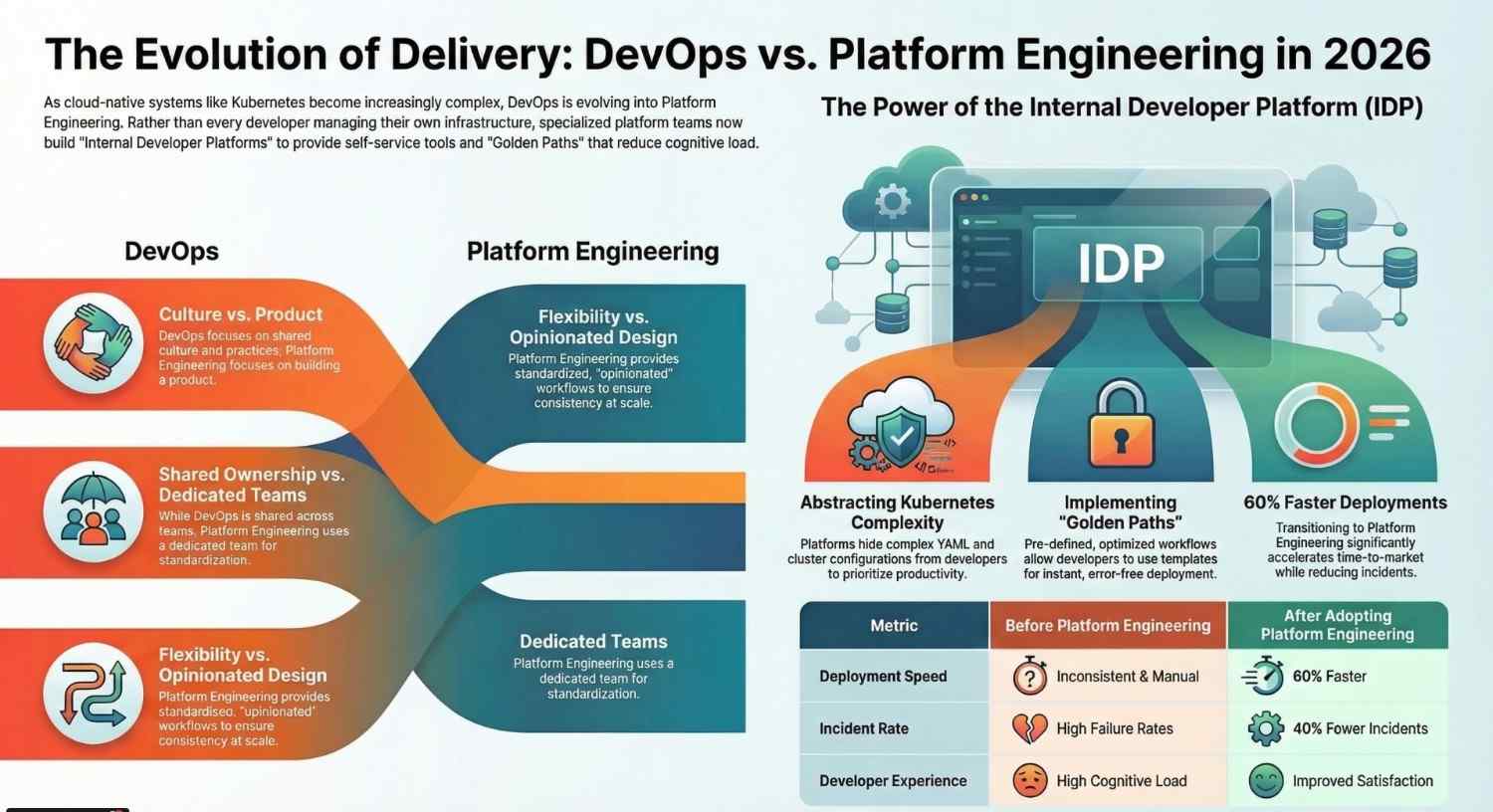
Platform Engineering is the practice of building and maintaining Internal Developer Platforms (IDPs) that enable developers to ship software faste with less cognitive load.
Think of it as:
“DevOps, but productized for developers.”
Core idea:
Instead of every team figuring out infrastructure, a platform team builds reusable tools, workflows, and abstractions.
Platform Engineering vs DevOps: Key Differences
| Aspect | DevOps | Platform Engineering |
|---|---|---|
| Focus | Culture & practices | Product (internal platform) |
| Goal | Collaboration | Developer productivity |
| Ownership | Shared across teams | Dedicated platform team |
| Approach | Flexible, team-driven | Standardized, opinionated |
| Tools | CI/CD, IaC | IDPs, self-service portals |
What’s Driving the Shift?
1. Kubernetes Complexity
While Kubernetes is powerful, it’s also complex:
- Networking
- Security
- Scaling
- Observability
Most developers don’t want to manage YAML files or cluster configs.
Platform engineering abstracts this complexity.
2. Tooling Explosion
Modern stacks include:
Too many tools = cognitive overload.
Platform teams create a unified developer experience.
3. Developer Experience (DevEx) as a Priority
Companies now treat developers like customers.
Why it matters:
- Faster onboarding
- Higher productivity
- Lower frustration
Platform engineering focuses heavily on:
- Self-service environments
- Golden paths
- Templates and automation
4. Scaling DevOps Doesn’t Always Work
DevOps works great in small teams.
But at scale:
- Inconsistencies emerge
- Best practices aren’t followed
- Costs increase
Platform engineering introduces standardization at scale.
What is an Internal Developer Platform (IDP)?
An Internal Developer Platform is a curated set of tools and workflows that developers use to:
- Deploy applications
- Monitor services
- Manage infrastructure
Common components:
- CI/CD pipelines
- Kubernetes abstractions
- Observability dashboards
- Self-service portals
Example stack:
- Orchestration: Kubernetes
- GitOps: Argo CD
- Observability: Prometheus + Grafana
Platform Engineering Architecture (Real-World)
Layered model:
- Infrastructure Layer
- Cloud providers
- Networking, compute, storage
- Platform Layer
- Kubernetes clusters
- CI/CD pipelines
- Security policies
- Developer Layer
- Self-service portals
- CLI tools
- Templates
Golden Paths: The Secret Sauce
Golden paths are pre-defined, optimized workflows developers can follow.
Example:
Instead of writing configs manually:
- Use a template → deploy instantly
Benefits:
- Faster development
- Fewer errors
- Consistency across teams
Benefits of Platform Engineering
1. Faster Time to Market
Developers spend less time on infrastructure.
2. Reduced Cognitive Load
No need to understand every tool.
3. Improved Security
Best practices baked into the platform.
4. Cost Optimization
Standardized infrastructure reduces waste.
5. Scalability
Works across large organizations.
Challenges of Platform Engineering
1. High Initial Investment
Building an IDP takes time and effort.
2. Platform Team Bottlenecks
If not designed well, teams depend too much on platform engineers.
3. Over-Engineering Risk
Too many abstractions can reduce flexibility.
DevOps Is Not Dead
Let’s be clear:
Platform Engineering does NOT replace DevOps.
Instead:
- DevOps = philosophy
- Platform Engineering = implementation at scale
Think of it like:
Real-World Example
A fintech company scaled from 10 to 150 engineers.
Before:
- Each team managed its own infrastructure
- Inconsistent deployments
- High failure rates
After adopting Platform Engineering:
- Built IDP on Kubernetes
- Standardized CI/CD using Argo CD
- Centralized monitoring with Grafana
Results:
- 60% faster deployments
- 40% fewer incidents
- Improved developer satisfaction
Trends Shaping the Future
1. GitOps Everywhere
Tools like Argo CD are becoming standard.
2. AI-Assisted Platforms
AI helps optimize infrastructure and debug issues.
3. Platform as a Product
Platform teams treat developers as customers.
4. Rise of Platform Engineering Roles
Dedicated roles are now common in tech companies
Final Thoughts
The shift from DevOps to Platform Engineering reflects a deeper truth:
Modern systems are too complex to manage without abstraction.
Platform engineering doesn’t replace DevOps it scales it.
Organizations that invest in platform engineering:
- Move faster
- Reduce costs
- Improve developer happiness
And most importantly they stay competitive in a cloud-native world powered by tools like Kubernetes.
- If you want to explore AWS, start your training here.