
Cloud cost optimization is one of the biggest priorities for DevOps teams in 2026. If you’re running workloads on AWS, choosing between Spot Instances vs Reserved Instances can dramatically impact your infrastructure bill.
Both pricing models are designed to reduce compute costs compared to On-Demand pricing but they serve very different use cases.
In this detailed guide, we’ll cover:
- What Spot Instances are
- What Reserved Instances are
- Cost comparison (2026)
- Use cases and risk factors
- When to choose each
- Best AWS cost optimization strategy
Let’s break it down.
Understanding AWS Compute Pricing
Before comparing, it’s important to understand that both Spot and Reserved Instances apply primarily to Amazon EC2 (Elastic Compute Cloud).
AWS offers multiple pricing models:
- On-Demand Instances
- Spot Instances
- Reserved Instances (RIs)
- Savings Plans
This article focuses on Spot vs Reserved Instances AWS comparison for cost-conscious teams.
What Are AWS Spot Instances?
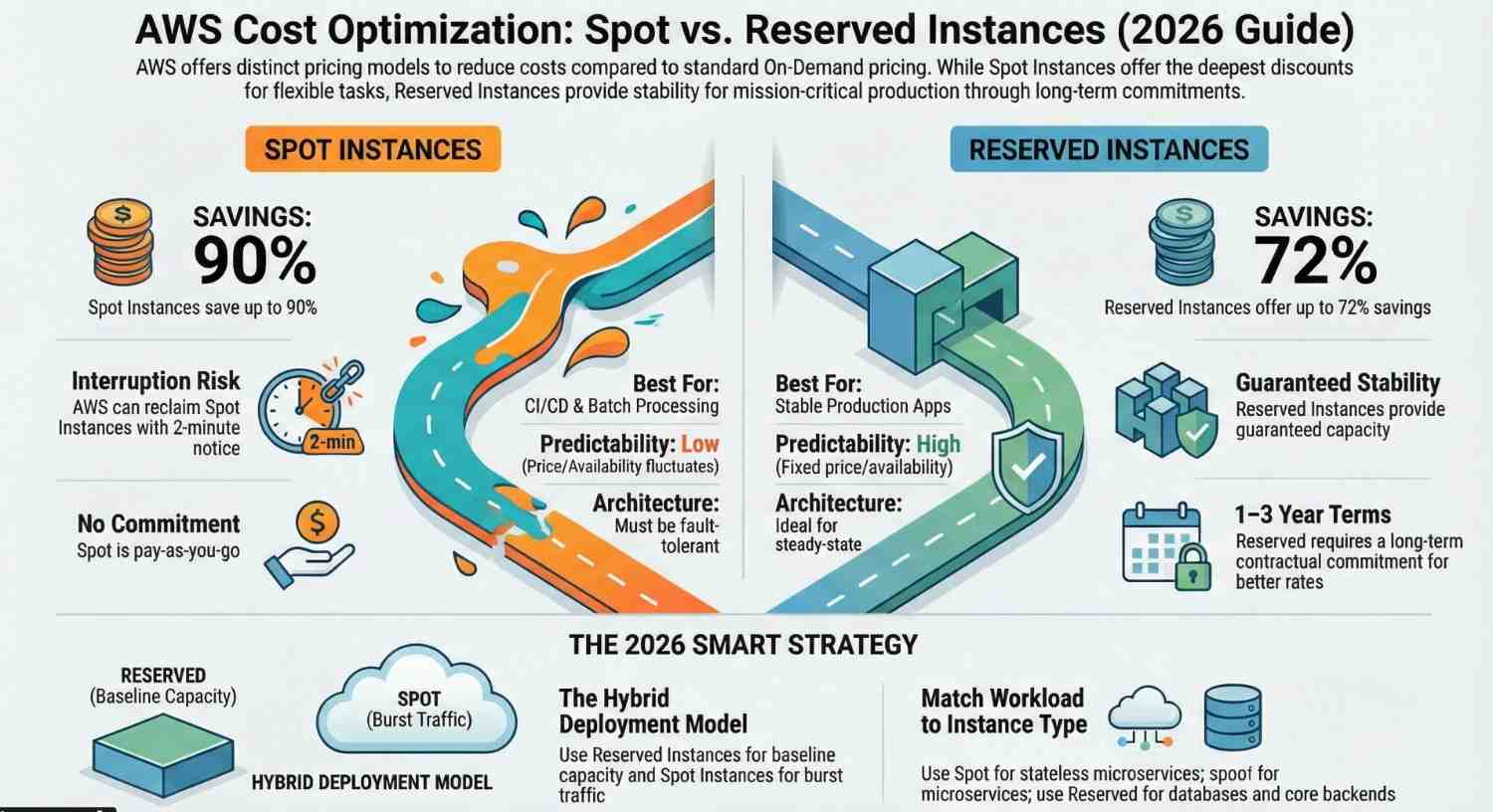
AWS Spot Instances allow you to use spare AWS compute capacity at deeply discounted rates sometimes up to 90% cheaper than On-Demand pricing.
However, there’s a catch.
AWS can interrupt your instance with short notice (typically 2 minutes) when capacity is needed elsewhere.
Key Features of Spot Instances
- Up to 90% cost savings
- No long-term commitment
- Ideal for fault-tolerant workloads
- Can be interrupted anytime
Best Workloads for Spot Instances
- Batch processing
- CI/CD pipelines
- Big data processing
- Machine learning training
- Stateless microservices
- Test environments
Spot Instances are extremely popular in DevOps automation workflows where interruptions don’t break the system.
What Are AWS Reserved Instances?
Reserved Instances (RIs) provide discounted pricing in exchange for a 1-year or 3-year commitment.
Unlike Spot, Reserved Instances are not interruptible. You’re paying for guaranteed capacity at a lower hourly rate.
Key Features of Reserved Instances
- Up to 72% savings vs On-Demand
- 1-year or 3-year commitment
- Predictable pricing
- Capacity reservation (optional)
Types of Reserved Instances
- Standard Reserved Instances (highest discount, less flexible)
- Convertible Reserved Instances (more flexibility, lower discount)
Reserved Instances are ideal for steady-state production workloads.
Spot Instances vs Reserved Instances: Feature Comparison
| Feature | Spot Instances | Reserved Instances |
|---|---|---|
| Discount | Up to 90% | Up to 72% |
| Commitment | None | 1 or 3 years |
| Interruption Risk | Yes | No |
| Predictability | Low | High |
| Best For | Flexible workloads | Stable production apps |
| Payment Options | Pay as used | All upfront / Partial / No upfront |
Cost Comparison: Which Is Cheaper in 2026?
Spot Instances: Maximum Savings
If your application can handle interruptions, Spot Instances provide the lowest possible AWS compute cost.
Example scenario:
- Dev/test environment running 10 hours/day
- Non-critical batch processing
Spot can reduce compute bills dramatically.
Reserved Instances: Long-Term Savings
If you’re running:
- Production web servers
- Databases
- Core backend services
Reserved Instances offer predictable and significant long-term savings.
Over a 3-year term, Reserved Instances may provide better financial planning stability.
Risk Factor: The Biggest Difference
The main difference between Spot vs Reserved Instances AWS comes down to risk tolerance.
Spot Risk
- Instance termination possible anytime
- Requires fault-tolerant architecture
- Needs auto-scaling and automation
Reserved Instance Stability
- Guaranteed availability
- No unexpected shutdowns
- Ideal for compliance-driven workloads
If downtime equals revenue loss, Spot may not be suitable alone.
Performance Considerations
Performance of Spot and Reserved Instances is identical when running.
The difference is:
- Spot → Availability risk
- Reserved → Cost commitment risk
Performance is determined by instance type (e.g., compute optimized, memory optimized), not pricing model.
DevOps Use Case Scenarios
CI/CD Pipelines
Spot Instances are ideal for:
- Jenkins builds
- GitHub Actions self-hosted runners
- Automated test environments
CI jobs are short-lived and restartable perfect for Spot pricing.
Production Web Applications
Reserved Instances are better for:
- E-commerce platforms
- SaaS applications
- Financial systems
Consistency matters more than ultra-low cost.
Hybrid Strategy: The Smart Approach in 2026
Most modern cloud architectures combine both.
Recommended Strategy
- Use Reserved Instances for baseline production capacity
- Use Spot Instances for burst traffic
- Implement Auto Scaling Groups
- Monitor usage with AWS Cost Explorer
This blended strategy maximizes cost efficiency while reducing risk.
When to Choose Spot Instances
Choose Spot if:
- Your workloads are fault-tolerant
- You want maximum cost savings
- You use Kubernetes with auto-healing
- You run large-scale batch processing
- You are optimizing DevOps infrastructure costs
When to Choose Reserved Instances
Choose Reserved if:
- Workloads are predictable
- Downtime is unacceptable
- You want cost predictability
- You operate mission-critical systems
- You need compliance stability
SEO Insight: What Are Teams Searching in 2026?
Popular related search queries:
- Spot Instances vs Reserved Instances cost comparison
- AWS cost optimization strategies
- How to reduce AWS EC2 cost
- Spot vs Reserved vs Savings Plans
- Is Spot Instance safe for production?
Cost optimization remains a top cloud priority in 2026.
Pros and Cons Summary
Spot Instances Pros
- Massive cost savings
- No long-term commitment
- Flexible scaling
Spot Instances Cons
- Interruptions possible
- Not ideal for critical apps
- Requires smart architecture
Reserved Instances Pros
- Predictable cost
- Stable infrastructure
- Long-term savings
Reserved Instances Cons
- Long commitment
- Less flexible
- Over-provisioning risk
Final Verdict: Spot vs Reserved Instances in 2026
There is no universal winner.
Best for Maximum Savings → Spot Instances
Best for Stability & Predictability → Reserved Instances
For most organizations, the smartest strategy is:
Baseline with Reserved Instances + Scale with Spot Instances
This approach delivers both cost efficiency and reliability.
Conclusion
Choosing between Spot Instances vs Reserved Instances on AWS depends on:
- Workload type
- Risk tolerance
- Financial planning strategy
- DevOps maturity
If your infrastructure is automated and resilient, Spot can cut costs dramatically.
If your business depends on uptime guarantees, Reserved Instances provide peace of mind.
Cloud cost optimization in 2026 isn’t about choosing one it’s about architecting intelligently.
- Don’t just read about DevOps build it. Explore DevOps training today.