Pipelines whether in software delivery, data engineering, or business workflows have always been about efficiency. Over the past decade, we’ve automated builds, deployments, and data processing. But in 2026, a new shift is redefining pipelines entirely: Artificial Intelligence (AI)-driven automation.
AI is no longer just a feature within applications it’s becoming the brain behind pipelines themselves. From self-optimizing CI/CD workflows to intelligent data pipelines that adapt in real time, AI is transforming how systems are built, deployed, and maintained.
This article explores how AI is shaping the future of pipelines, the technologies enabling it, real-world use cases, and what teams need to prepare for in this rapidly evolving landscape.
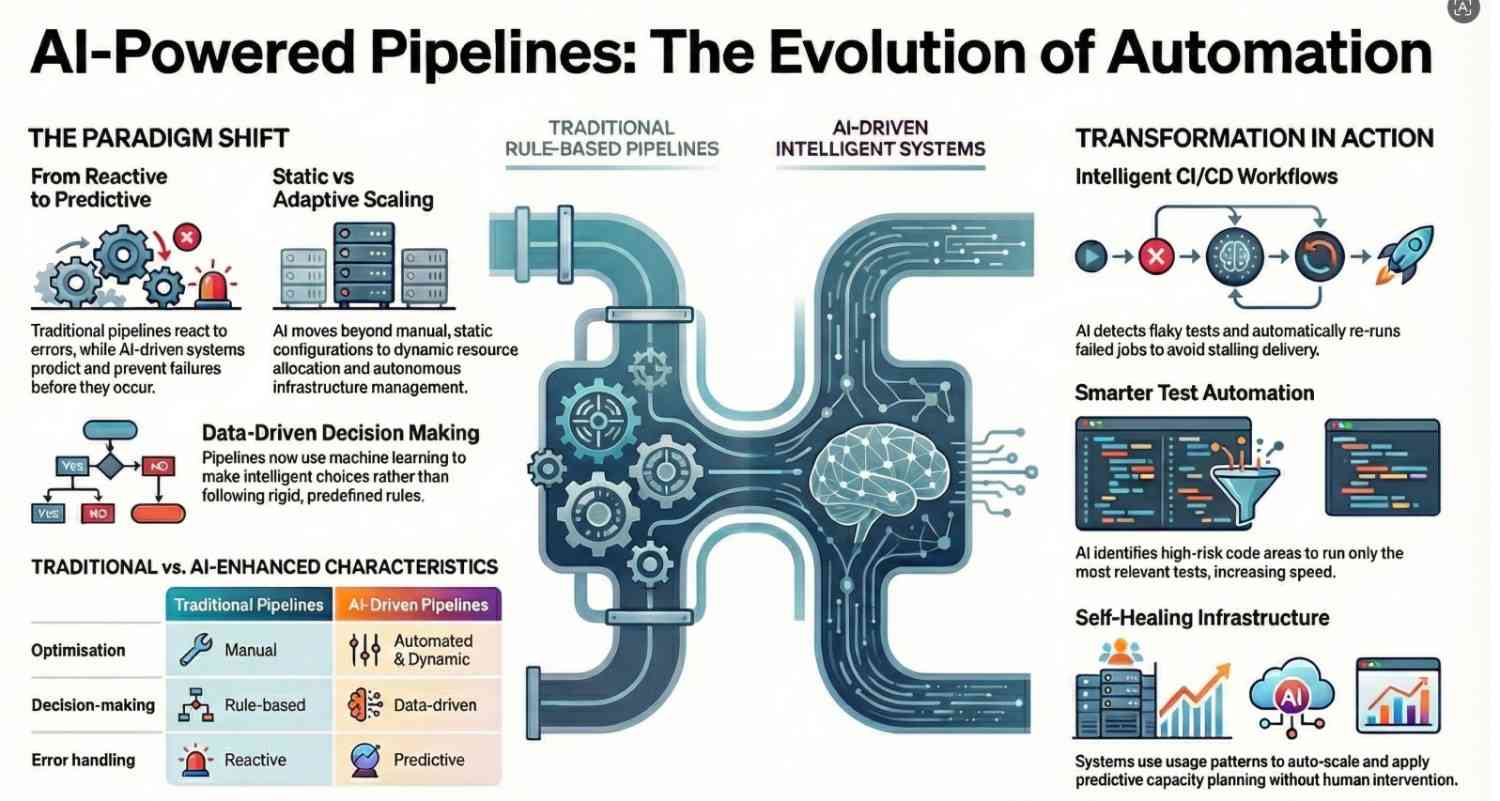
What Are AI-Driven Pipelines?
An AI-driven pipeline is a system where artificial intelligence enhances or fully automates decision-making across pipeline stages.
Unlike traditional pipelines that follow predefined rules, AI-powered pipelines can:
- Learn from past executions
- Predict failures before they occur
- Optimize workflows dynamically
- Adapt to changing conditions
Traditional vs AI-Driven Pipelines
| Feature | Traditional Pipelines | AI-Driven Pipelines |
|---|---|---|
| Decision-making | Rule-based | Data-driven |
| Optimization | Manual | Automated |
| Error handling | Reactive | Predictive |
| Scalability | Static | Adaptive |
Why AI in Pipelines Matters
As systems grow more complex, manual optimization becomes inefficient.
Key drivers:
- Increasing data volume and velocity
- Complex microservices architectures
- Demand for faster releases
- Need for proactive issue resolution
Benefits:
- Reduced pipeline execution time
- Improved reliability
- Lower operational costs
- Enhanced developer productivity
AI transforms pipelines from automation tools into intelligent systems.
Key Areas Where AI Is Transforming Pipelines
1. Intelligent CI/CD Pipelines
CI/CD tools are integrating AI to optimize build and deployment processes.
Platforms like GitHub Actions and GitLab CI/CD are increasingly incorporating AI capabilities.
AI capabilities include:
- Predicting build failures
- Suggesting pipeline improvements
- Automatically re-running failed jobs
- Optimizing test execution order
Example:
An AI system detects that a specific test suite often fails due to flaky tests and automatically isolates or retries it without impacting the entire pipeline.
2. Smart Test Automation
Testing is one of the most time-consuming parts of pipelines.
AI improves testing by:
- Identifying high-risk areas of code
- Running only relevant tests (test impact analysis)
- Detecting flaky tests
- Generating test cases automatically
Result:
Faster pipelines with better test coverage.
3. Self-Optimizing Data Pipelines
In data engineering, AI is revolutionizing how pipelines process and manage data.
Tools like Apache Spark and Apache Flink are increasingly paired with machine learning models.
AI-driven improvements:
- Dynamic resource allocation
- Automatic anomaly detection
- Intelligent data routing
- Schema evolution handling
4. Predictive Monitoring and Observability
Monitoring tools such as Prometheus and Datadog are evolving with AI capabilities.
AI enables:
- Predicting system failures before they occur
- Root cause analysis
- Automated alert prioritization
- Noise reduction in alerts
Instead of reacting to issues, teams can prevent them entirely.
5. Autonomous Infrastructure Management
Infrastructure is becoming self-managing with AI.
Using tools like Terraform combined with AI:
Capabilities:
- Auto-scaling based on usage patterns
- Cost optimization recommendations
- Predictive capacity planning
- Self-healing systems
Real-World Use Cases
1. E-Commerce Platforms
AI-driven pipelines analyze user behavior in real time to:
- Adjust recommendations
- Detect fraud
- Optimize pricing dynamically
2. Financial Services
Banks use AI pipelines to:
- Detect fraudulent transactions instantly
- Monitor compliance
- Analyze market trends
3. SaaS Companies
AI helps:
- Optimize deployment pipelines
- Reduce downtime
- Improve release confidence
4. Healthcare Systems
Real-time pipelines powered by AI:
- Monitor patient data
- Detect anomalies
- Support critical decision-making
Core Technologies Behind AI-Driven Pipelines
1. Machine Learning Models
Used to:
- Predict outcomes
- Detect anomalies
- Optimize workflows
2. Big Data Processing Frameworks
Frameworks like Apache Spark process large datasets to train AI models.
3. Cloud Computing
Cloud platforms provide:
- Scalability
- On-demand resources
- AI/ML services
4. Observability Platforms
Provide the data needed for AI to make decisions.
Challenges of AI-Driven Pipelines
Despite the benefits, there are challenges to consider:
1. Data Quality Issues
AI is only as good as the data it learns from.
Solution: Ensure clean, reliable data pipelines.
2. Complexity
AI systems add another layer of complexity.
Solution: Start small and scale gradually.
3. Trust and Transparency
Teams may hesitate to rely on AI decisions.
Solution: Use explainable AI and maintain human oversight.
4. Cost
AI infrastructure can be expensive.
Solution: Optimize usage and monitor ROI.
Best Practices for Adopting AI in Pipelines
- Start with a clear use case
- Use AI to augment not replace human decision-making
- Continuously monitor AI performance
- Invest in data quality and governance
- Train teams on AI tools and workflows
The Future Trends to Watch
Fully Autonomous Pipelines
Pipelines that require minimal human intervention.
AI Co-Pilots for DevOps
AI assistants integrated into development workflows.
Real-Time Decision Systems
Instant decision-making powered by AI pipelines.
AI-Driven Security (DevSecOps)
Automated threat detection and response.
Edge AI Pipelines
Processing data closer to the source for ultra-low latency.
A Glimpse Into the Future
Imagine a pipeline that:
- Detects a bug before code is merged
- Automatically fixes minor issues
- Optimizes itself for speed and cost
- Deploys with zero downtime
- Monitors performance and adjusts in real time
This isn’t science fiction it’s the direction pipelines are heading.
Final Thoughts
AI-driven automation is not just an upgrade to existing pipelines it’s a paradigm shift. Pipelines are evolving from static workflows into intelligent, adaptive systems that continuously learn and improve.
Organizations that embrace this transformation early will gain a significant competitive advantage through faster delivery, better reliability, and smarter operations.
However, success requires more than just adopting new tools. It demands a cultural shift toward data-driven decision-making, continuous learning, and experimentation.
The future of pipelines is intelligent, autonomous, and AI-powered and it’s already here.
- Curious about AI? Click here and dive in.
- Ready to master Devops? Click here and begin.