
Most people don’t fail interviews because they aren’t qualified. They fail because they practice the wrong way, at the wrong time, and under the wrong pressure.
They cram answers the night before. They memorize scripts. They practice alone, silently, and without structure.
This guide fixes that. This is a week-by-week interview practice system designed to build real confidence so when the interview starts, you’re not “performing,” you’re just explaining what you already know about yourself. Whether you have four weeks, three weeks, or less, this checklist shows you exactly what to practice, how long to spend, and why it works.
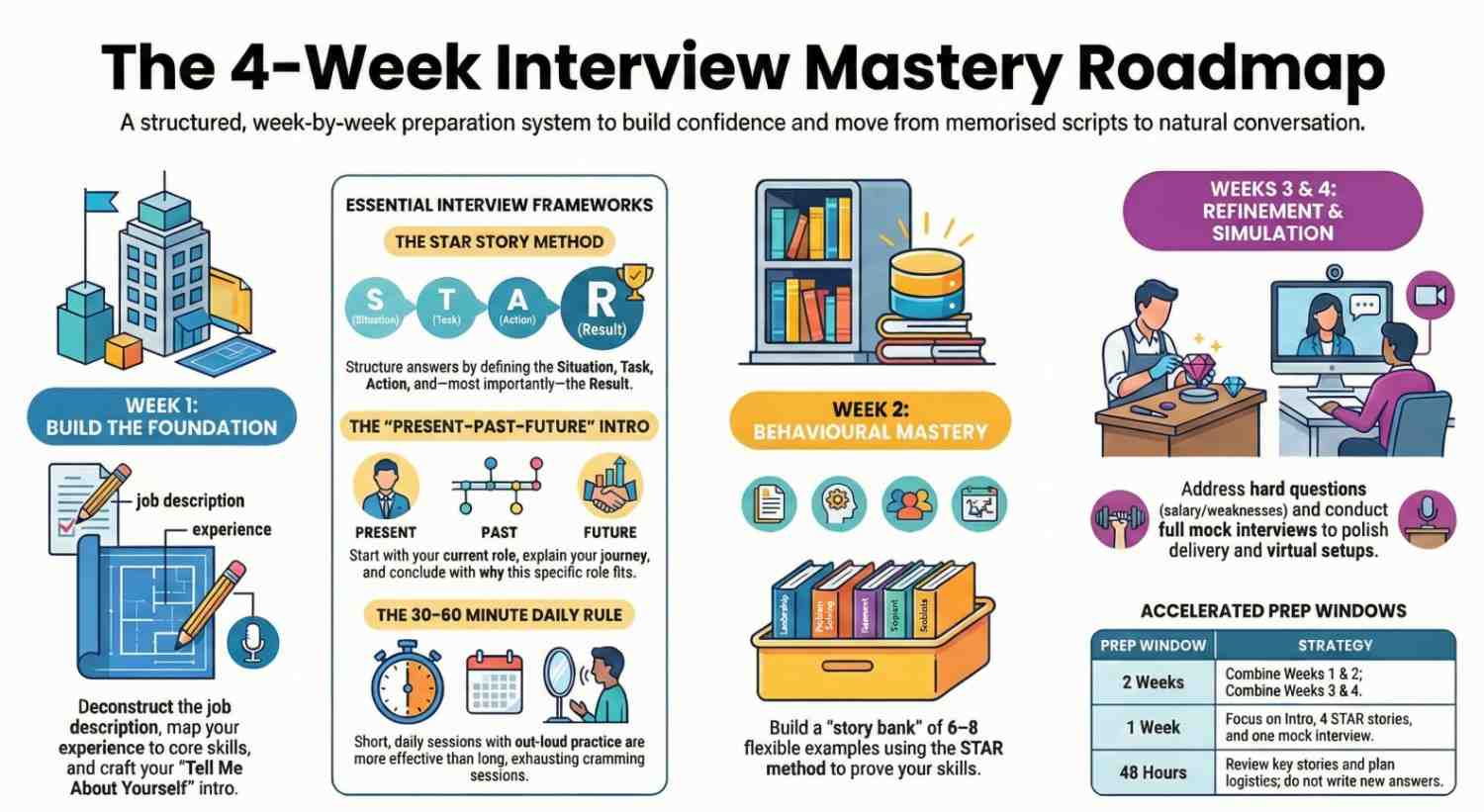
How to Use This Checklist (Read This First)
Before we jump into the weeks, a quick reset on expectations.
Interview practice is not about:
- Sounding perfect
- Memorizing clever answers
- Impressing with buzzwords
It is about:
- Knowing your stories
- Communicating clearly under pressure
- Adapting naturally to different interviewers
Time Commitment
- 30–60 minutes per day
- Short, focused sessions beat long, exhausting ones
- Practice out loud at least 3x per week
Now let’s break it down.
Week 1: Build the Foundation (Clarity Before Confidence)
Goal: Understand the role, the company, and your own story.
If you skip this week, everything else feels harder.
This is where confidence actually starts before you answer a single interview question.
1. Deconstruct the Job Description
Most candidates read job descriptions passively.
Strong candidates reverse-engineer them.
Checklist
- Highlight repeated skills and keywords
- Separate:
- Must-have skills
- Nice-to-have skills
- Identify 5–7 core competencies the role truly cares about
These competencies will guide every answer you practice.
2. Map Your Experience to the Role
Now you prove on paper that you’re qualified.
Checklist
- For each core skill, write:
- One strong example
- One backup example
- Include:
- What you did
- Why it mattered
- What changed because of it
This becomes your story bank.
3. Craft Your “Tell Me About Yourself” Answer
This question sets the tone for the entire interview.
Structure That Works
- Present – What you do now
- Past – How you got here
- Future – Why this role makes sense
Practice Rules
- 2–3 minutes max
- No childhood stories
- No resume reading
Practice this answer every other day this week.
4. Company Research That Actually Helps
You don’t need to memorize facts.
You need to understand context.
Checklist
- Company mission and values
- Product or service overview
- Recent news or changes
- Team or department goals (if available)
Practice explaining:
“Why this company?”
out loud without sounding rehearsed.
Week 2: Behavioral Interview Mastery (Your Proof of Skill)
Goal: Turn your experience into clear, confident stories.
Behavioral interviews aren’t about what you say you can do.
They’re about what you’ve already done.
1. Build Your STAR Story System
You don’t need 20 stories.
You need 6–8 flexible ones.
Story Categories to Cover
- Leadership or initiative
- Problem-solving
- Conflict or disagreement
- Failure or mistake
- Working under pressure
- Communication or collaboration
STAR Breakdown
- Situation – Set the scene briefly
- Task – Your responsibility
- Action – What you did
- Result – Outcome and learning
2. Practice the Most Common Behavioral Questions
Examples:
- “Tell me about a challenge you faced.”
- “Describe a time you disagreed with someone.”
- “Tell me about a failure.”
Practice Method
- Speak out loud
- Time yourself (60–90 seconds)
- Focus on clarity, not drama
If you’re rambling, lead with the result first, then explain how you got there.
3. Eliminate These Common Mistakes
❌ Talking too much about the team
❌ Skipping the result
❌ Sounding defensive about failures
❌ Over-explaining obvious details
Practice cutting answers down, not adding more.
Week 3: Hard Questions & Role-Specific Practice
Goal: Remove uncertainty and reduce anxiety triggers.
This is where most candidates feel shaky so this is where smart practice pays off.
1. Role-Specific or Technical Questions
You’re not expected to know everything.
You are expected to explain your thinking.
Checklist
- Practice explaining your process
- Walk through examples step by step
- Say “I’d approach it this way…” confidently
If you don’t know something:
“Here’s how I’d figure it out.”
That’s a strong answer.
2. Strengths and Weaknesses (Done Right)
Strengths
- Relevant to the role
- Backed by examples
- Not generic
Weaknesses
- Real, but manageable
- Show improvement
- Never fatal to the role
Practice these until they feel calm not clever.
3. Salary & Logistics Questions
Avoiding these creates stress.
Practice Saying:
- Your expected range
- Why it’s reasonable
- That you’re open to discussion
Confidence here signals seniority.
4. Prepare Your Questions for Them
Your questions show how you think.
Strong topics:
- Team success metrics
- Role expectations
- Challenges in the first 90 days
- Growth and feedback
Prepare at least five.
Week 4: Mock Interviews & Real-World Simulation
Goal: Make the interview feel familiar before it happens.
This is where everything comes together.
1. Do Full Mock Interviews
At least two.
Options:
- Friend or mentor
- Career coach
- AI interview tools
- Recording yourself
Rules
- Dress like it’s real
- Sit at a desk
- No notes (after the first run)
2. Refine Delivery, Not Content
Focus on:
- Eye contact
- Pausing before answering
- Speaking slower than feels natural
- Confident posture
Small changes make a big difference.
3. Virtual Interview Setup
Practice:
- Camera at eye level
- Clean background
- Good lighting
- Clear audio
Test everything two days before, not the morning of.
Final 48 Hours: Maintain, Don’t Cram
This is about calm confidence.
Do:
- Review key stories
- Rehearse your opening once
- Plan logistics
- Get rest
Don’t:
- Write new answers
- Over-practice weaknesses
- Compare yourself to others
If You Have Less Than 4 Weeks
2 Weeks
- Combine Weeks 1 & 2
- Combine Weeks 3 & 4
1 Week
Focus only on:
- “Tell me about yourself”
- 4 STAR stories
- Role-specific questions
- One mock interview
Final Thought
The best interviews don’t feel like performances.
They feel like clear conversations.
When you practice the right way, confidence shows up naturally without forcing it.
Practice early. Practice smart.
Then walk in knowing you’re ready.