
Machine learning has become one of the most transformative technologies of the modern era, powering everything from recommendation systems to self-driving cars. Whether you’re a beginner stepping into the world of artificial intelligence or an aspiring data scientist, understanding the core machine learning algorithms is essential.
In this blog, we’ll explore the top 10 machine learning algorithms you should know, breaking down how they work, where they are used, and why they matter.
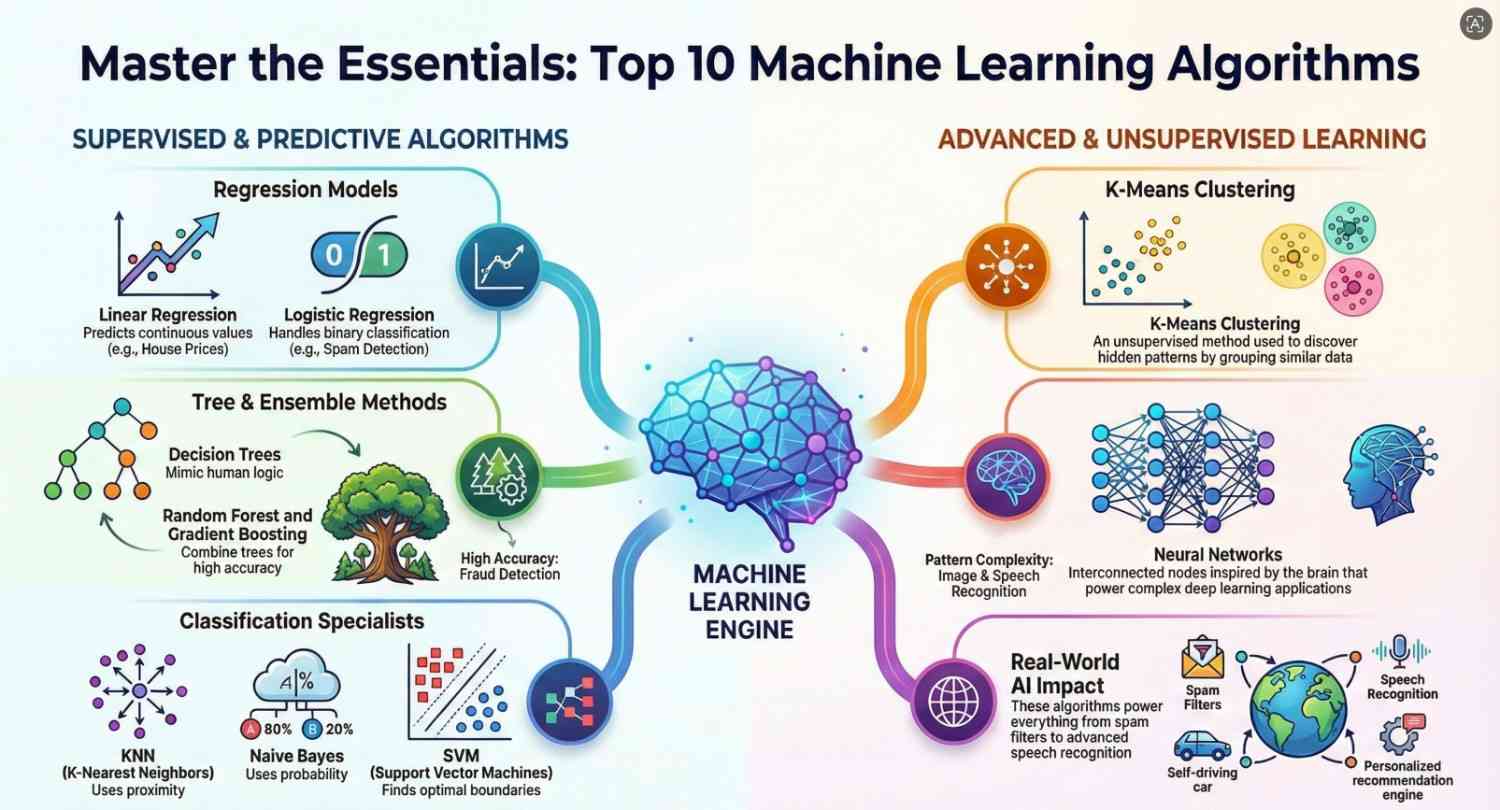
1. Linear Regression
Linear Regression is one of the simplest and most widely used machine learning algorithms. It is used for predicting a continuous value based on one or more input features.
How it works:
It establishes a linear relationship between the input variables (X) and the output variable (Y). The model tries to fit a straight line that best represents the data.
Example:
Predicting house prices based on size, location, and number of rooms.
Why it matters:
- Easy to understand and implement
- Forms the foundation for more complex algorithms
2. Logistic Regression
Despite its name, Logistic Regression is used for classification problems rather than regression.
How it works:
It uses a logistic (sigmoid) function to map predicted values to probabilities between 0 and 1.
Example:
- Email spam detection
- Disease prediction (yes/no outcomes)
Why it matters:
- Efficient for binary classification
- Provides probability outputs
3. Decision Trees
Decision Trees are intuitive models that mimic human decision-making.
How it works:
The algorithm splits the dataset into branches based on feature values, forming a tree-like structure of decisions.
Example:
- Loan approval systems
- Customer segmentation
Why it matters:
- Easy to visualize and interpret
- Works well with both numerical and categorical data
4. Random Forest
Random Forest is an ensemble learning method that combines multiple decision trees to improve accuracy.
How it works:
It builds several decision trees and merges their outputs to get a more stable and accurate prediction.
Example:
- Fraud detection
- Stock market prediction
Why it matters:
- Reduces overfitting
- High accuracy in many real-world scenarios
5. Support Vector Machines (SVM)
Support Vector Machines are powerful algorithms used for both classification and regression tasks.
How it works:
SVM finds the optimal boundary (hyperplane) that separates data points into different classes.
Example:
- Image classification
- Text categorization
Why it matters:
- Effective in high-dimensional spaces
- Works well with clear margin separation
6. K-Nearest Neighbors (KNN)
KNN is a simple, instance-based learning algorithm.
How it works:
It classifies a data point based on the majority class of its nearest neighbors.
Example:
- Recommendation systems
- Pattern recognition
Why it matters:
- Simple and intuitive
- No training phase required
7. Naive Bayes
Naive Bayes is a probabilistic classifier based on Bayes’ Theorem.
How it works:
It assumes that features are independent of each other and calculates probabilities accordingly.
Example:
- Spam filtering
- Sentiment analysis
Why it matters:
- Fast and efficient
- Performs well on text data
8. K-Means Clustering
K-Means is an unsupervised learning algorithm used for clustering.
How it works:
It divides data into K clusters, where each data point belongs to the cluster with the nearest mean.
Example:
- Customer segmentation
- Market analysis
Why it matters:
- Easy to implement
- Useful for discovering hidden patterns
9. Gradient Boosting (e.g., XGBoost)
Gradient Boosting is another ensemble technique that builds models sequentially.
How it works:
Each new model corrects the errors of the previous one, improving overall performance.
Example:
- Ranking systems
- Predictive analytics
Why it matters:
- Highly accurate
- Widely used in competitions and industry
10. Neural Networks (Deep Learning)
Neural Networks are inspired by the human brain and are the foundation of deep learning.
How it works:
They consist of layers of interconnected nodes (neurons) that process data and learn patterns.
Example:
- Image recognition
- Speech recognition
- Natural language processing
Why it matters:
- Powers modern AI applications
- Can model complex relationships in data
Final Thoughts
Understanding these 10 machine learning algorithms gives you a strong foundation to explore the vast field of AI. While each algorithm has its strengths and weaknesses, the key lies in knowing when and where to use them.
As you progress, try implementing these algorithms in real-world projects. Hands-on experience will not only deepen your understanding but also make you industry-ready.
What to Do Next?
- Start with simple datasets and apply these algorithms
- Learn libraries like Scikit-learn, TensorFlow, or PyTorch
- Work on real-world projects to build your portfolio
Machine learning is a journey, not a destination. The more you experiment and explore, the better you’ll become.
Happy Learning!
- If you want to explore machine learning, click here and start your journey today.