Table of Contents
ToggleFrontend Questions
1. What is the difference between client-side and server-side rendering?
Client-side rendering renders content in the browser using JavaScript after the page loads. Server-side rendering generates HTML on the server and sends a fully rendered page to the browser.
2. What is the Virtual DOM?
The Virtual DOM is a lightweight JavaScript representation of the real DOM. Libraries like React use it to optimize UI updates by minimizing direct DOM manipulation.
3. What are React hooks?
Hooks are functions that let you use state and lifecycle features in functional components. Examples include useState and useEffect for managing state and side effects.
4. What is state management?
State management controls how data flows and updates across components. Tools like Redux help manage global application state predictably.
5. Difference between props and state?
Props are read-only inputs passed from parent to child components. State is mutable and managed within the component itself.
6. What is CORS?
CORS (Cross-Origin Resource Sharing) is a browser security feature. It allows or restricts resources requested from a different domain.
7. What is event delegation?
Event delegation attaches a single event listener to a parent element. It improves performance by handling events for multiple child elements efficiently.
8. What is lazy loading?
Lazy loading delays loading of resources until they are needed. It improves page performance and reduces initial load time.
9. What is responsive design?
Responsive design ensures UI adapts to different screen sizes. It uses CSS media queries, flexible grids, and layouts.
10. What is the difference between == and === in JavaScript?
== compares values after type coercion.
=== compares both value and data type strictly.
Backend Questions
11. What is REST?
REST (Representational State Transfer) is an architectural style for APIs. It uses HTTP methods like GET, POST, PUT, DELETE.
12. What is middleware?
Middleware functions execute during request-response cycles. In Express.js, middleware can handle logging, authentication, or validation.
13. What is JWT?
JWT (JSON Web Token) is a compact token used for authentication. It contains encoded user information and is digitally signed.
14. Difference between authentication and authorization?
Authentication verifies user identity. Authorization determines what resources the user can access.
15. What is MVC architecture?
MVC stands for Model-View-Controller. It separates business logic, UI, and data handling.
16. What is dependency injection?
Dependency injection provides dependencies from outside a class. It improves testability and loose coupling.
17. What is rate limiting?
Rate limiting restricts the number of requests from a client. It protects APIs from abuse and DDoS attacks.
18. What is microservices architecture?
Microservices break applications into small, independent services. Each service can be deployed and scaled independently.
19. What is caching?
Caching stores frequently accessed data temporarily. It improves performance and reduces database load.
20. What is asynchronous programming?
Asynchronous programming allows non-blocking execution. In Node.js, it uses callbacks, promises, and async/await.
Database Questions
21. Difference between SQL and NoSQL?
SQL databases use structured tables and relationships. NoSQL databases handle unstructured data and scale horizontally.
22. What is normalization?
Normalization organizes database tables to reduce redundancy. It improves data integrity and consistency.
23. What is indexing?
Indexing improves database query performance. It allows faster data retrieval using indexed columns.
24. What is ACID?
ACID stands for Atomicity, Consistency, Isolation, Durability. It ensures reliable transaction processing.
25. What is a foreign key?
A foreign key links two tables together. It maintains referential integrity.
26. What is sharding?
Sharding splits large databases across multiple servers. It improves scalability and performance.
27. What is CAP theorem?
CAP theorem states a system can only guarantee two of Consistency, Availability, Partition tolerance. Distributed databases must balance these trade-offs.
28. Difference between JOIN and UNION?
JOIN combines columns from multiple tables. UNION combines rows from multiple queries.
29. What is ORM?
ORM (Object Relational Mapping) maps objects to database tables. It simplifies database interaction using code.
30. What is transactions?
A transaction is a sequence of operations treated as one unit. If one step fails, the entire transaction rolls back.
DevOps & Deployment
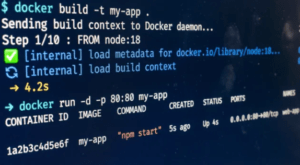
31. What is Docker?
Docker is a containerization platform. It packages applications with dependencies into containers.
32. What is CI/CD?
CI/CD stands for Continuous Integration and Continuous Deployment. It automates testing and deployment pipelines.
33. What is load balancing?
Load balancing distributes traffic across servers. It improves reliability and scalability.
34. What is reverse proxy?
A reverse proxy forwards client requests to backend servers. It improves security and performance.
35. What is cloud computing?
Cloud computing provides computing resources over the internet. Examples include Amazon Web Services and Microsoft Azure.
System Design & Architecture
36. How would you design a scalable web application?
Use load balancers, caching, database replication, and microservices. Design stateless services for horizontal scaling.
37. What is horizontal vs vertical scaling?
Vertical scaling increases server power (CPU/RAM). Horizontal scaling adds more servers to handle load.
38. What is API versioning?
API versioning manages changes without breaking clients. It can be done via URL, headers, or query parameters.
39. What is GraphQL?
GraphQL is a query language for APIs. It allows clients to request only the required data.
40. What is message queue?
Message queues enable asynchronous communication between services. They improve decoupling and reliability.
Behavioral & Practical
41. How do you explain your full stack project?
Start with the problem statement and architecture. Then explain frontend, backend, database, and deployment choices.
42. How do you handle production bugs?
Reproduce the issue and check logs. Deploy a hotfix and write tests to prevent recurrence.
43. How do you ensure application security?
Implement HTTPS, input validation, and authentication. Use secure password hashing and rate limiting.
44. How do you optimize frontend performance?
Minify assets and use lazy loading. Implement caching and code splitting.
45. How do you optimize backend performance?
Use indexing and caching strategies. Profile slow queries and optimize algorithms.
46. What is your debugging process?
Reproduce the issue consistently. Use logs, breakpoints, and monitoring tools.
47. How do you handle team conflicts?
Listen actively to all sides. Focus on solutions and shared project goals.
48. How do you stay updated?
Follow tech blogs and documentation. Experiment with new tools in side projects.
49. Why should we hire you as a full stack developer?
I can handle both frontend and backend efficiently. I understand system design and can deliver end-to-end solutions.
50. What makes a good full stack developer?
Strong fundamentals in frontend, backend, and databases. Ability to design scalable systems and solve real-world problems.
Conclusion
Preparing for a full stack interview requires more than just memorizing questions it demands a strong understanding of frontend, backend, databases, system design, and deployment concepts. Employers look for developers who can think holistically, design scalable solutions, and confidently explain their technical decisions.
By mastering these 50 commonly asked questions and practicing real-world scenarios, you position yourself as a well-rounded full stack developer who can handle end-to-end development challenges. Stay consistent with hands-on projects, revise core fundamentals regularly, and approach interviews with clarity and confidence the right opportunity will follow.
- If you want to explore Full Stack, start your training here.