Introduction
Modern applications need to be scalable, resilient, and fast to deploy. That’s where cloud-native technologies come in and at the center of this ecosystem is the
Cloud Native Computing Foundation (CNCF)
This guide will help you understand:
- What CNCF is
- Why it matters
- Key projects (like Kubernetes, Prometheus, etc.)
- How to start your cloud-native journey
What is CNCF?
The Cloud Native Computing Foundation (CNCF) is an open-source organization that:
Promotes, hosts, and sustains cloud-native technologies
It was founded in 2015 under the umbrella of the
Linux Foundation
CNCF Mission
- Make cloud-native computing universal and sustainable
- Support open-source innovation
- Build vendor-neutral ecosystems
In Simple Terms
CNCF is like a home for modern DevOps tools such as:
- Containers
- Kubernetes
- Monitoring tools
- Service meshes
What Does “Cloud Native” Mean?
Cloud-native refers to building and running applications that:
- Use containers
- Are microservices-based
- Run on dynamic cloud infrastructure
- Use automation (CI/CD)
Core Principles of Cloud Native
- Scalability
- Resilience
- Automation
- Observability
- Portability
Why CNCF is Important
1. Standardization
CNCF creates standards across tools and platforms.
2. Vendor Neutrality
- No single company controls the ecosystem
- Encourages open innovation
3. Faster Innovation
Thousands of contributors improve tools continuously.
4. Industry Adoption
Used by companies like:
- AWS
- Microsoft
Key CNCF Projects You Should Know
CNCF hosts hundreds of projects. Here are the most important ones:
Container Orchestration
Kubernetes
- Automates container deployment
- Handles scaling and networking
- Most popular CNCF project
Monitoring & Observability
Prometheus
- Collects metrics
- Alerts on system health
Grafana
- Dashboards for metrics
- Visualization tool
Distributed Tracing
Jaeger
- Tracks requests across services
- Helps debug microservices
Security
Falco
- Detects abnormal behavior in containers
GitOps & CI/CD
Argo CD
- Continuous deployment using Git
- Automates Kubernetes deployments
Service Mesh
Istio
- Manages communication between services
- Adds security, routing, and observability
CNCF Project Maturity Levels
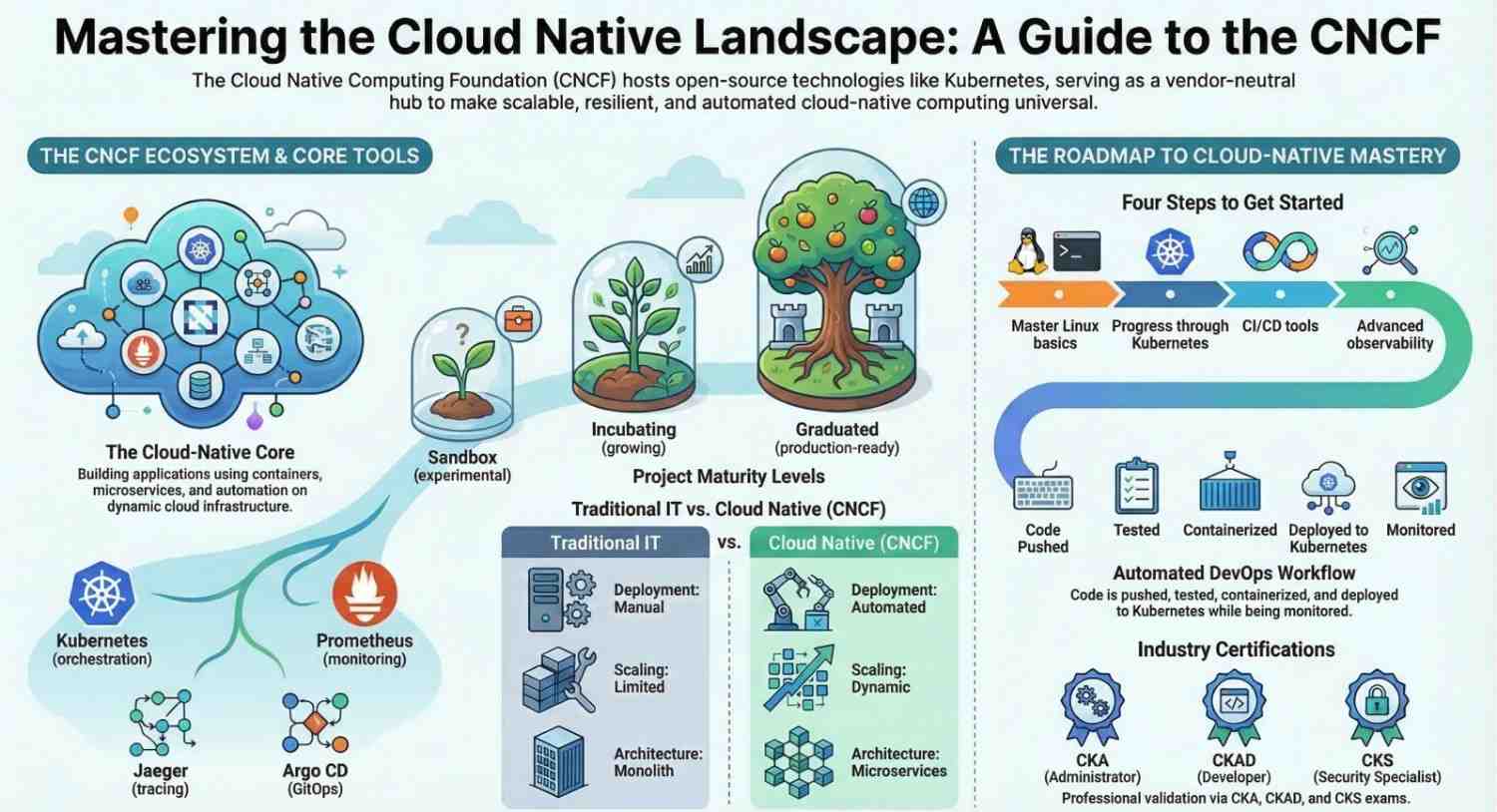
CNCF categorizes projects into 3 levels:
Sandbox
- Early-stage projects
- Experimental
Incubating
- Growing adoption
- Stable but evolving
Graduated
- Production-ready
- Widely adopted
Example: Kubernetes is a graduated project
CNCF Landscape Explained
The CNCF Landscape is a huge map of cloud-native tools.
Categories include:
- Container runtime
- CI/CD
- Observability
- Security
- Networking
- Storage
Why It Matters
- Helps choose the right tools
- Shows ecosystem diversity
- Guides architecture decisions
How CNCF Fits into DevOps
CNCF tools are the backbone of modern DevOps pipelines.
Example Workflow
Code → CI/CD → Container → Kubernetes → Monitor → Scale
Real Example
- Developer pushes code
- CI pipeline runs tests
- Docker builds container
- Kubernetes deploys app
- Prometheus monitors
- Grafana visualizes
Result: Fully automated system
CNCF vs Traditional IT
| Feature | Traditional IT | Cloud Native (CNCF) |
|---|---|---|
| Deployment | Manual | Automated |
| Scaling | Limited | Dynamic |
| Architecture | Monolith | Microservices |
| Infrastructure | Static | Elastic |
CNCF & Security (DevSecOps)
CNCF promotes:
- Secure-by-design systems
- Continuous security scanning
- Runtime protection
Benefits of Using CNCF Tools
- Faster deployment
- Better scalability
- High availability
- Improved observability
- Vendor flexibility
Challenges to Know
- Steep learning curve
- Complex architecture
- Tool overload (too many options)
How to Get Started with CNCF
Step-by-Step Roadmap
1. Learn Basics
- Linux
- Networking
- Containers
2. Master Kubernetes
Start with
Kubernetes
3. Learn CI/CD Tools
- GitHub Actions
- GitLab CI
4. Add Observability
- Prometheus
- Grafana
5. Explore Advanced Tools
- Istio
- Argo CD
CNCF Certifications
Popular certifications:
- CKA (Kubernetes Administrator)
- CKAD (Kubernetes Application Developer)
- CKS (Kubernetes Security Specialist)
Conclusion
The
Cloud Native Computing Foundation
is the driving force behind modern cloud-native technologies.
By learning CNCF tools like:
- Kubernetes
- Prometheus
- Grafana
You position yourself for the future of DevOps and cloud engineering.
Next Steps
- Explore the CNCF landscape
- Build a Kubernetes project
- Practice CI/CD pipelines
- Learn monitoring tools
- Prepare for certifications