
If you’re planning a cloud career, one of the biggest questions you’ll face is:
AWS Developer vs DevOps Engineer certification — which pays more?
Both certifications from Amazon Web Services are highly respected. Both can boost your salary. But they lead to slightly different career paths, responsibilities, and earning potential.
In this guide, we’ll compare:
- AWS Certified Developer – Associate
- AWS Certified DevOps Engineer – Professional
- Salary comparison (2026 data trends)
- Job demand and career growth
- Difficulty level
- ROI (return on investment)
Let’s break it down.
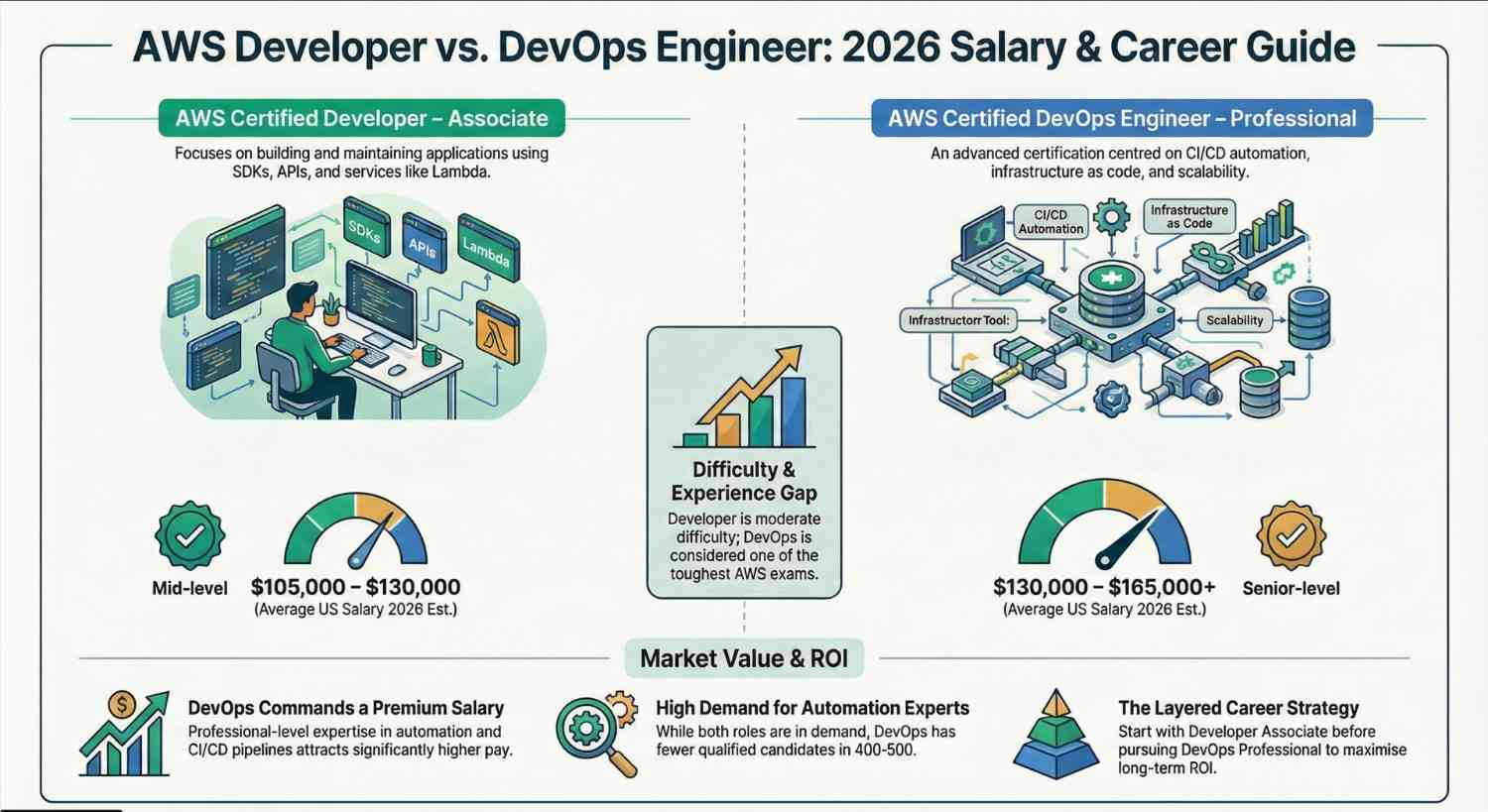
1. Certification Overview
✅ AWS Certified Developer – Associate
The AWS Certified Developer – Associate focuses on:
- Developing and maintaining AWS applications
- Using AWS SDKs and APIs
- Working with services like Lambda, DynamoDB, API Gateway
- CI/CD basics
- Monitoring and debugging cloud apps
This certification is ideal for:
- Software developers
- Backend engineers
- Application developers moving to cloud
It validates hands-on experience building applications on AWS.
✅ AWS Certified DevOps Engineer – Professional
The AWS Certified DevOps Engineer – Professional is an advanced certification. It focuses on:
- CI/CD automation pipelines
- Infrastructure as Code (IaC)
- Monitoring & logging
- Incident response
- High availability & scalability
- Automation using CloudFormation & Terraform
It is considered one of the most difficult AWS certifications and is designed for experienced professionals.
2. AWS Developer vs DevOps Engineer Salary Comparison (2026)
Now let’s answer the main question:
Which pays more?
While salaries vary by country and experience, here’s a general comparison:
| Certification | Average US Salary (2026 est.) | Experience Level |
|---|---|---|
| AWS Developer Associate | $105,000 – $130,000 | Mid-level |
| AWS DevOps Engineer Professional | $130,000 – $165,000+ | Senior-level |
Verdict:
AWS DevOps Engineer certification typically pays more.
Why?
Because:
- It’s a professional-level certification
- Requires deeper cloud automation expertise
- DevOps roles often involve system-wide responsibility
- Companies pay premium for CI/CD and automation skills
However, salary also depends on:
- Years of experience
- Location
- Company size
- Additional skills (Docker, Kubernetes, Terraform)
3. Job Demand: Which Role Is More In-Demand?
AWS Developer Jobs
Search job boards and you’ll find thousands of listings for:
- Cloud Developer
- AWS Application Developer
- Backend Engineer (AWS)
Developers are always in demand because companies continuously build cloud-native applications.
DevOps Engineer Jobs
DevOps engineers are responsible for:
- Automating deployments
- Ensuring reliability
- Maintaining cloud infrastructure
- Reducing downtime
With the rise of cloud-native architectures and microservices, DevOps engineers are among the most sought-after professionals in 2026.
👉 Demand is high for both but DevOps roles often have fewer qualified candidates, increasing salary potential.
4. Difficulty Level Comparison
AWS Developer – Associate
- Moderate difficulty
- Requires coding knowledge
- Good for 1–2 years AWS experience
- Exam duration: ~130 minutes
AWS DevOps Engineer – Professional
- Advanced difficulty
- Deep understanding of automation
- Requires real-world DevOps experience
- Scenario-based questions
- Considered one of the toughest AWS exams
DevOps Engineer certification is significantly harder.
5. Career Path Comparison
If You Choose AWS Developer:
Career progression:
- AWS Developer
- Senior Cloud Developer
- Cloud Architect
- Technical Lead
Best for:
- Strong coders
- Backend engineers
- Application-focused professionals
If You Choose DevOps Engineer:
Career progression:
- DevOps Engineer
- Senior DevOps Engineer
- Site Reliability Engineer (SRE)
- Cloud Architect
- DevOps Manager
Best for:
- Automation lovers
- Infrastructure enthusiasts
- CI/CD pipeline experts
- Professionals interested in scalability & reliability
6. ROI: Which Certification Gives Better Return?
Cost Factors:
- Exam fee (Associate vs Professional)
- Study materials
- Training courses
- Time investment
DevOps certification costs more and requires more preparation time.
However:
Higher salary potential = Higher ROI long-term.
If you already have developer experience, moving into DevOps can significantly increase your earning ceiling.
7. Skills Comparison: Developer vs DevOps
| Skill Area | AWS Developer | DevOps Engineer |
|---|---|---|
| Coding | High | Medium |
| Automation | Medium | High |
| Infrastructure | Basic | Advanced |
| CI/CD | Basic | Expert |
| Monitoring | Basic | Advanced |
| Architecture | Moderate | Advanced |
DevOps requires broader system knowledge, while Developer is more code-focused.
8. Which Certification Should You Choose?
Choose AWS Developer – Associate if:
- You are early in your cloud journey
- You are a software developer
- You want faster entry into cloud jobs
- You prefer coding over infrastructure
Choose AWS DevOps Engineer – Professional if:
- You already have AWS experience
- You enjoy automation & pipelines
- You want higher salary potential
- You aim for senior-level roles
9. Final Verdict: Which Pays More?
✅ AWS DevOps Engineer Certification generally pays more than AWS Developer Associate.
But here’s the smarter strategy:
Many professionals follow this path:
- Start with AWS Developer Associate
- Gain hands-on experience
- Move to DevOps Engineer Professional
This layered approach maximizes both learning and earning potential.
10. Are AWS Certifications Still Worth It in 2026?
Yes especially from Amazon Web Services.
Cloud adoption continues to grow globally, and AWS remains the dominant market leader. Certified professionals consistently earn higher salaries than non-certified peers.
But remember:
Certification + Hands-on projects + Real-world experience = Highest salary impact
Conclusion
If your goal is maximum salary, DevOps Engineer Professional wins.
If your goal is career entry and solid foundation, AWS Developer Associate is a strong start.
Both certifications are powerful. The right choice depends on your:
- Experience level
- Career goals
- Technical strengths
- Long-term income target